Secretary desks for small spaces — The desk that closes
The Wooden Stars is a participant in the Amazon Services LLC Associates Program. We may earn a commission when you buy through links on our site, at no extra cost to you.
A secretary desk is the only desk that stops being a desk when you are not using it. The fall-front closes over the work surface, the clutter disappears behind it, and what is left standing in the room is a cabinet.
In a room that is also a bedroom or a living room, that is worth more than any amount of extra surface area — because the problem with a desk in a shared room is not the desk, it is what is on it at seven in the evening.
A secretary desk has a hinged fall-front that drops down to become the work surface and closes to hide everything behind it. Typical footprint is 30 to 40 inches wide and 16 to 20 deep closed — about half the floor of an ordinary desk. Open, the fall adds 12 to 16 inches of projection, so allow that plus 30 to 36 inches for the chair. The things that decide whether it works: the open work surface is shallow, usually 16 to 20 inches, and the fall-front supports carry your forearms all day.
The trade, stated plainly
You give up working depth and you get the room back.
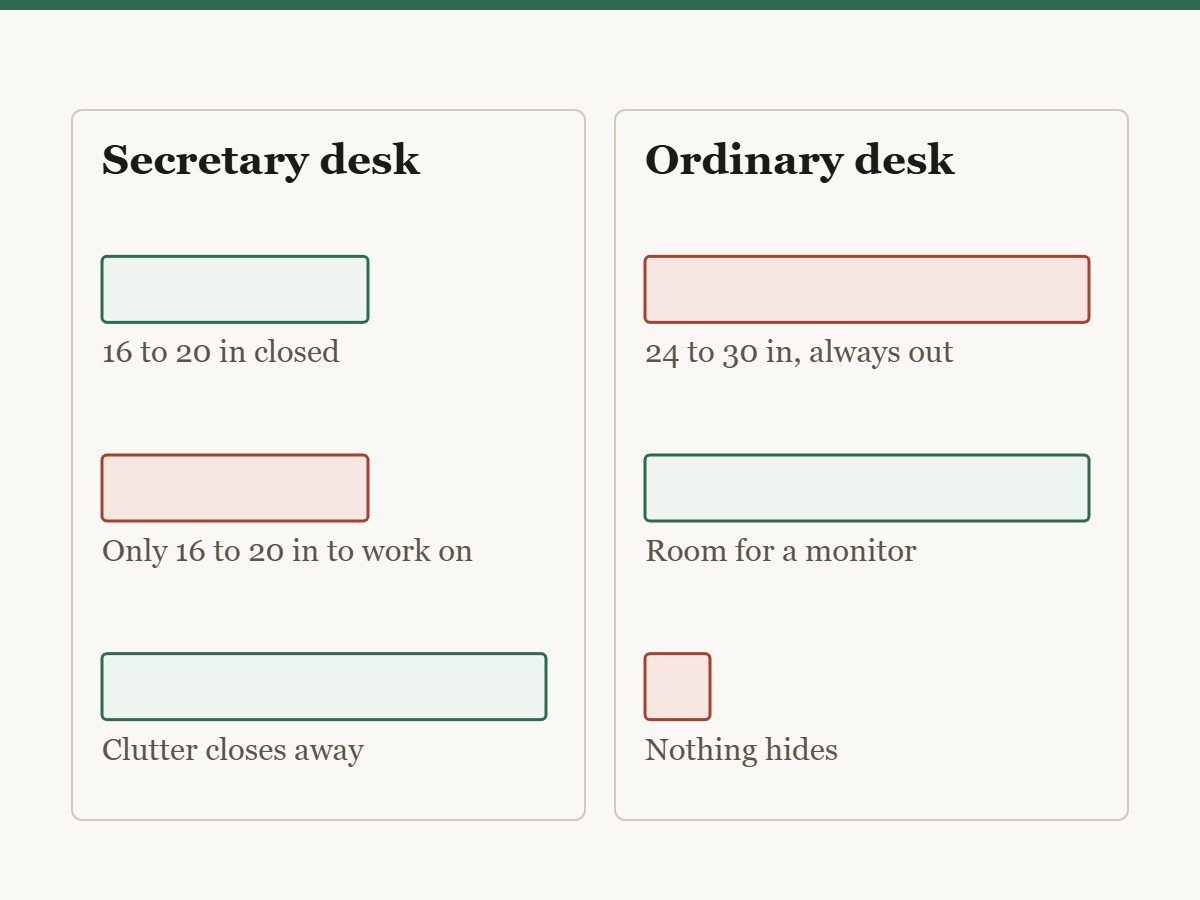
An ordinary desk is 24 to 30 inches deep, which puts a monitor at a comfortable arm’s length. A secretary’s fall-front gives you 16 to 20 inches when open — enough for a laptop, a notebook and a mug, and not enough for a large monitor at a healthy distance.
So the honest split: a secretary desk is excellent for laptop work, correspondence, admin and study. It is the wrong desk for a two-monitor setup, and no amount of good design changes that.
| Measure | Secretary | Ordinary desk |
|---|---|---|
| Closed footprint | 30 to 40 × 16 to 20 in | 48 to 60 × 24 to 30 in |
| Open work depth | 16 to 20 in | 24 to 30 in |
| Projection when open | Adds 12 to 16 in | None, always out |
| Hides the clutter | Yes, that is the point | No |
| Suits a monitor | Small one at best | Yes |
| Doubles as furniture | Yes, closed it is a cabinet | No |
The fall-front supports: the part that fails
When the front is down, your forearms and everything on the surface are carried by whatever holds it level. There are three systems and they are not equal.
Pull-out runners (lopers)
Two timber slides pull out from the carcase and the fall rests on them. This is the traditional answer and the best one: the load goes straight back into the case, and a worn loper can be re-waxed or replaced.
Look for lopers that are a decent section and that pull out far enough — a short loper carries the fall near its hinge and lets the outer edge flex.
Quadrant stays or folding arms
Metal arms on each side that unfold as the front drops. Compact and common on smaller pieces. They work, and they concentrate the load at two points on the case sides, so those sides need to be solid or plywood rather than particleboard.
Chains or fabric straps
The cheapest, found on light decorative pieces. Fine for a surface you write a card on. Not fine for leaning on while you type, and they stretch.
Whichever it is, the same rule applies as anywhere else in furniture: the fixing points want material that holds a screw. The distinctions are in what engineered wood actually is.
Height, and the number people get wrong
The fall-front sits at whatever height the carcase puts it, and that is not always desk height.
Standard desk height is 29 to 30 inches. Plenty of secretary desks — especially the tall bureau-bookcase kind — drop their fall at 31 to 34 inches, because the design came from an era of different chairs.
Measure the stated open-surface height and compare it with your chair. At 33 inches with an 18-inch seat you are typing with your shoulders up, and the fix is a taller chair rather than anything you can do to the desk.
What goes behind the front
The interior is the other half of the product and listings under-photograph it.
- Pigeonholes and small drawers are traditional and genuinely useful for stationery, but they eat the depth available for a laptop when the front is closed.
- A clear cavity is more useful for modern work, because a laptop, a charger and a notebook can be left in place and shut away mid-task. This is the single most practical feature and the easiest to overlook.
- A cable notch at the back of the cavity lets you leave a charger plugged in with the front closed. Rare, and worth looking for — otherwise you unplug every time.
If the piece has no cable route, one can be added; grommet sizes and fitting are in desk grommets.
Stability and tipping
A tall secretary with the front down has weight cantilevered out into the room and a narrow base. Leaning on the open fall is exactly the load that tips it.
Anchor it to the wall, into a stud, on the day it is assembled. The reasoning is the same as for a tall chest of drawers, and the geometry here is worse because the fall projects.
Also check the floor. A secretary stands on a small footprint, so an uneven floor shows as a rock every time you lean — levelling feet fix it, and the options are in levelling feet and glides.
Where a secretary beats the alternatives
In a bedroom. Work closes away at the end of the day, which matters more than most people expect for actually stopping work.
In a living room or hallway. Closed, it reads as a cabinet rather than as an office in the corner.
On one short wall. A corner desk needs two wall runs; a secretary needs about 36 inches of one wall.
Where guests come. A surface that hides its own mess in four seconds is a different proposition from a desk you have to tidy.
Where it does not
Two monitors. Long working days at a fixed screen height. Anything that needs the desk left set up. And anyone who will not actually close it — a secretary left permanently open is a small desk with a door in the way.
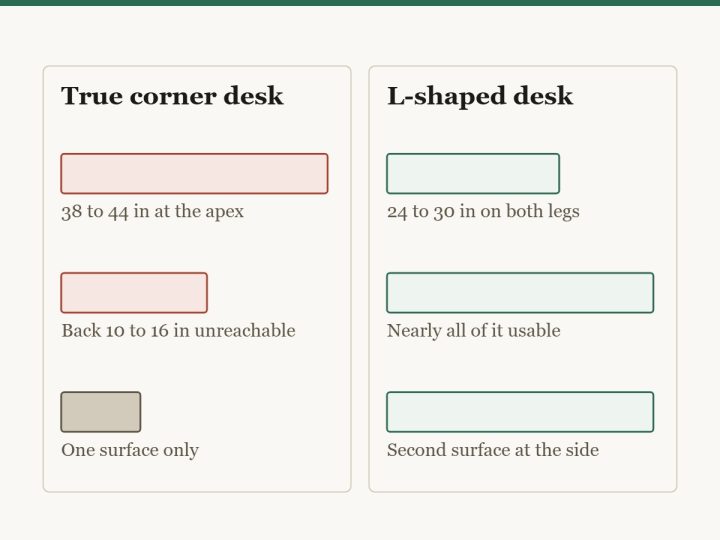
For those cases the honest answer is a proper desk, and if floor space is the constraint, an L-shaped corner desk uses the part of the room nothing else wants.
Before you order
- Tape measure Open-surface height against your chair, and the projection when the fall is down
- Furniture anti-tip kit A tall secretary with the front down tips forward; use a stud
- Levelling feet A small footprint shows every unevenness as a rock
- Paste wax Keeps timber lopers sliding; the traditional fix and still the best
What to buy


If you have two wall runs to spare, compare the corner desk. For building a surface from parts, wooden desk legs and mounting a butcher block desktop. For the confusing older name, see dresser or bureau — a UK bureau is exactly this piece.
Questions we get asked
What is a secretary desk?
A cabinet with a hinged fall-front that drops to become the work surface and closes to hide what is on it. In the UK the same piece is called a bureau.
How much space does a secretary desk need?
About 30 to 40 inches of wall and 16 to 20 inches of depth closed, plus 12 to 16 inches of projection when open and room for a chair.
Is a secretary desk big enough to work at?
For a laptop, notebook and mug, yes. The open surface is 16 to 20 inches deep, which is too shallow for a large monitor at a healthy distance.
What holds the fall-front up?
Pull-out timber lopers are the best system, metal quadrant stays are common and fine, and chains or straps are for light decorative use only.
Are secretary desks the right height?
Not always. Many drop the fall at 31 to 34 inches rather than the standard 29 to 30. Check the stated open-surface height against your chair.
Does a secretary desk need anchoring?
Yes. A tall one with the front down and somebody leaning on it is the exact load that tips furniture forward.