Wood vs metal bar stools — Weight, wobble and warmth
The Wooden Stars is a participant in the Amazon Services LLC Associates Program. We may earn a commission when you buy through links on our site, at no extra cost to you.
Wood vs metal bar stools is usually argued on looks, but the three things that decide it in a kitchen are weight, noise and how the joints fail.
Both last a long time. They fail in completely different ways, and one of those ways is repairable.
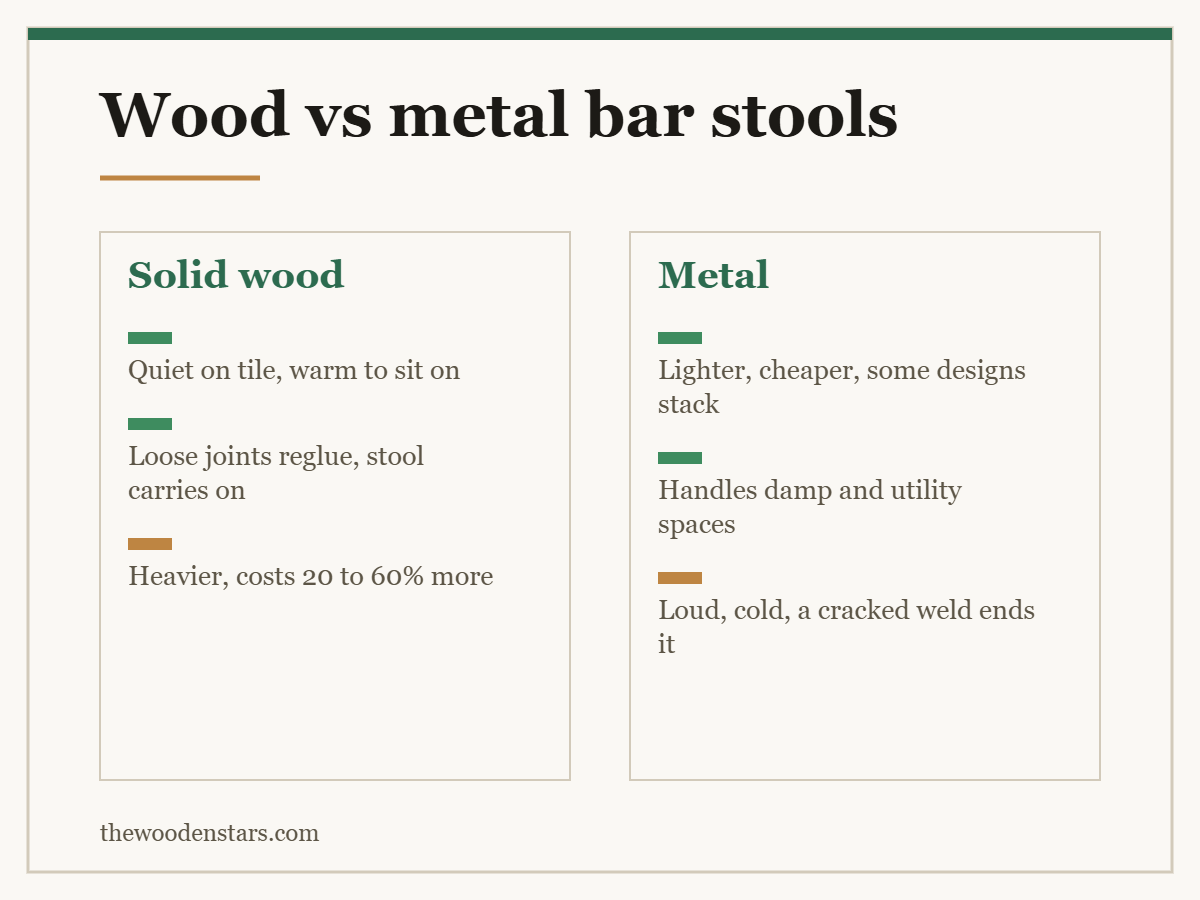
A solid wood stool weighs 14 to 22 lb, is quiet to drag, warm to sit on, and loosens at the joints over years — which glue and a clamp fix. A metal stool weighs 9 to 16 lb, is cheaper at the same strength, stackable in some designs, and fails by weld cracking or the powder coat chipping, neither of which you can fix at home. Metal is louder on tile, colder in winter and shows scuffs on skirting boards. Wood costs 20 to 60% more and holds resale value. For a kitchen with hard floors and small children, wood is quieter; for a utility space or outdoors, metal wins.
Wood vs metal bar stools: what actually differs
- Weight. Wood 14 to 22 lb, metal 9 to 16. Heavier is steadier under someone pushing off it, lighter is easier to move for cleaning.
- Noise. Metal legs on tile or stone are loud, and metal feet transmit every scrape. Timber deadens it.
- Temperature. A metal seat in an unheated kitchen in January is genuinely unpleasant for the first minute. Wood is not.
- Failure mode. Wood loosens; metal cracks at a weld or chips its coating and then rusts from the chip outward.
- Price. Solid wood runs 20 to 60% more than steel at the same load rating.
The mixed construction — timber seat on a steel frame — takes most of metal’s strength and most of wood’s comfort, and it is what a large share of the market actually sells. It also inherits metal’s repair problem at the frame.
| Measure | Solid wood | Metal |
|---|---|---|
| Weight each | 14 to 22 lb | 9 to 16 lb |
| Noise on tile | Quiet | Loud |
| Cold to sit on | No | Yes in winter |
| Typical failure | Joints loosen | Weld cracks, coating chips |
| Home repairable | Yes, glue and clamp | Rarely |
| Stacks | Almost never | Some designs |
| Outdoor tolerance | Needs the right species | Good if coated, rusts at chips |
| Price | 20 to 60% more | Baseline |
The repair argument, which is the strongest one
Every stool loosens eventually. Stools take more abuse than dining chairs because people push off the seat to stand and because they get dragged sideways rather than lifted.
On a timber stool that shows up as a leg that moves in its socket. Knock it apart, clean the old glue off, re-glue and clamp overnight, and the stool is as good as it was — how to reglue a loose joint covers the method. A well-made timber stool can go round that loop three or four times across a couple of decades.
On a welded steel stool a cracked weld means welding gear. Most households do not have it, most furniture shops will not do it, and the economics of paying someone rarely work on a $90 stool. The stool is scrap.
The coating is the other slow failure. Powder coat chips where feet kick it, and once bare steel is exposed in a kitchen it corrodes at that point. Touch-up paint slows it but never stops it.
Where metal is clearly the better buy
Outdoors or in a utility space. Treated steel or aluminium handles damp far better than any timber that has not been specified for it — see best wood to use outside for what timber outdoors actually requires.
When you need them to stack. Very few timber bar stools stack; several metal ones do, which matters if the seating is occasional.
At the budget end. Under about $80 a stool, a competent metal frame is structurally better than the softwood-and-staples timber stool at the same price. Cheap timber stools are the worst option in the category.
When lightness matters. Nine pounds against 20 is a real difference if stools get moved daily for cleaning.
Judging a timber stool properly
“Solid wood” on a listing is not a specification. Four things to look for:
- The species. Rubberwood, acacia and beech dominate this price bracket; oak and walnut sit above it. Hardness matters because stool legs get kicked — the wood hardness scale and best wood for furniture.
- Whether it is solid or veneered. A veneered seat on particleboard is not a solid wood stool, whatever the title says — engineered wood against hardwood.
- The leg-to-seat joint. A round tenon into a socket is the durable version. Screws into end grain is not.
- A stretcher or foot ring. The rail that doubles as a footrest is also the thing stopping the legs racking. Its absence is why some timber stools wobble in year two.
Load ratings for both materials are in how much weight a bar stool can hold.
One distinction inside the metal camp is worth making. Aluminium does not rust at all, so a chipped coating is cosmetic rather than terminal, and it is lighter again at 7 to 12 lb. Steel is stronger and cheaper but every chip is the start of corrosion. If the stools are going anywhere damp, the extra cost of aluminium buys you the one thing steel cannot offer.
Keeping either alive
- Wood glue for loose joints The repair that keeps a timber stool going for decades
- Felt furniture pads Cuts the noise metal legs make and saves the floor
- Touch-up paint for metal furniture Slows rust starting at a powder-coat chip
- Hex key set Metal stool fixings loosen and are meant to be retightened
What to buy


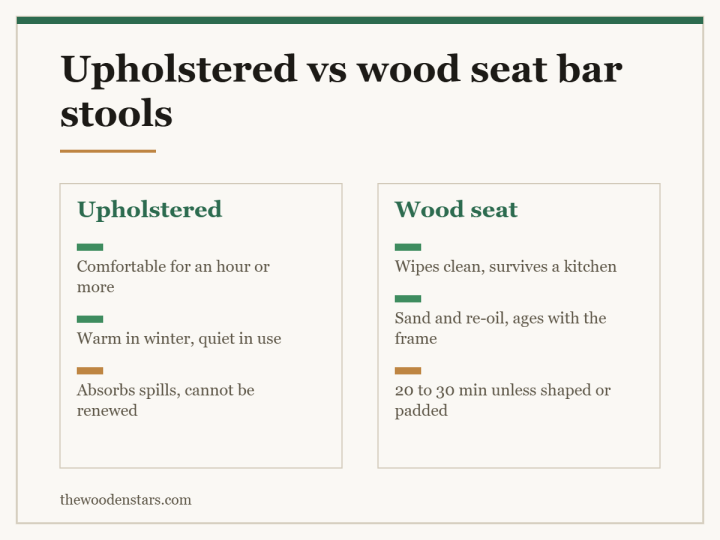
For the height decision, see bar stool against counter stool and how tall a bar stool should be. For the seat, upholstered against wood seat and with a back against backless.
Questions we get asked
Are wood or metal bar stools better?
Wood is quieter, warmer and repairable. Metal is lighter, cheaper and better in damp. The repair difference is the strongest argument.
Which lasts longer?
A good timber stool, because its failure mode is a loose joint you can reglue. A cracked weld ends a metal stool.
Are metal bar stools noisy?
Yes, on tile and stone. Felt pads help a lot but never fully match timber.
Which is heavier?
Wood, at 14 to 22 lb against 9 to 16. Heavier is steadier; lighter is easier to move.
What about a wood seat on a metal frame?
It gives you timber’s comfort and metal’s strength, but it inherits metal’s repair problem at the frame.
Is cheap wood better than cheap metal?
No. Under about $80 a competent metal frame beats a softwood-and-staples timber stool.