Upholstered vs wood seat bar stools — Comfort cost
The Wooden Stars is a participant in the Amazon Services LLC Associates Program. We may earn a commission when you buy through links on our site, at no extra cost to you.
Upholstered vs wood seat bar stools is a kitchen question before it is a comfort question — because the seat you choose has to survive being eaten over.
Upholstery buys you about forty minutes of extra comfort. It costs you the ability to wipe the seat.
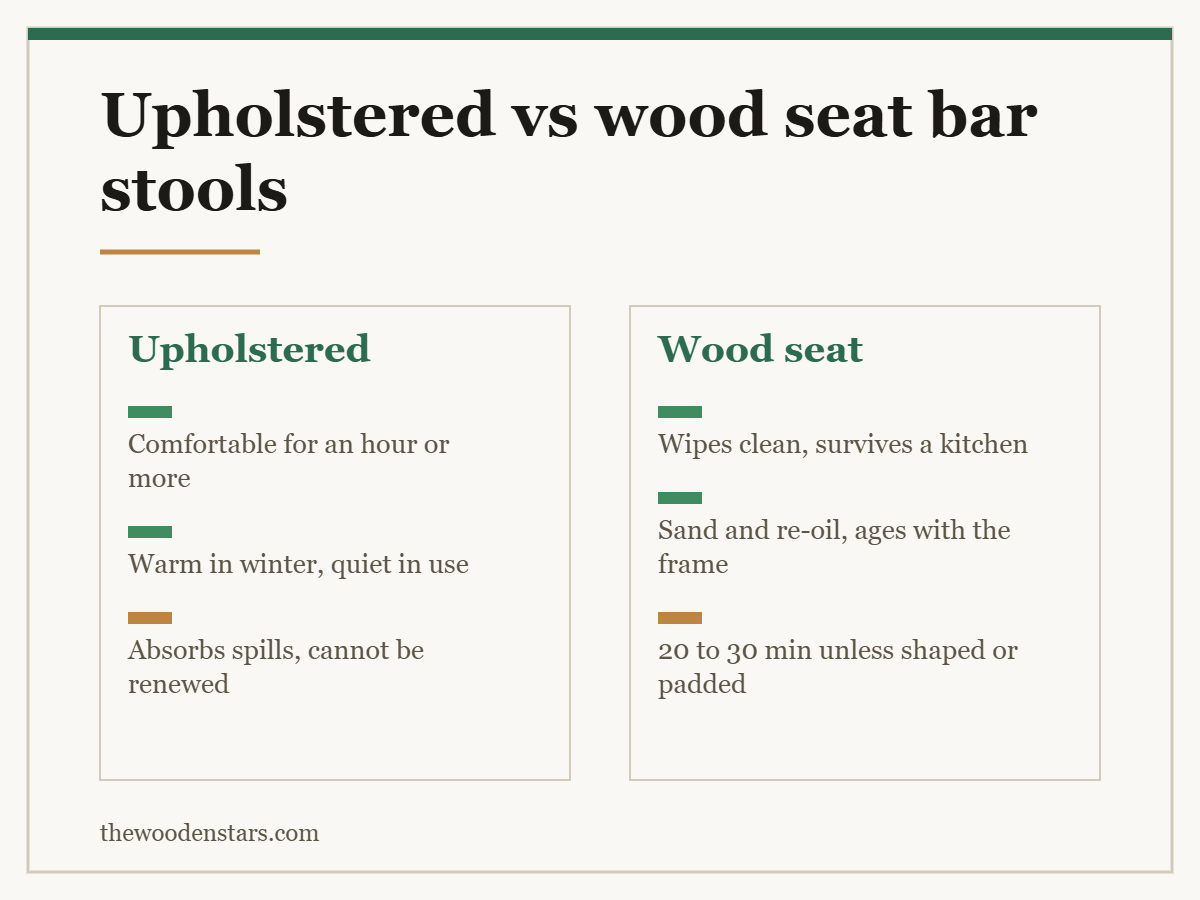
A wood seat wipes clean in seconds, survives spills and children, costs less, and is comfortable for about 20 to 30 minutes before you want a cushion. An upholstered seat is comfortable for an hour or more, is warmer in winter and quieter, and costs 25 to 50% more — but fabric absorbs everything spilled at a kitchen counter, and a seat that cannot be wiped gets replaced long before the frame wears out. The practical middle: a wood seat with a removable washable pad, or upholstery in faux leather or a performance weave rather than linen or boucle.
Upholstered vs wood seat bar stools: what each costs you
- Comfort: 20 to 30 minutes on bare timber against an hour or more upholstered.
- Cleaning: a wipe against a stain-removal project.
- Lifespan of the seat: timber outlives the frame; fabric usually does not.
- Price: upholstery adds 25 to 50%.
- Warmth and noise: upholstery wins both, noticeably in a tiled kitchen in winter.
The asymmetry is what matters. A timber seat that looks tired can be sanded and re-oiled at home. A fabric seat that has absorbed a bowl of soup is finished, and re-covering a stool costs most of what the stool cost.
| Measure | Upholstered | Wood seat |
|---|---|---|
| Comfortable for | An hour or more | 20 to 30 min |
| Cleaning | Stain removal | A wipe |
| Warm in winter | Yes | No |
| Noise | Quiet | Harder |
| Seat depth | 17 to 19 in | 13 to 17 in |
| Renewable at home | No | Yes, sand and re-oil |
| Price | 25 to 50% more | Baseline |
The kitchen problem with fabric
Bar stools sit where food is prepared and eaten, usually by whoever is least careful in the house.
Three things happen to them: spills, grease in the air from cooking a metre away, and daily contact with clothing. Fabric takes all three; timber takes none of them.
If you want upholstery in a kitchen anyway — and there are good reasons to — choose the material accordingly:
- Faux leather or vinyl. Wipes like timber, warmer to sit on, and the practical choice for families. It cracks eventually at the fold lines, typically after 5 to 8 years.
- Performance weave. Solution-dyed acrylic or a stated stain-resistant finish. Handles spills far better than a plain cotton or linen weave.
- Removable covers. Rare on stools, but if the listing offers them it is the single best feature in the category.
What to avoid at a kitchen counter: linen, boucle, velvet and anything pale and untreated. They are lovely on a dining chair in a room where nobody eats standing up.
What a wood seat gets right
It is the same material as the frame. So it ages at the same rate and can be refinished at the same time. The routine is the same as for any solid timber surface — best finish for a solid wood table top.
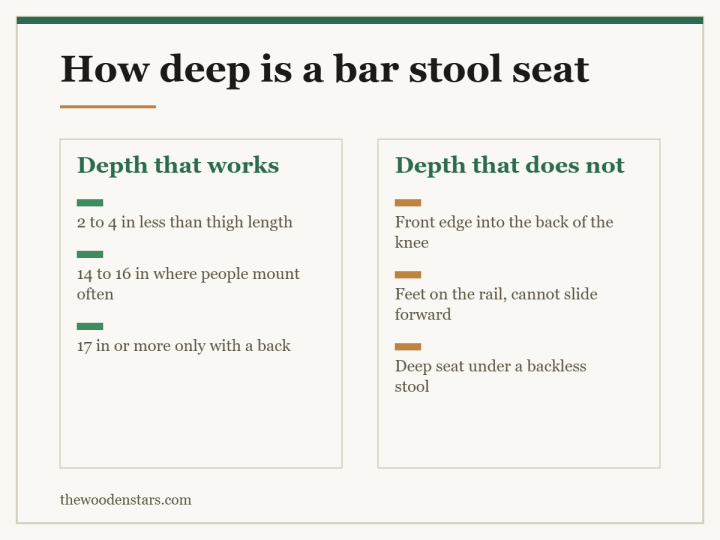
It is shallower, which suits a stool. Timber seats run 13 to 17 inches deep against 17 to 19 upholstered, and shallower is easier to get on and off — how deep a bar stool seat is.
It is lighter, by 2 to 5 lb a stool.
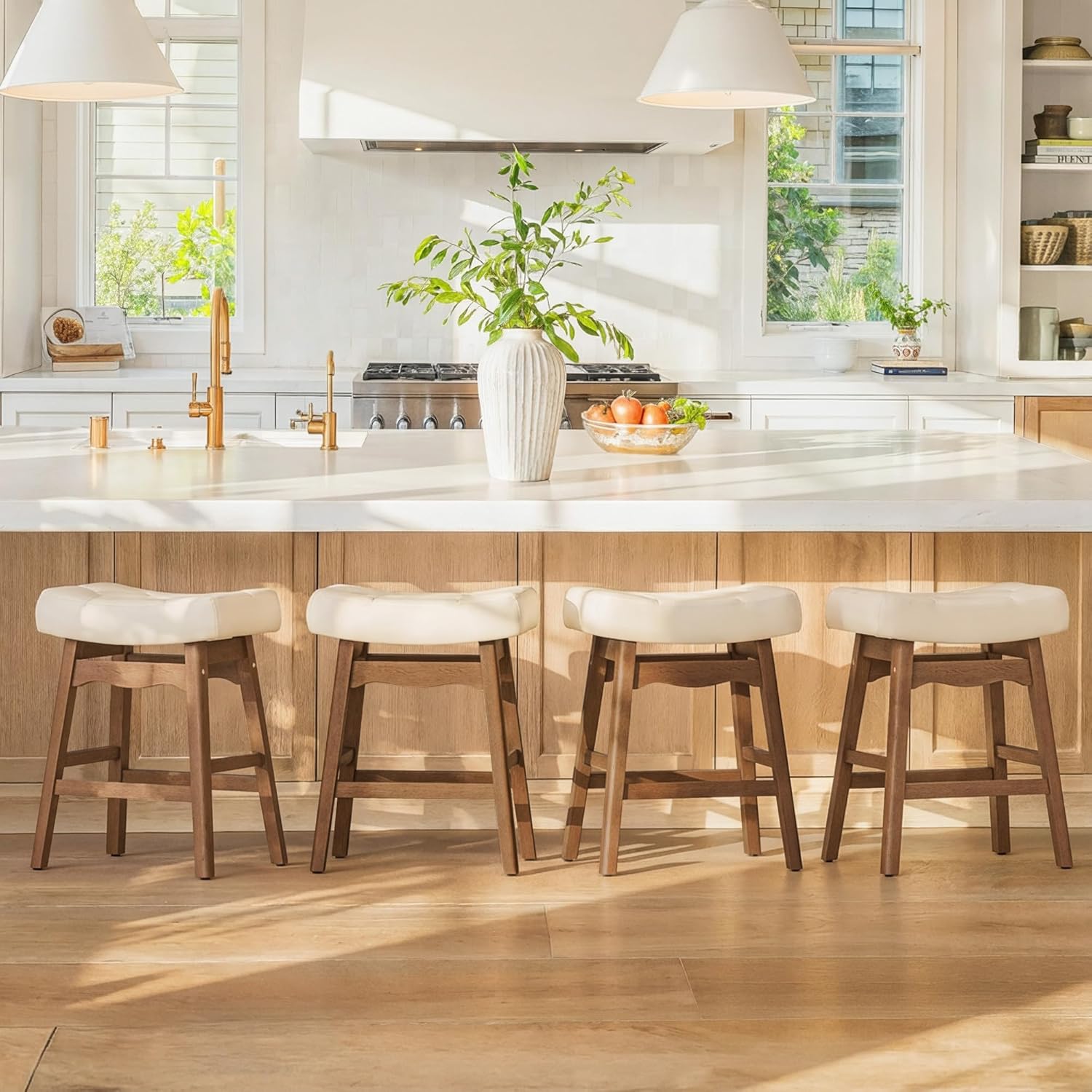
Shaped timber is better than flat. A saddle or scooped seat is dramatically more comfortable than a flat board and costs almost nothing extra to make. If you are buying timber, buy shaped — it closes most of the comfort gap with upholstery on its own.
And a pad closes the rest. A tie-on washable cushion gives you upholstered comfort with the seat still wipeable underneath, for a fraction of the price. It is the answer for most kitchens.
Which to buy
Wood seat if the stools are at a kitchen counter, there are children, people eat at them daily, or you want the stools to last as long as the frame. Buy shaped rather than flat, and add pads.
Upholstered if the stools are at a home bar rather than a food-prep counter, people sit for long stretches, the kitchen is cold, or the room is more sitting room than kitchen. Choose faux leather or a performance weave.
Either way, the seat is the cheap part to change and the frame is not — so put the money into the frame. Joints, foot ring and timber quality decide how long the stool lives, as set out in how much weight a bar stool can hold and wood against metal bar stools.
A note on pads, since they are the answer for most kitchens. Buy them shaped to the seat rather than square: a round pad on a round seat stays put, while a square pad on a round seat rotates and slides off. Ties are better than non-slip backing on a timber seat, and a cover that comes off for the wash is worth more than a thicker foam. Two inches of foam is the practical maximum before the seat height changes enough to matter against the worktop.
Either seat
- Seat pads for stools Upholstered comfort with a wipeable seat underneath
- Fabric protector spray What buys a performance weave another two or three years
- Danish oil or hardwax oil Renews a tired timber seat in an afternoon
- Felt furniture pads Applies whatever the seat is made of
What to buy


For the rest of the choice, see with a back against backless, swivel against stationary and wood against metal. For sizing, how deep a bar stool seat is.
Questions we get asked
Are upholstered bar stools worth it?
At a home bar where people sit for hours, yes. At a kitchen counter where food is eaten, a wipeable seat is worth more.
How long is a wooden seat comfortable?
Twenty to 30 minutes flat, and considerably longer if it is shaped or has a pad.
What fabric survives a kitchen?
Faux leather, vinyl or a performance weave. Avoid linen, boucle, velvet and anything pale and untreated.
Can upholstered stools be re-covered?
Yes, but it usually costs most of the price of a new stool.
What is the cheapest way to make a wood seat comfortable?
A tie-on washable pad. You keep the wipeable seat underneath.
Is a shaped wooden seat much better than a flat one?
Yes, and it costs little extra to make. If you are buying timber, buy shaped.