Bar stool with back vs backless — Tuck or lean
The Wooden Stars is a participant in the Amazon Services LLC Associates Program. We may earn a commission when you buy through links on our site, at no extra cost to you.
Bar stool with back vs backless comes down to one question nobody asks in the shop: do people sit at this counter, or do they perch at it?
Backs make a stool comfortable for an hour. Backless stools give you the room back.
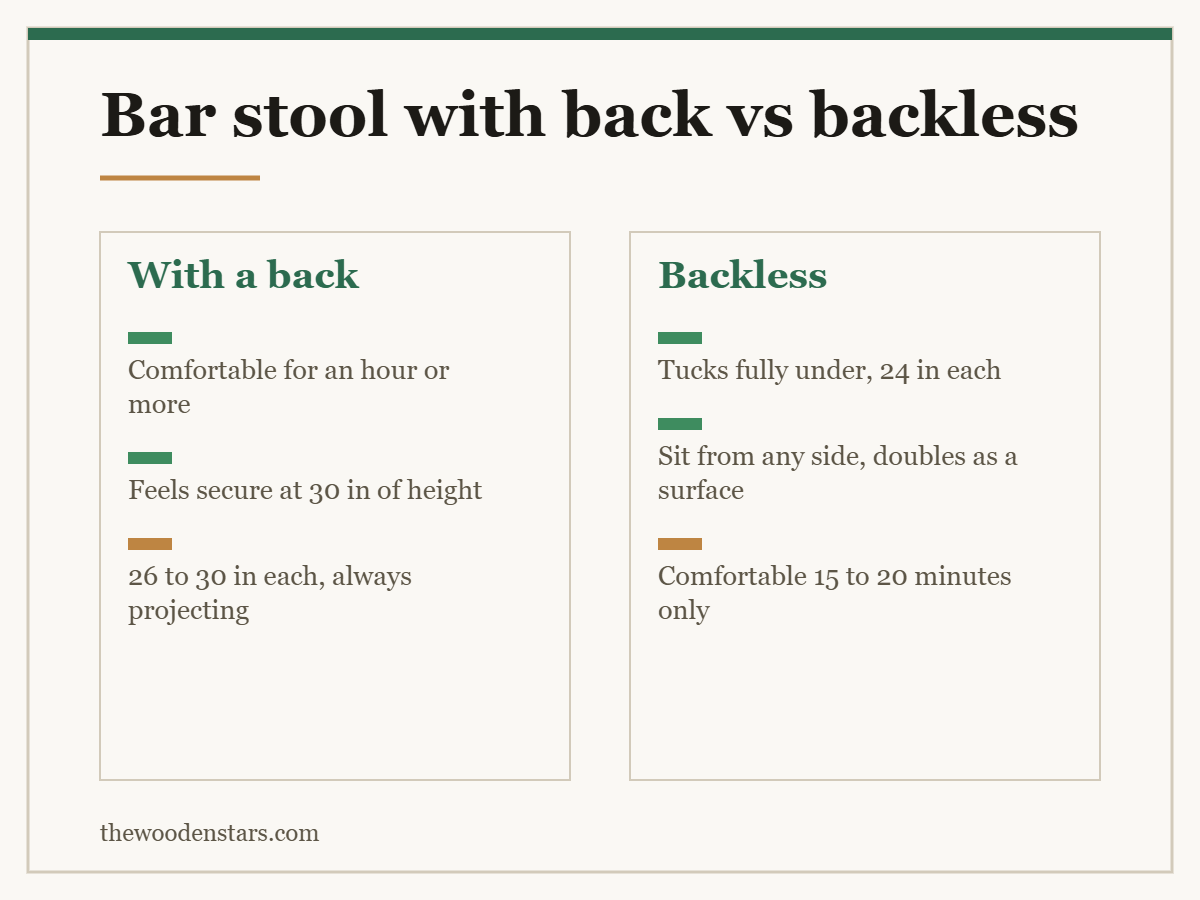
A backless stool needs about 24 inches of worktop per seat and tucks fully under the overhang, so the walkway behind is clear when nobody is sitting. A stool with a back needs 26 to 30 inches, sits 6 to 10 inches proud permanently because the back fouls the worktop, and is what makes a 40-minute breakfast comfortable. Backs matter more as the stool gets taller — at 30 inches leaning back without one feels precarious. The usual right answer in a kitchen: backs if the counter is where people eat, backless if it is where they pass through.
Bar stool with back vs backless: the space cost
Two numbers do most of the work.
- Worktop per seat: 24 inches backless, 26 to 30 with a back. Over three seats that is 6 to 18 inches — often a whole extra place.
- Depth when not in use: a backless stool disappears under a 12-inch overhang. One with a back stops when the back meets the worktop edge, leaving 6 to 10 inches sticking into the room permanently.
The second number is the one that changes how a kitchen feels. A galley or a tight island run with three backed stools has a walkway 8 inches narrower than the plan suggested, all day, whether anyone is sitting or not. The seat-count arithmetic is in how many bar stools fit at an island.
| Measure | With a back | Backless |
|---|---|---|
| Worktop per seat | 26 to 30 in | 24 in |
| Tucks under overhang | No, 6 to 10 in proud | Yes, fully |
| Comfortable for | An hour or more | 15 to 20 minutes |
| Weight each | 14 to 22 lb | 9 to 15 lb |
| Doubles as extra surface | No | Yes |
| Suits tall bar height | Strongly | Feels precarious |
| Price | 20 to 40% more | Baseline |
What a back actually buys
Time. Without lumbar support, most adults start shifting after about 20 minutes. That is fine for coffee and homework supervision, and not fine for a family that eats breakfast at the island every day.
Confidence at height. This matters more than people expect. On a 24-inch counter stool your feet are near the floor and leaning back is a small movement. On a 30-inch bar stool your feet are on a rail and there is nothing behind you — a back changes how secure the seat feels, particularly for older users and children. The height difference is set out in bar stool against counter stool.
Somewhere to hang a bag or a coat. Trivial until you own backless stools.
What a back does not buy is much extra load capacity — that comes from the base and the joints, covered in how much weight a bar stool can hold.
What backless buys
The room back. Already covered, and it is the main thing.
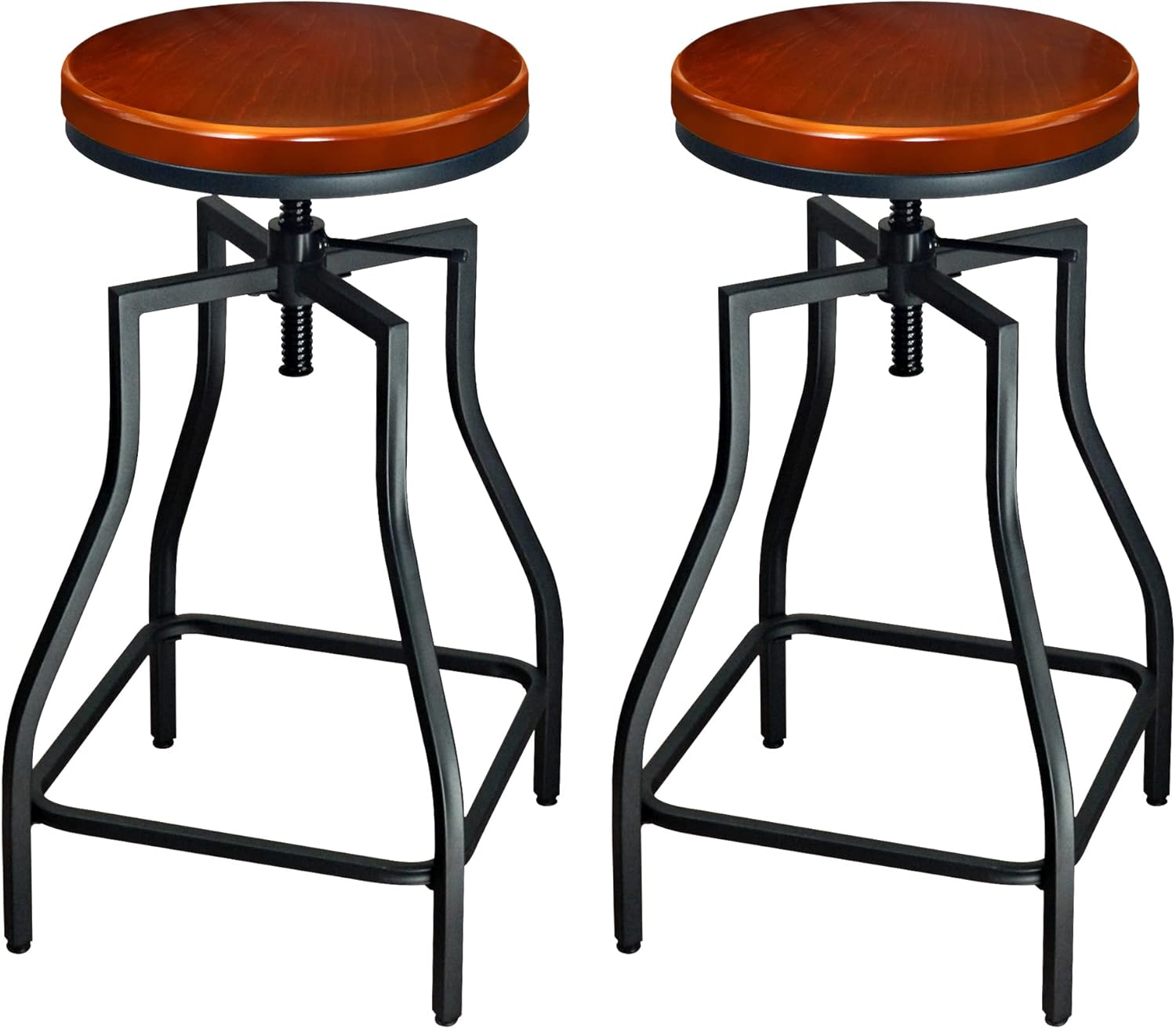
Approach from any side. A backless stool can be sat on facing the counter, facing the room, or sideways to talk to someone. At a corner or the end of a run this is genuinely useful.
An extra surface. A flat backless stool takes a tray, a laundry basket or a child reaching a high cupboard. A backed stool does none of that.
Lightness. Nine to 15 lb against 14 to 22, so they get moved rather than lived around.
Lower price. Typically 20 to 40% less for equivalent build.
The mix most kitchens should buy
Two with backs where people eat, backless for the overflow.
It works because the two uses are different. The seats used every morning want support; the third and fourth seats used when guests come round do not need to be comfortable for an hour, and the rest of the time you want them out of the walkway.
Two things to match if you mix: seat height to the inch, and the footrest height, which should be within an inch or two across the set. Mismatched footrails look wrong in a row far more than mismatched seat shapes do.
Two situations where the mix is not the answer: a proper home bar at 42 inches, where everything should have a back because people sit for hours; and a narrow galley, where everything should be backless because the walkway is the constraint.
Width per seat and how it changes the count is in how wide a bar stool is and how much space between bar stools.
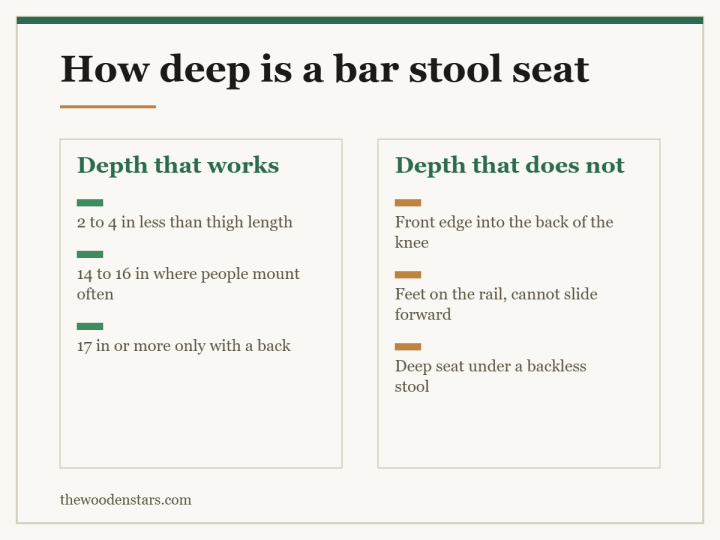
One measurement to take before ordering a backed stool: the height of the back above the seat, and the height of your worktop edge above the seat. If the back is taller than that gap, the stool will never tuck in at all, and a low back of 8 to 12 inches will. Low-back stools are a genuine middle option here — they support the lumbar region where it matters, still slide most of the way under a 36-inch counter, and cost roughly what a backless stool does. On a 42-inch bar they are less useful, because the gap to the worktop is bigger and a low back leaves you with nothing behind your shoulders.
Either style
- Seat pads for stools An inch of pad extends a hard backless seat considerably
- Felt furniture pads Backless stools get dragged in and out far more often
- Wood glue for loose joints The back-to-seat joint is the first to loosen on backed stools
- Tape measure Check the back height against the worktop edge before ordering
What to buy


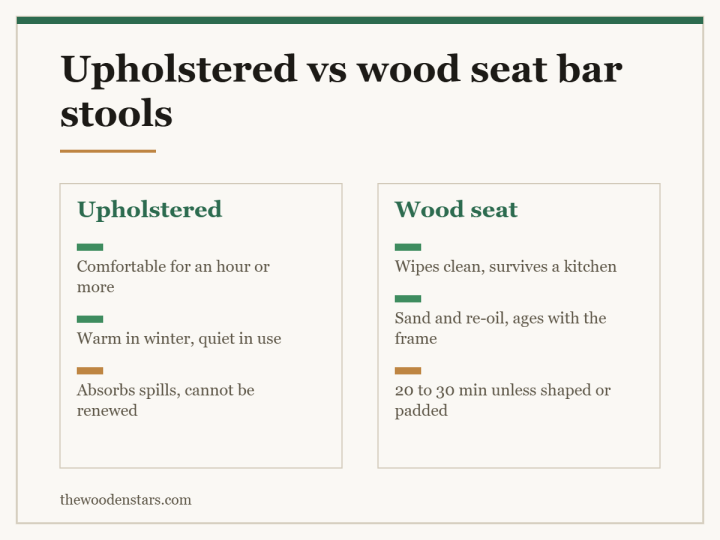
For height, see how tall a bar stool should be. For the other stool decisions, swivel against stationary, wood against metal and upholstered against wood seat.
Questions we get asked
Should bar stools have backs?
Yes if people eat at the counter, no if they pass through it. Backs buy sitting time; backless buys floor space.
How much worktop does each need?
Twenty-four inches backless, 26 to 30 with a back.
Do backed stools tuck under the counter?
Rarely. The back meets the worktop edge and leaves the stool 6 to 10 inches proud permanently.
How long is a backless stool comfortable?
Fifteen to 20 minutes for most adults before they start shifting.
Do backs matter more at bar height?
Yes. At 30 inches your feet are on a rail with nothing behind you, and a back changes how secure the seat feels.
Can I mix backed and backless?
Yes, and it suits most kitchens. Match the seat height exactly and the footrest height to within an inch or two.