How much weight can a bar stool hold? 250 to 500 lb
The Wooden Stars is a participant in the Amazon Services LLC Associates Program. We may earn a commission when you buy through links on our site, at no extra cost to you.
How much weight can a bar stool hold? 250 to 500 lb — and a bar stool is the one seat in the house where that number genuinely deserves checking, because people mount and dismount it several times a day.
A dining chair is sat on. A bar stool is climbed.
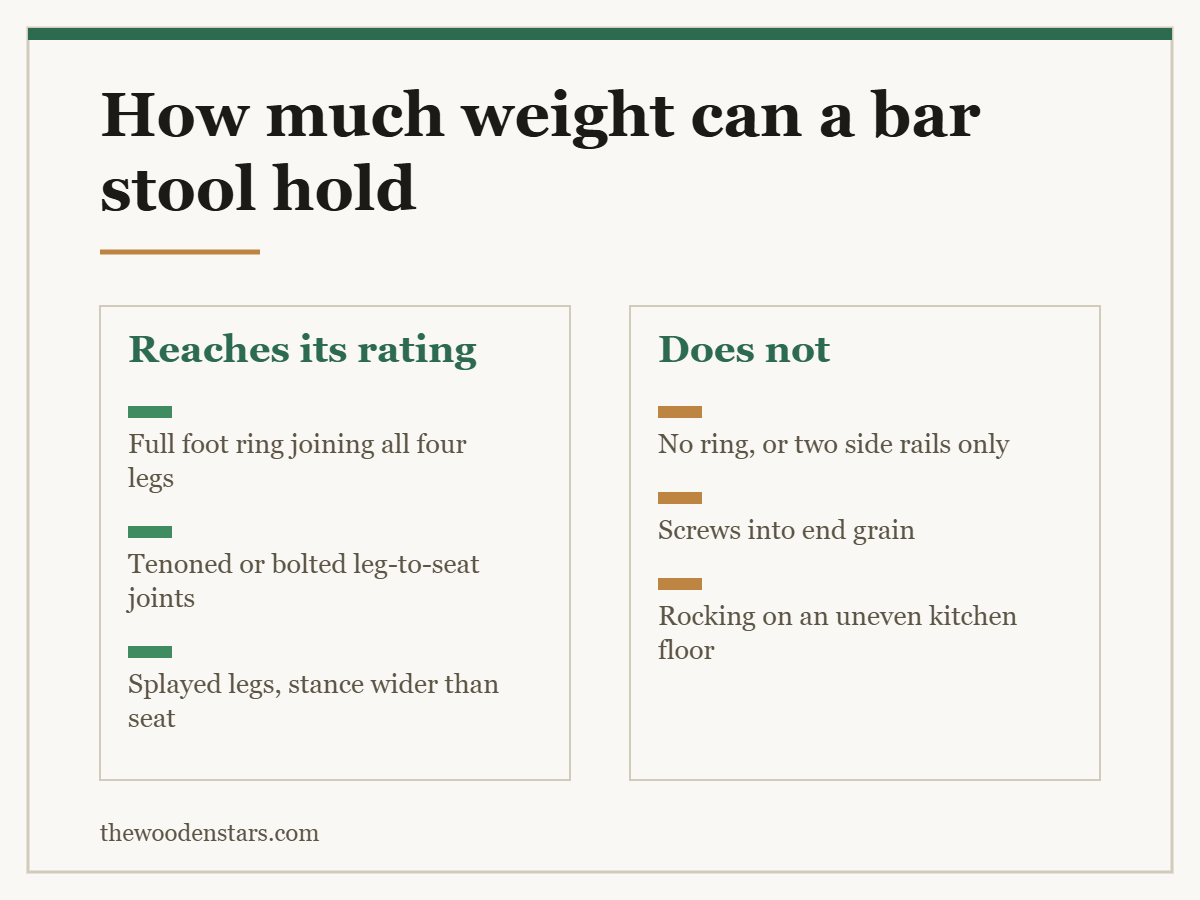
Typical ratings: 250 to 300 lb on light metal and gas-lift stools, 300 lb as the commonest published figure, 350 to 400 on solid timber with a foot ring, and 400 to 500 on heavy-duty and commercial stools. Ratings are static, and mounting a 30-inch stool applies two to three times body weight to two legs for a moment — so rate for roughly double the heaviest regular user. What sets the number is the foot ring that ties the legs together, the leg-to-seat joint, and on gas lifts the cylinder class. A stool with no ring and screws into end grain is at the bottom of its range whatever the listing says.
How much weight can a bar stool hold, by type
- Gas-lift adjustable: 250 to 300 lb. The cylinder, not the frame, is the limit.
- Light metal four-leg: 250 to 330 lb.
- Solid timber with a foot ring: 350 to 400 lb.
- Heavy-duty or commercial: 400 to 500 lb, sometimes more.
- Backless timber: often higher than the same maker’s backed model, because there is no back-to-seat joint to fail.
Notice that backless stools often beat their backed siblings. The back is a lever: someone leaning against it puts a bending load into the joint where it meets the seat, and that joint is the commonest failure on a stool with a back — see bar stool with a back against backless.
| Feature | Weak | Strong |
|---|---|---|
| Foot ring or stretcher | None | Full ring welded or tenoned |
| Leg-to-seat joint | Screws into end grain | Round tenon, or bolted |
| Seat | Plywood under a pad | Solid timber 1 in or more |
| Leg stance | Vertical | Splayed outward |
| Gas cylinder | Unrated or class 2 | Class 4, replaceable |
| Back-to-seat joint | Screwed through the seat | Through-tenon or bolted |
Why the static number understates it
A published rating is what the stool holds standing still, loaded evenly. Getting onto a bar stool is neither.
You put a foot on the ring, transfer your whole weight onto one side of the stool, then pivot. For a moment two legs carry everything, off-centre and with a sideways component. Add the drop as you settle and the instantaneous load is two to three times body weight on half the frame.
That is why the working rule is the same as for other seating: rate for roughly double the heaviest regular user. A 250 lb-rated stool is not a stool for a 240 lb adult who uses it daily; it is a stool for occasional light use. The same arithmetic for ordinary seating is in how much weight a patio chair can hold.
Two aggravating factors specific to stools: people tilt them onto two legs while talking, and children stand on them to reach cupboards. Neither is in any rating.
The foot ring does more than rest your feet
This is the single most useful thing to look at on a listing photograph.
A ring or stretcher joining all four legs turns four separate levers into one braced frame. Without it, every time someone shifts their weight the legs rack independently, the joints work, and within two or three years the stool has a wobble that no amount of tightening fixes.
What to look for:
- A full ring, not two rails on opposite sides. Two rails brace one axis and leave the other free.
- Joined properly. Welded on metal; a tenon or a bolt on timber. A ring held by screws into the side of a leg is decoration.
- At 7 to 9 inches below the seat, which is also where it is useful to your feet.
- Splayed legs. Stance width at the floor greater than seat width means the stool resists tipping — how wide a bar stool is.
The rocking problem, which is free to fix
Kitchen floors are rarely flat. Tile is laid with a fall to a drain, timber cups, and a stool on three points carries everything through three legs and one diagonal — well below its rating.
Rocking is also self-worsening: every rock works the joints, and a loose stool fails further below its number.
Two cheap fixes. Adjustable levellers screwed into the feet take the rock out permanently. Retightening annually — ten minutes with a hex key across four stools — keeps them where they started; on timber, a joint that has already opened wants glue rather than a screw, per how to reglue a loose joint.
If you need a genuinely heavy-duty stool, look for a commercial-rated timber model with a welded or tenoned ring, no back, and a stance wider than the seat. Those reach 400 to 500 lb and are built for exactly this duty cycle — material trade-offs in wood against metal bar stools.
If a stool has already developed a wobble, tighten it before loading it again; a loose stool loses capacity faster than a tight one ever will.
Keeping a stool at its rating
- Adjustable furniture levellers Takes the rock out of a stool on an uneven kitchen floor
- Wood glue for loose joints The leg-to-seat joint opens first, and glue restores it
- Hex key set Ten minutes a year across four stools keeps the rating real
- Replacement gas cylinder On adjustable stools the cylinder is the rated part
What to buy
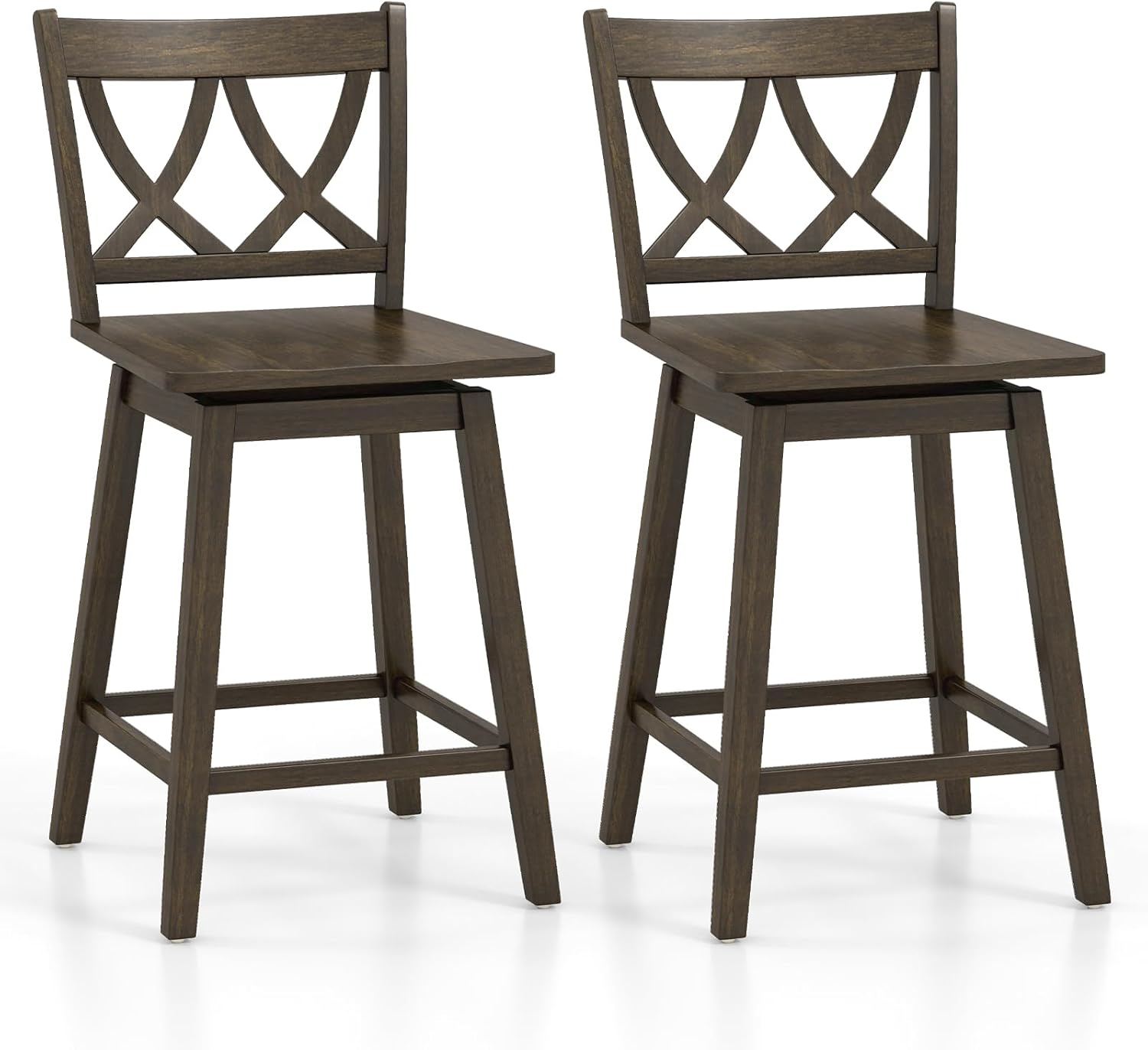


For sizing, see how wide a bar stool is and how tall a bar stool should be. For the mechanism, adjustable against fixed height and swivel against stationary.
Questions we get asked
How much weight can a bar stool hold?
Two hundred and fifty to 500 lb. Gas lifts sit at 250 to 300; solid timber with a foot ring reaches 350 to 400.
How much margin should I leave?
Rate for roughly double the heaviest regular user, because mounting applies two to three times body weight to half the frame.
What if no rating is published?
Assume the bottom of the class, then judge the foot ring, the leg-to-seat joint and whether the legs splay.
Are backless stools stronger?
Often yes, because there is no back-to-seat joint to take bending loads.
Why does my stool wobble?
Usually an uneven floor, which loads three legs instead of four. Levellers fix it, and fixing it stops the joints working loose.
What limits an adjustable stool?
The gas cylinder class, not the frame. An under-rated cylinder sinks long before anything breaks.