How deep is a bar stool seat? 14 to 18 inches
The Wooden Stars is a participant in the Amazon Services LLC Associates Program. We may earn a commission when you buy through links on our site, at no extra cost to you.
How deep is a bar stool seat? 14 to 18 inches — shallower than a dining chair, and deliberately so, because you get on and off a stool far more often than you sit down at a table.
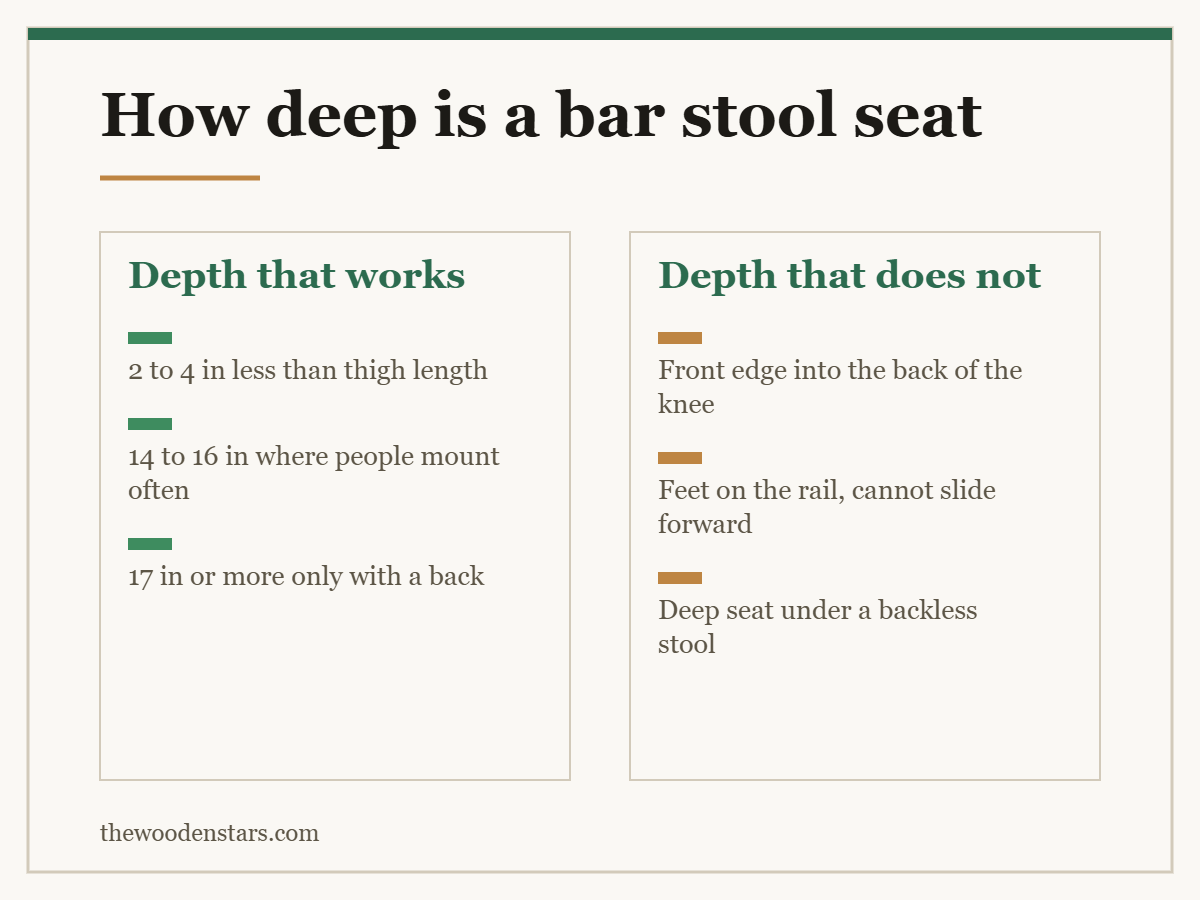
Depth is the dimension nobody checks and the one that decides whether the front edge cuts into the back of your knee.
Seat depths: 13 to 15 inches on a round backless stool, 15 to 17 on a standard square or round seat, 17 to 19 on an upholstered stool with a back, against 16 to 18 inches on a dining chair. Shallow is intentional — a stool you mount and dismount a dozen times a day wants less to swing a leg over. The comfort limit is your thigh length: with feet on the rail, a seat deeper than the back of your knee to your hip presses the front edge into the leg. Under 5 ft 5 in aim for 14 to 15 inches; over 6 ft, 17 to 19.
How deep is a bar stool seat, by type
- Round backless: 13 to 15 inches, which for a round seat is the same as the diameter.
- Square or rectangular, no back: 15 to 17.
- With a back: 16 to 18, because the back needs something to sit on.
- Upholstered with a back: 17 to 19, the deepest in the category.
- Dining chair, for comparison: 16 to 18.
Two things follow. A backless stool is usually shallower than a dining chair, and an upholstered stool with a back is usually deeper — so “bar stool” covers a six-inch range and the label tells you nothing.
Width is a separate figure that varies independently — how wide a bar stool is.
| Situation | Depth | Note |
|---|---|---|
| Under 5 ft 5 in | 14 to 15 in | Deeper cuts behind the knee |
| 5 ft 5 in to 6 ft | 15 to 17 in | The broad comfort band |
| Over 6 ft | 17 to 19 in | Shallow feels perched |
| Frequent mounting | 14 to 16 in | Less to swing a leg over |
| Long sitting | 17 to 19 in | With a back, not without |
| Children | 13 to 15 in | Shallow and a low rail |
Why stools are deliberately shallow
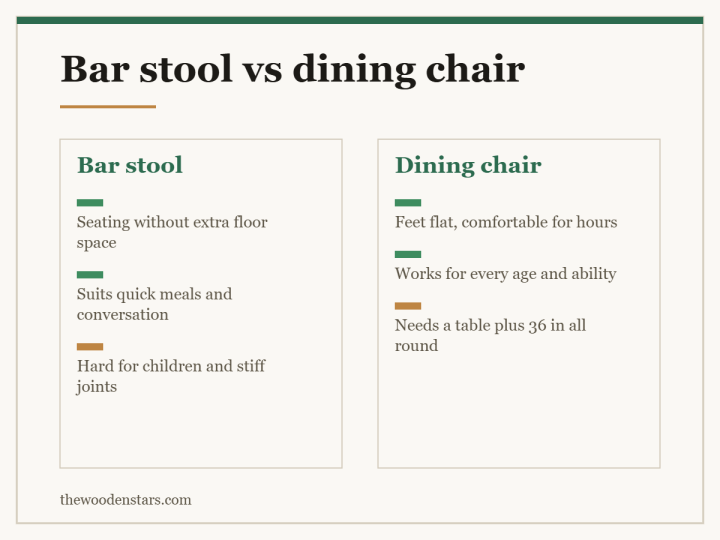
A dining chair is approached once, sat in for an hour, and left. A bar stool at a kitchen island is mounted and dismounted a dozen times over a morning.
Every extra inch of depth is an extra inch to clear with your leg on the way on and off, and at 30 inches off the floor that manoeuvre is already awkward. Shallow seats are not a cost saving; they are what makes the stool usable.
The second reason is that stools are often used perched rather than sat in — leaning forward onto the worktop with only the front half of the seat under you. A deep seat contributes nothing in that posture and gets in the way when you slide off.
Which is why depth and back go together. If you want an 18 or 19-inch seat, you want a back to go with it, or you are paying for cushion nobody sits on — bar stool with a back against backless.
Matching depth to the person
The measurement that matters is from the back of your knee to your hip, seated. On most adults that is 16 to 21 inches, and the seat should be 2 to 4 inches less.
Too deep and the front edge presses the back of your knee. On a chair you would slide forward and lose the back support; on a stool with your feet on a rail you cannot slide forward, so the pressure just stays. That is the specific reason a too-deep stool becomes uncomfortable faster than a too-deep chair.
Too shallow and you feel perched, with your thighs unsupported past the halfway point. For a quick coffee that is fine. For an hour it is not.
A household spanning both ends is best served at 16 inches, which suits most adults, plus a seat pad for anyone who wants more.
Depth, the overhang and the footrest
Depth interacts with two other numbers.
The overhang. A deep seat pushes you further from the worktop edge, so you need more overhang for your knees. A 19-inch seat under a 12-inch overhang leaves you reaching; the same stool under 15 inches is fine. The overhang rule is in how many bar stools fit at an island.
The footrest position. The deeper the seat, the further forward your feet sit naturally, and a rail directly below the front edge starts to feel too far back. Stools with deep seats want a ring rather than a single front rail, so your feet land somewhere useful whichever way you sit.
Both are reasons to treat depth, overhang and rail as one decision rather than three — along with seat height, which is set by the worktop in how tall a bar stool should be.
If a stool you already own is too deep, a firm wedge-shaped cushion that lifts the back of the thigh will relieve most of the pressure on the front edge.
Getting depth right
- Tape measure Seat depth is front edge to the back of the seat, not to the backrest
- Seat pads for stools Adds an inch and softens a front edge that presses
- Memory foam stool cushion For a shallow seat that leaves thighs unsupported
- Felt furniture pads Deep stools get dragged more because they tuck less easily
What to buy


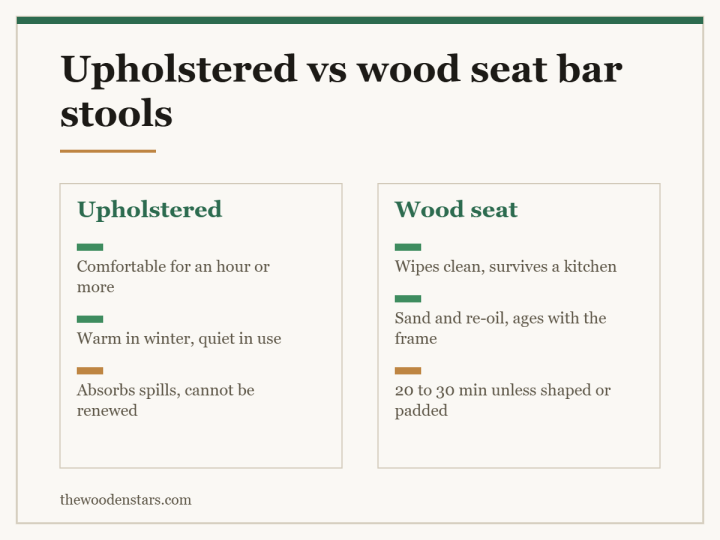
For the other dimensions, see how wide a bar stool is and how tall a bar stool should be. For the seat itself, upholstered against wood seat and with a back against backless.
Questions we get asked
How deep is a bar stool seat?
Fourteen to 18 inches. Round backless stools are 13 to 15; upholstered stools with backs reach 19.
Why are stools shallower than dining chairs?
Because you mount and dismount them many times a day, and every extra inch is another inch to swing a leg over.
What depth suits me?
Two to 4 inches less than your knee-to-hip length. Under 5 ft 5 in aim for 14 to 15; over 6 ft, 17 to 19.
Why does a deep stool hurt more than a deep chair?
Because your feet are on a rail, so you cannot slide forward to take the pressure off the back of your knee.
Should a deep seat have a back?
Yes. At 17 inches or more without a back, you are paying for cushion nobody leans into.
Does depth change the overhang I need?
Yes. A 19-inch seat wants 15 inches of overhang where a 15-inch seat manages on 12.