Best wood to use outside — Four timbers and what each survives
The Wooden Stars is a participant in the Amazon Services LLC Associates Program. We may earn a commission when you buy through links on our site, at no extra cost to you.

Outdoors, the property that keeps timber alive is not hardness. It is resistance to water and to the fungi that follow water — and those come from natural oils, resins and extractives, not from density.
That is why the hardest timber in most furniture showrooms will rot outside, and a softer one will sit under rain for thirty years.
Four timbers cover almost all outdoor furniture. Teak — very high natural oil and silica, survives 25 to 50 years untreated, expensive. Western red cedar — light, naturally rot-resistant, soft and dents easily, 15 to 20 years. Acacia and eucalyptus — dense and affordable but moderate oil, so oil yearly for 10 to 15 years. Pressure-treated pine — chemically protected rather than naturally, cheapest, the only one rated for ground contact. Hardness predicts dents, not rot; oil content predicts rot resistance.
The timbers, ranked by what matters outdoors
| Timber | Untreated life | Janka | Maintenance | Cost |
|---|---|---|---|---|
| Teak | 25 to 50 years | 1,070 | Optional, cosmetic only | Very high |
| Ipe | 40+ years | 3,510 | Oil for colour only | Very high |
| White oak | 10 to 20 years | 1,350 | Annual oil helps | Moderate |
| Western red cedar | 15 to 20 years | 350 | Seal to slow greying | Moderate |
| Eucalyptus | 10 to 15 years | 1,125 | Oil yearly | Low to moderate |
| Acacia | 3 to 7, or 10 to 15 oiled | 1,700 to 2,300 | Oil yearly | Low |
| Pressure-treated pine | 20 to 40 years | 400 to 700 | Reseal every 2 to 3 years | Lowest |
| Untreated pine or spruce | 1 to 3 years | 400 to 700 | Hopeless | Lowest |
Compare the top and bottom of the Janka column against the life column and the point becomes obvious: acacia is the hardest timber on the list and nearly the shortest-lived untreated. Cedar is the softest and lasts three times as long.
What actually makes a timber last outside
Natural oils and resins. They repel water, so the timber does not repeatedly swell and shrink — which is what opens the checks that let water into the middle. Teak’s oil content is the benchmark.
Extractives that discourage fungi. Cedar’s aromatic compounds, teak’s tectoquinones. These are mildly toxic to the organisms that cause rot, which is why cedar lasts so well despite being soft.
Silica. Teak has a lot, which adds to its weather resistance — and blunts tools, which is part of why teak furniture costs what it does.
Heartwood, not sapwood. The protective compounds sit in the heartwood at the centre of the tree. Pale sapwood from the outside has almost none, in any species. This is why teak grade matters: Grade A is heartwood, Grade C includes sapwood and will not behave like teak.
Choosing, by what you actually want
Buy it once and forget it
Teak or ipe. Both will outlast you with no maintenance beyond an occasional wash, and both weather to a silver-grey that harms nothing. The cost is real and the argument for it is a twenty-year one.
Best value that still lasts
Western red cedar or white oak. Cedar is light enough to move easily, naturally resistant, and pleasant. Its weakness is softness — it dents and scratches from ordinary use, so it suits a bench or a planter more than a table that takes plates.
White oak is the one hardwood on the list that works outdoors, because its pores are blocked by internal growths. Red oak, which looks similar and is cheaper, is open-pored and will rot. If a listing says only “oak”, assume red.
Cheapest that works, with a job attached
Acacia or eucalyptus. Dense, affordable, widely available as complete furniture sets, and they need oiling once a year. That half-hour is the difference between five years and fifteen — the detail is in is acacia good outdoors.
Anything touching the ground
Pressure-treated pine, and only that. No natural timber on this list is rated for permanent ground contact. Posts, deck frames, anything bedded in soil — this is the material.
The three things that kill outdoor furniture
- Standing water at the feet. End grain wicks water upward like a straw. A puddle under a leg travels several inches up it. Pads, risers or a draining surface fix this, and it is the highest-value thing you can do for any timber.
- Freeze-thaw on wet wood. Water enters a check, freezes, widens it, repeats. A breathable cover or winter storage ends the cycle.
- A sealed plastic cover. The opposite mistake, and very common. It traps moisture against the timber and grows mildew. Breathable covers only, or lift them in dry weather.
Oil, sealer or nothing
Nothing is a legitimate choice for teak, ipe and cedar. They grey and carry on. The grey is a thin surface layer, not decay, and it sands back if you change your mind.
Oil slows moisture exchange and keeps the colour. It needs redoing yearly, it cannot really be done wrong, and it patches invisibly. The right choice for acacia and eucalyptus, and for anyone who wants teak to stay gold.
Film-forming sealer or varnish lasts two to three years but peels when it fails, which means stripping back before recoating. More work, less often, and less forgiving of neglect.
Whatever you use, give the end grain — feet, rail ends — an extra coat. That is where water enters.
What not to buy for outdoors
Mango, rubberwood, poplar, birch, maple, walnut, cherry and untreated pine are all indoor timbers. Several are sold in “indoor/outdoor” listings with a coat of varnish on them, and they will check within two seasons.
If a set is cheap and the species is not named, assume it is one of these. The vocabulary problem is the same one described in what “all wood” actually means.
For outdoor timber
- Teak oil Annual on acacia and eucalyptus; optional on teak and cedar
- Breathable furniture cover Sealed plastic traps moisture and grows mildew
- Furniture feet pads Keeps end grain out of standing water
- Exterior wood sealer The longer-interval alternative to oil, with more preparation
What to buy
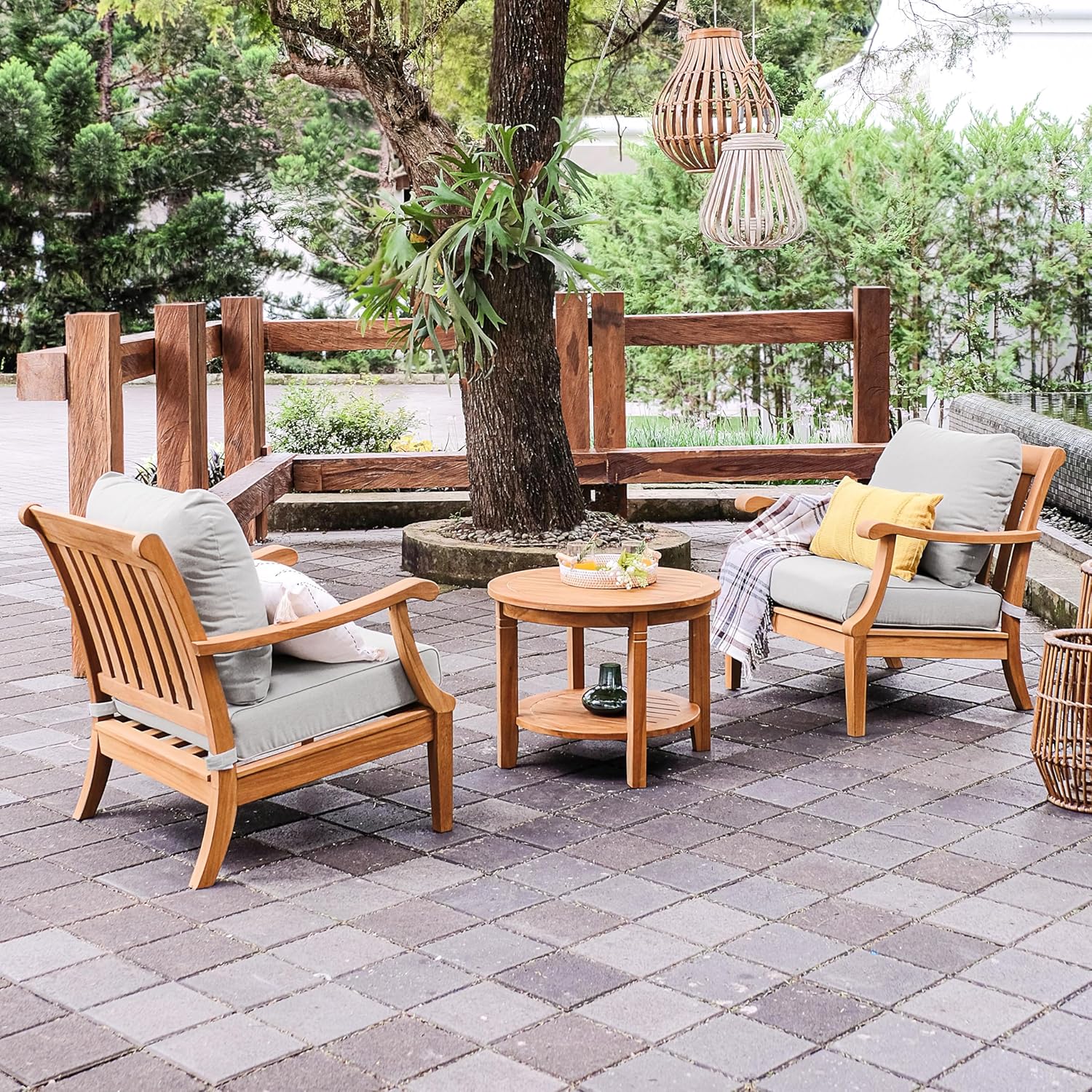


For the two most common choices head to head, see acacia against teak and is acacia good outdoors. For indoor timber selection, what wood is best for furniture and the wood hardness scale.
Questions we get asked
What is the best wood to use outside?
Teak if the budget allows, cedar or white oak for value, acacia or eucalyptus with yearly oiling, and pressure-treated pine for anything touching the ground.
Does hardness predict how long wood lasts outdoors?
No. Oil content and natural extractives do. Acacia is the hardest common outdoor timber and one of the shortest-lived untreated.
Is cedar good for outdoor furniture?
Yes — naturally rot-resistant and long-lived. It is soft, so it dents and scratches more than hardwoods.
Can oak be used outdoors?
White oak can; its pores are blocked internally. Red oak cannot — it is open-pored and will rot.
Do I have to oil outdoor furniture?
Teak, ipe and cedar survive without it. Acacia and eucalyptus need it yearly to reach their potential.
What wood can touch the ground?
Only pressure-treated timber rated for ground contact. No natural species on this list is suitable bedded in soil.

