L shaped desk vs rectangular desk — Two walls or one
The Wooden Stars is a participant in the Amazon Services LLC Associates Program. We may earn a commission when you buy through links on our site, at no extra cost to you.
L shaped desk vs rectangular desk is a decision about whether you use two walls or one — and about whether you actually need a second surface or just more of the first.
The L is not simply a bigger desk. It changes where you sit, what you can reach, and how hard the room is to rearrange later.
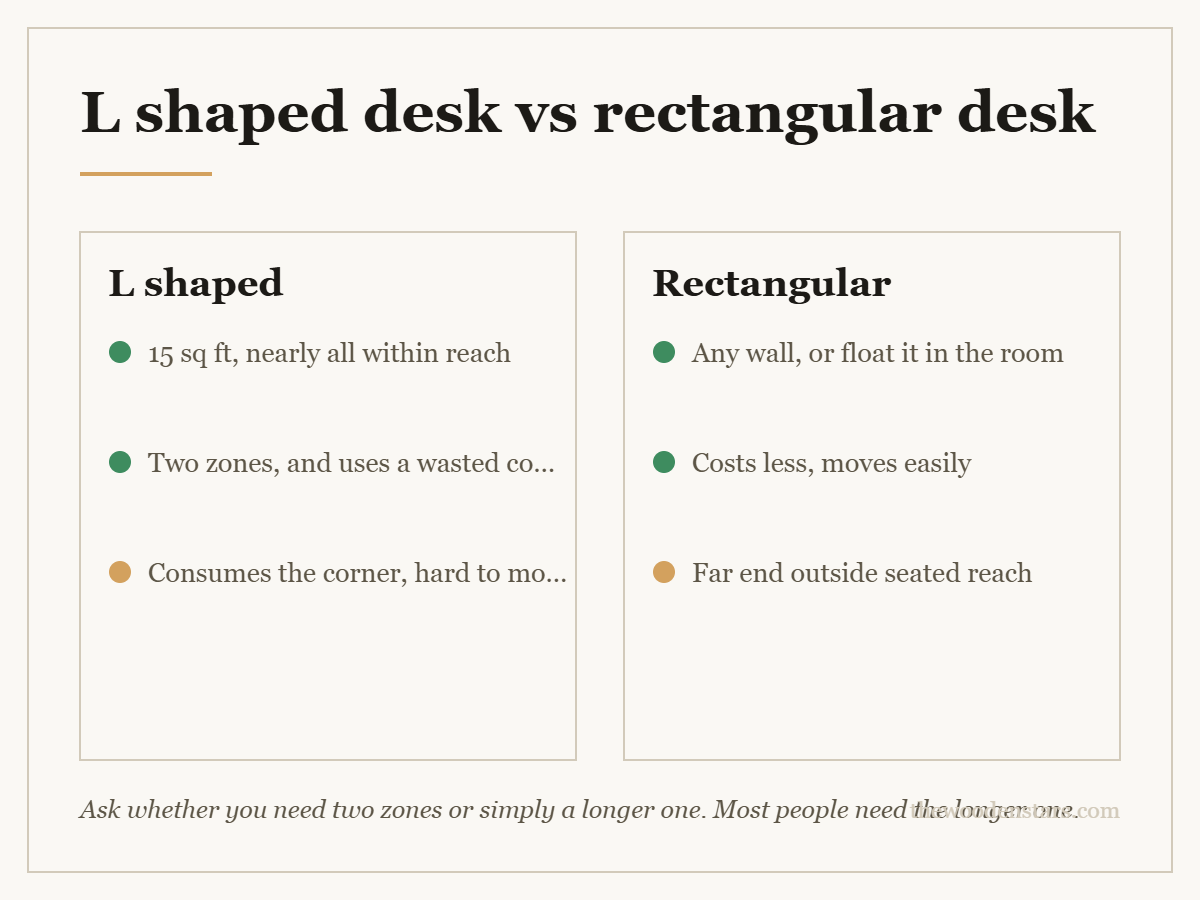
An L shaped desk gives roughly 50% more surface than a rectangle of the same main length, by turning a corner. It puts a second zone within arm’s reach without widening the main run, which suits two monitors, paperwork, or a laptop plus a work area. It costs you a corner of the room permanently, needs two walls measured, and is much harder to move or resell. A rectangular desk at 48 to 60 inches suits most single-screen work, fits anywhere, and can be pulled into the room. Both want 24 to 30 inches of depth.
L shaped desk vs rectangular desk: the surface arithmetic
Compare like for like on the main run.
- Rectangle, 60 × 24 inches: 10 square feet.
- L, 60 × 24 with a 48 × 24 return: about 15 square feet.
- Rectangle enlarged to 72 × 30: 15 square feet — the same area, in one straight line.
So the L does not create area out of nothing. What it does is put that area within reach. Seated reach across a desk is about 26 inches and along it maybe 30 each way; the far end of a 72-inch rectangle is outside that, while the return of an L is beside your elbow.
That is the actual case for an L: not more surface, but more reachable surface without standing up.
| Measure | L shaped | Rectangular |
|---|---|---|
| Typical size | 58 to 78 in per leg | 40 to 72 in |
| Surface | About 15 sq ft | 10 to 15 sq ft |
| Reachable seated | Nearly all of it | The middle 60 in |
| Walls needed | Two | One |
| Depth | 24 to 30 in each leg | 24 to 30 in |
| Moves easily | No | Yes |
| Suits | Two screens, paperwork, dual tasks | Single screen, writing |
What the L costs
A corner, permanently. An L occupies the junction of two walls and cannot be moved without rethinking the room. Every other layout option in that corner is gone.
Two measurements instead of one, and both matter: the long leg, the return, and crucially what each one runs into — a door swing, a radiator, a window sill, a skirting board.
Reconfiguring. Most L desks are reversible, but that is the only flexibility. You cannot make it smaller, you cannot put it in the middle of a room, and you cannot easily take it up a stair — the long leg is usually one rigid panel.
The corner joint. On cheaper L desks the two legs meet at a butt joint supported by one shared leg, and that junction is where wobble starts. Look for a proper corner bracket or a shared cabinet at the elbow — the general diagnosis is in how to fix a wobbly desk.
Where the rectangle is the better buy
Single-screen work. If the job is a laptop or one monitor and a notebook, 48 to 60 inches of rectangle is enough, and the extra return is surface that collects things.
A room you will rearrange. Rectangles go against any wall, float in the middle, face a window, or become a dining table in an emergency.
Where the corner is needed for something else — a bookcase, a chair, a wardrobe. Corners are the most useful part of a small room and an L consumes one entirely.
Shared or rented rooms. A rectangle moves out; an L is negotiated with.
The L is not the same as a corner desk
Worth separating, because the words get used interchangeably and the shapes behave differently.
A true corner desk has a curved or angled front that fills the corner itself, putting you facing into it. It wastes the deepest part of the corner — the bit behind the curve is unreachable — and it puts your back to the room.
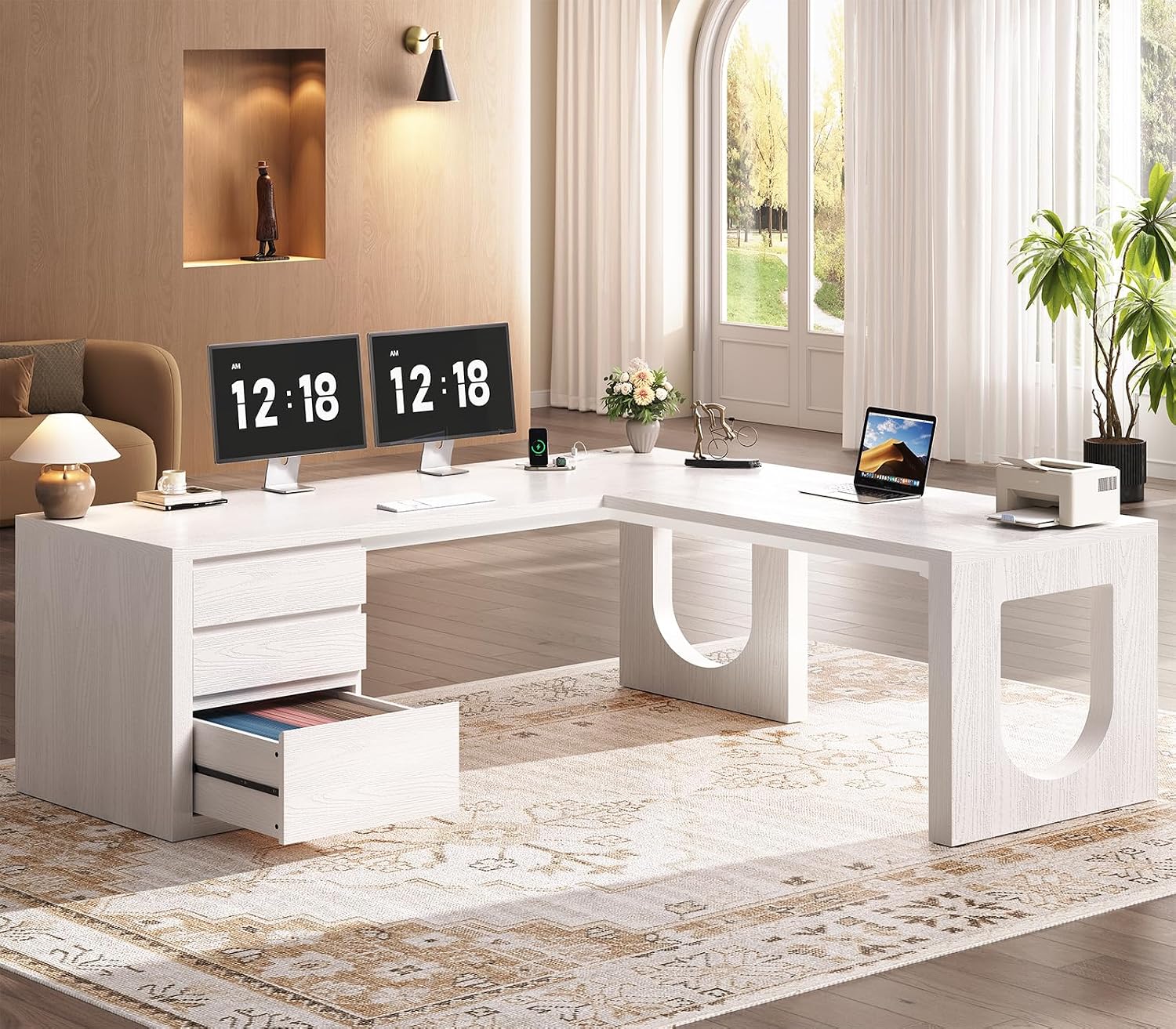
An L shape has two straight legs meeting at a right angle. You sit at the inside of the L, facing along one leg, with the return to your side. Nothing is wasted and the geometry is usable.
Where both fit, the L is the better shape. That comparison is worked through in corner desks for small spaces.
What to check on either
- Depth of 24 to 30 inches. Screen distance sets it, and a shallow desk is uncomfortable no matter what shape it is — how deep a desk should be.
- Knee clearance of 25 to 27 inches to the underside of the lowest part. Drawers and corner cabinets are where this disappears.
- Racking resistance. A back panel, stretcher or corner brace. Four legs and a top is the wobbliest arrangement there is.
- Which side the return is on, and whether it is reversible. Get this wrong and the desk faces the wrong way in the room.
- Cable route. An L has two back edges and usually one socket — desk grommets.
Construction and material notes are in wooden desk legs and what engineered wood actually is.
Either shape
- Monitor arm Frees the depth a stand eats, and lets an L carry two screens
- Desk grommet An L has two back edges and usually one socket
- Corner brace set Stiffens the elbow joint where L desks start to wobble
- Felt floor glides A desk gets pushed back every time somebody stands up
What to buy



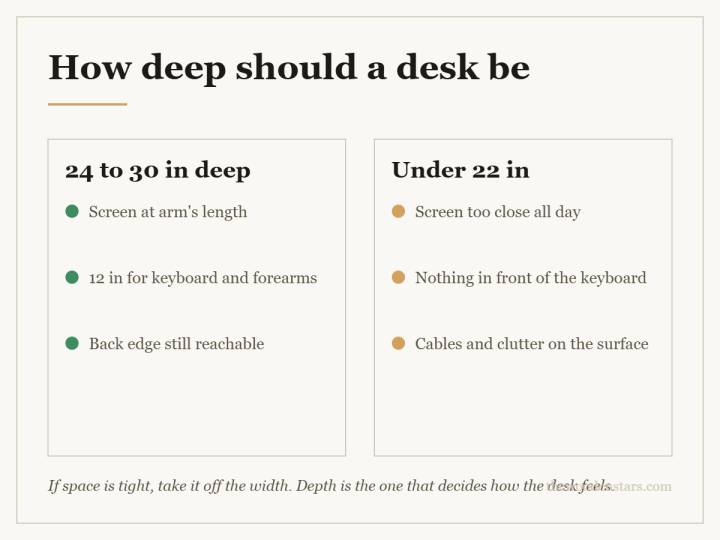
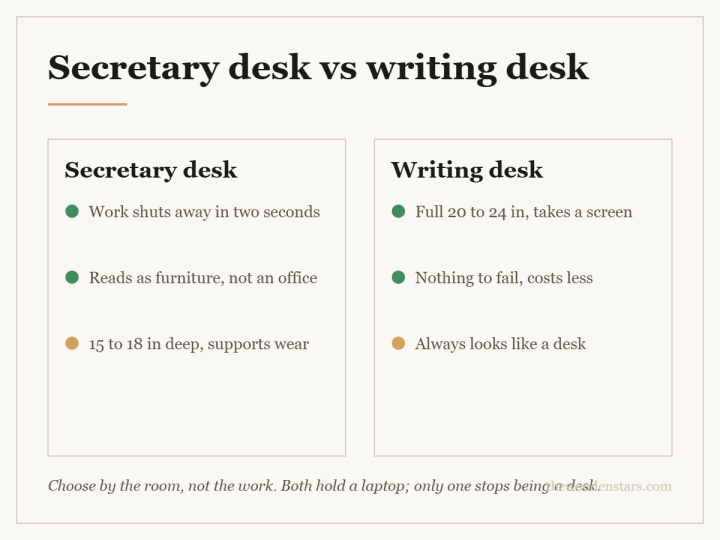
For desks by type, see corner desks for small spaces, secretary against writing desks and standing desks with drawers. For sizing, how deep a desk should be. For storage above, hutch desks with drawers.
Questions we get asked
Is an L shaped desk better than a rectangular one?
For two screens or two kinds of work, yes — it puts more surface within reach. For single-screen work a 48 to 60-inch rectangle is enough.
How much more surface does an L give?
About 50% more than a rectangle of the same main length — roughly 15 square feet against 10.
Is an L shaped desk the same as a corner desk?
No. A corner desk has an angled or curved front that fills the corner and wastes the space behind it. An L has two straight legs and wastes nothing.
What depth should each leg be?
Twenty-four to 30 inches, the same as any desk. Screen distance sets it, not the shape.
Where do L shaped desks wobble?
At the elbow, where the two legs meet. Look for a corner bracket or a shared cabinet rather than a butt joint on one shared leg.
Can an L shaped desk be reversed?
Most can, and that is usually the only flexibility they offer. Check before buying, because the return side decides how the room works.