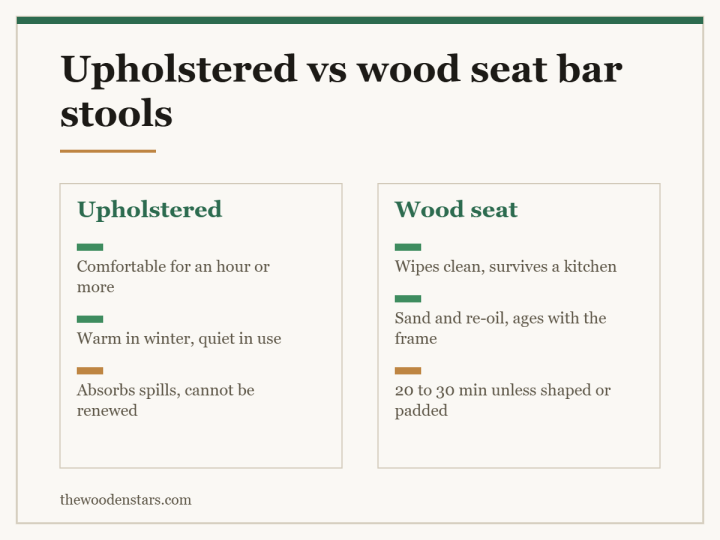
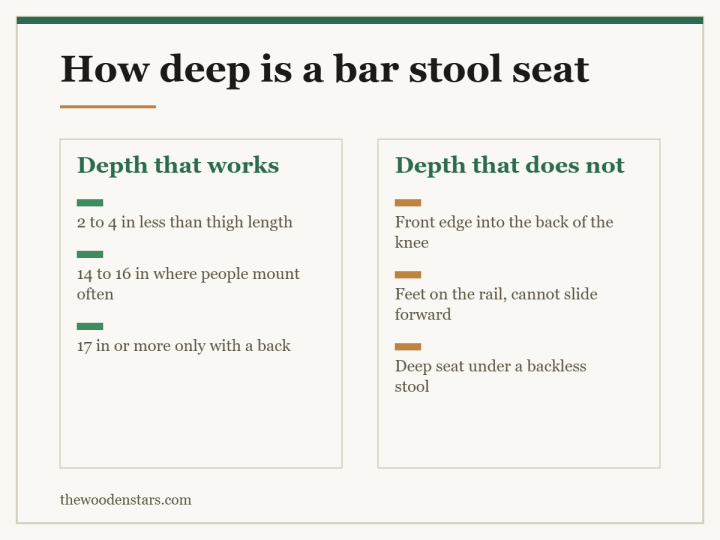
How much space between bar stools? 6 to 10 inches
The Wooden Stars is a participant in the Amazon Services LLC Associates Program. We may earn a commission when you buy through links on our site, at no extra cost to you.
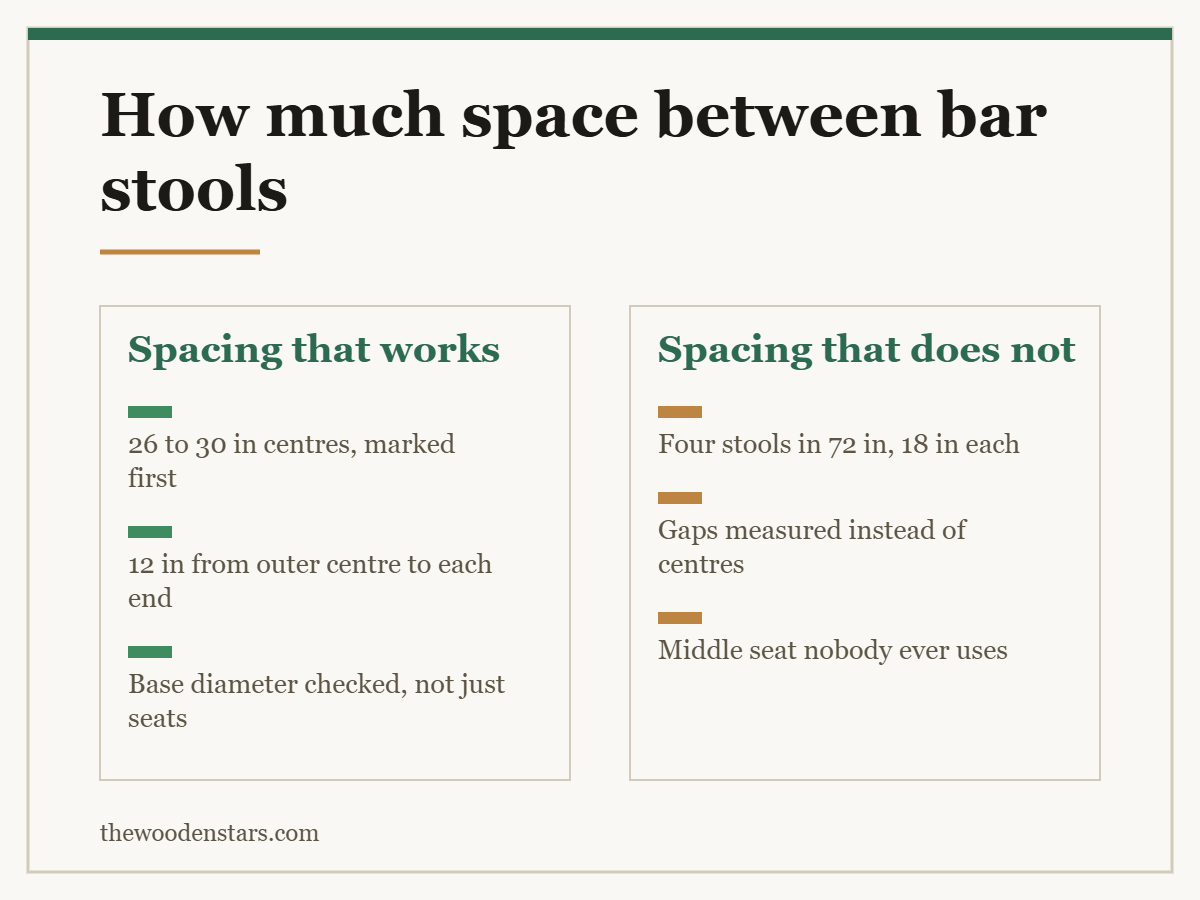
How much space between bar stools? 6 to 10 inches of gap — which works out at 26 to 30 inches from centre to centre, and the centre figure is the one to plan with.
Measuring gaps is how people end up with stools that touch. Measuring centres is how you end up with seats people use.
Plan on 26 to 30 inches centre to centre. Since a stool seat is 15 to 21 inches wide, that leaves a gap of 6 to 10 inches between them — enough for elbows and for getting off without shoving a neighbour. Use 26 for narrow round backless stools, 28 for typical square seats, and 30 for wide upholstered stools or anything with arms. At the ends of a run, leave 12 inches from the stool centre to the worktop corner. Below about 22 inches centre to centre, seats touch and the middle one stops being used.
How much space between bar stools, measured properly
Two ways to state the same layout, and only one of them survives contact with a tape measure.
- Centre to centre: 26 to 30 inches. Independent of which stools you end up buying, so you can mark it on the worktop before ordering.
- Gap between seats: 6 to 10 inches. Depends entirely on seat width, so it changes if you swap stools.
Plan in centres. A 72-inch run marked at 26-inch centres gives three positions with 12 inches of margin either side — and those marks stay right whether you buy 15-inch round seats or 20-inch square ones.
The gap figure is worth knowing for a different reason: it tells you whether a set of stools you already own will fit. Seat width is in how wide a bar stool is.
| Stool | Seat width | Centres | Gap |
|---|---|---|---|
| Narrow round backless | 15 to 16 in | 24 to 26 in | 8 to 10 in |
| Standard round | 17 to 18 in | 26 to 28 in | 8 to 10 in |
| Square or rectangular | 18 to 20 in | 28 in | 8 to 10 in |
| Upholstered with a back | 20 to 22 in | 30 in | 8 to 10 in |
| With arms | 22 to 24 in | 30 to 32 in | 6 to 8 in |
Why the gap exists at all
It is not decoration. Three things use it.
Elbows. Adults sitting at a counter eat with elbows out. Shoulder width is roughly 16 to 20 inches, but elbow width in use is closer to 24 to 26 — which is exactly why the centre figure is what it is.
Getting off. On a stool you swing a leg down. With seats touching, the person in the middle of three cannot leave without the neighbours moving. At an island where people come and go constantly, that is the difference between three usable seats and one.
The footrest. Stool bases are often wider than the seat at rail height. Two stools whose seats clear each other by 8 inches can still clash at the foot ring — check base diameter, not just seat width.
The same reasoning at a dining table gives 24 inches per diner, which is slightly less because chairs do not need the mounting room — how much space around a dining table.
What happens when you squeeze
Below about 22 inches centre to centre, seats touch. What follows is predictable:
- The middle seat stops being used. People take the outer two and the third becomes a shelf.
- Stools get dragged constantly to let people out, which is loud and marks the floor.
- Backs and arms clash before seats do, so the problem is worse than the seat widths suggest.
Four stools crammed into a 72-inch run is the classic version: on paper 18 inches each, in practice two usable seats. Three at 26 inches would have given three. The full seat-count method is in how many bar stools fit at an island.
Corners, returns and the ends of a run
Leave 12 inches from the outer stool centre to the end of the worktop. Less than that and the end person’s shoulder is against the return or the wall.
An L-shaped counter needs more at the inside corner. Two people seated on adjoining faces are effectively knee to knee. Allow 36 inches along the diagonal between those two stool centres, or leave the corner empty.
The short end of an island takes one stool if there is 15 inches of overhang there — worth checking, because it turns a row of three into an L of four without touching the spacing on the long side.
Behind the stools, keep 36 inches of walkway, 42 to 48 if it is the main route. Remember stools rarely tuck fully under, especially with backs — with a back against backless.
The end of a run against a wall needs its own allowance. A stool whose centre sits 12 inches from a corner is fine where the return is a worktop, but where it is a wall you want 15 to 18 inches, because a wall stops your shoulder and your elbow rather than just your knee. The same applies where a tall fridge or a full-height cupboard forms the end of the run, and those are easy to miss on a plan because they are drawn as a thin line.
Marking it out
- Tape measure Mark centres on the worktop in pencil before ordering anything
- Painter’s tape Tape circles on the floor at seat width to test the spacing
- Felt furniture pads Tight spacing means more dragging, so protect the floor first
- Adjustable furniture levellers A stool that rocks gets shoved more than one that does not
What to buy

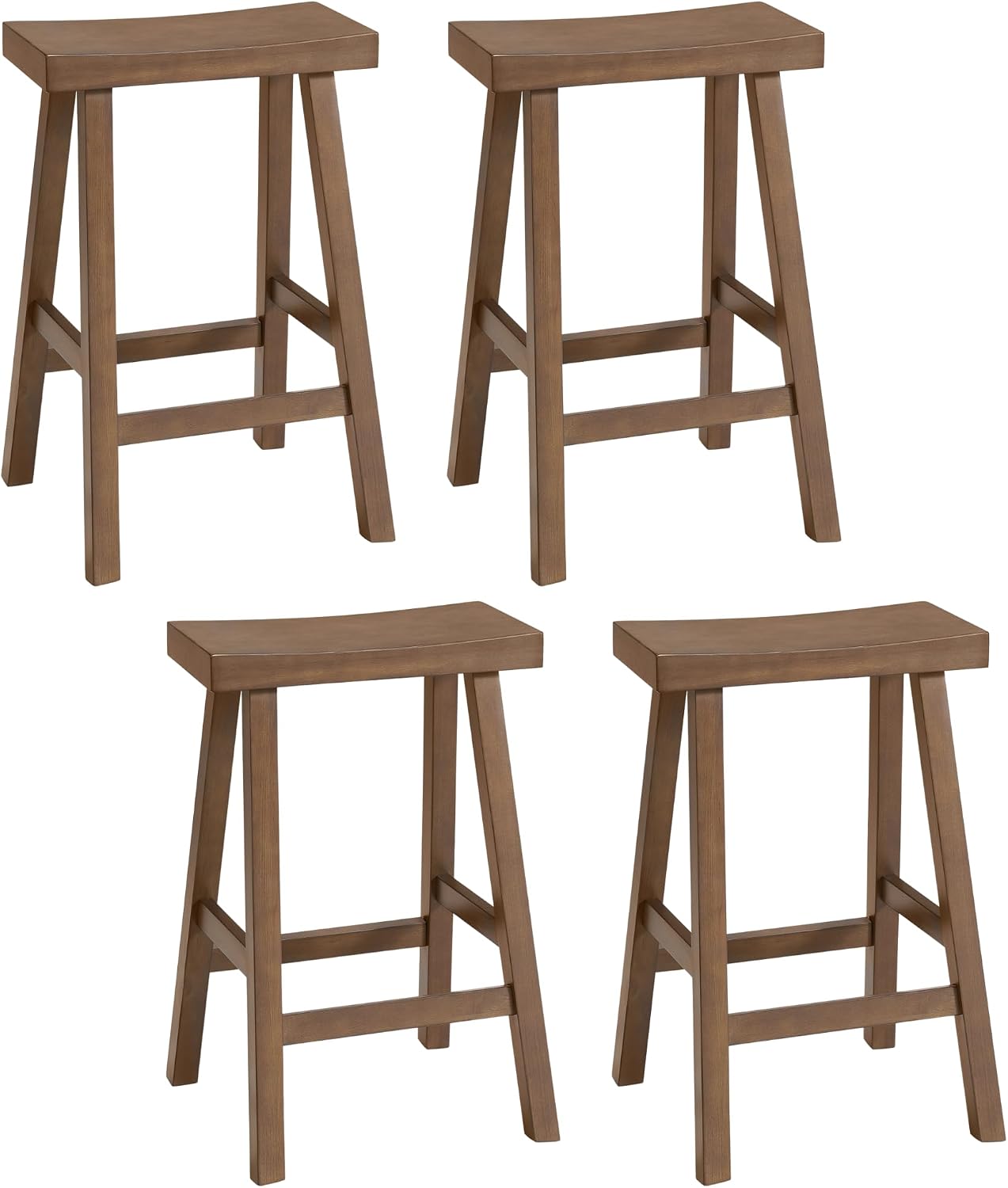


For the counts, see how many bar stools fit at an island and how wide a bar stool is. For height, how tall a bar stool should be and bar stool against counter stool.
Questions we get asked
How much space between bar stools?
Six to 10 inches of gap, which is 26 to 30 inches centre to centre. Plan in centres, not gaps.
Why plan in centres?
Because centres stay correct whichever stools you buy. Gaps change with seat width.
What is the minimum spacing?
About 22 inches centre to centre before seats touch, and at that point the middle seat stops being used.
How far from the end of the counter?
Twelve inches from the outer stool centre to the worktop corner, or the end person’s shoulder hits the return.
Do wider stools need more than 30 inches?
Stools with arms want 30 to 32 inches of centres. Everything else fits inside 30.
What about an L-shaped counter?
Allow 36 inches diagonally between the two stools either side of the inside corner, or leave that corner empty.