How much space between dining chairs? 6 inches
The Wooden Stars is a participant in the Amazon Services LLC Associates Program. We may earn a commission when you buy through links on our site, at no extra cost to you.
How much space between dining chairs? 6 inches of gap — which works out at 24 inches from centre to centre, and the centre figure is the one to plan with.
Measuring gaps is how people end up with chairs that touch. Measuring centres is how you end up with seats people actually use.
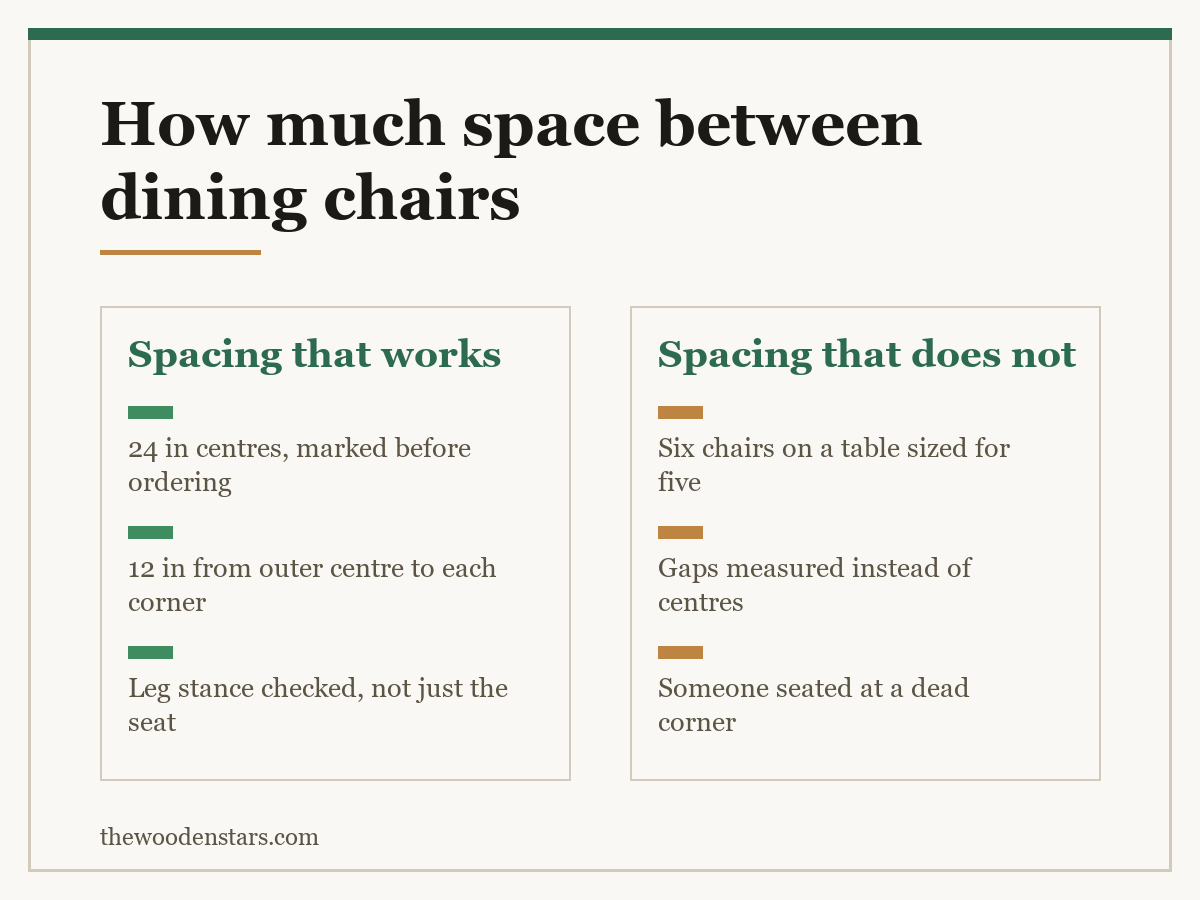
Plan on 24 inches centre to centre for armless chairs and 26 to 28 with arms. Since a side chair is 16 to 20 inches wide, that leaves a gap of 4 to 8 inches between them — enough for elbows and for getting out without shoving a neighbour. At the ends of a run, leave 12 inches from the outer chair’s centre to the table corner, because a corner blocks a shoulder rather than just a knee. Below about 22 inches centre to centre, chairs touch and the middle seat quietly stops being used.
How much space between dining chairs, measured properly
Two ways to state the same layout, and only one survives contact with a tape measure.
- Centre to centre: 24 inches armless, 26 to 28 with arms. Independent of which chairs you buy, so you can mark it on the table before ordering.
- Gap between chairs: 4 to 8 inches. Depends entirely on chair width, so it changes if you swap chairs.
Plan in centres. A 72-inch table side marked at 24-inch centres gives three positions with 12 inches of margin either end — and those marks stay right whether you buy 16-inch side chairs or 20-inch parsons chairs.
The gap figure is still worth knowing, because it tells you whether chairs you already own will fit. Widths are in how wide a dining chair is.
| Chair | Width | Centres | Gap |
|---|---|---|---|
| Slim side chair | 16 to 18 in | 24 in | 6 to 8 in |
| Standard side chair | 18 to 20 in | 24 in | 4 to 6 in |
| Parsons chair | 19 to 21 in | 26 in | 5 to 7 in |
| Armchair or carver | 22 to 26 in | 26 to 28 in | 2 to 6 in |
| Bench, per person | — | 20 to 22 in | None |
What the gap is actually for
It is not decoration. Three things use it.
Elbows. Shoulder width is 16 to 20 inches, but elbow width while eating is closer to 24 to 26 — which is exactly where the centre figure comes from.
Getting out. With chairs touching, the person in the middle of three cannot leave without the neighbours moving. At a family meal where people get up constantly, that is the difference between three usable seats and one.
The legs, not the seats. Dining chair legs often splay outward, so two chairs whose seats clear each other by 6 inches can still clash at floor level. Check the stance width at the feet, not just the seat width.
The same reasoning at a kitchen island gives 26 to 30 inches, slightly more because stools need mounting room — how much space between bar stools.
Corners, ends and round tables
Leave 12 inches from the outer chair’s centre to the table corner. Less than that and the end person’s shoulder is against the corner, which is worse than a tight gap because there is nothing to move.
Rectangular table corners are dead. Nobody sits diagonally at a corner, so a 72 × 36-inch table seats three per long side and one per end — six, not the eight or nine the raw perimeter suggests.
Round tables have no corners, which is why they seat more per square foot. Divide the circumference by 24: a 60-inch round is 188 inches round, so seven or eight armless places. The full method is in how many chairs fit a round table.
Behind the chairs, keep 36 inches of clearance to push back and stand, or 42 to 48 if it is the main route through the room — how much space around a dining table.
When the table will not give it
Four moves, in order of how much they return.
Armless chairs. Twenty-four inches instead of 26 to 28 is two to four inches back per seat, which over six seats is a whole place — dining chair with arms against without.
A bench on one side. Twenty to 22 inches per person because there are no frames between people, and it pushes back against the wall rather than into the walkway — dining bench against chairs.
Narrower chairs. A 16-inch slim side chair against a 21-inch parsons chair is five inches back per seat.
An extendable table, so the everyday layout is comfortable and the squeeze only happens at Christmas — extendable dining table.
What does not work: buying six chairs for a table with 120 inches of usable edge. At 20 inches each they touch, nobody can get out cleanly, and in practice two of the six stop being used.
High chairs and booster seats break all of this, and it is worth planning for if it applies. A freestanding high chair occupies 22 to 26 inches of table edge — more than an adult armchair — and it cannot tuck in, so it sits permanently in the walkway. A booster strapped to an existing chair adds nothing horizontally but raises the child above the table edge, which is the point. Where floor space is tight, the booster is the arrangement that keeps the table seating the number of people it was bought for.
Setting out the table
- Tape measure Mark centres on the table edge in pencil before ordering
- Painter’s tape Tape chair footprints on the floor and live with them a day
- Felt furniture pads Tight spacing means more dragging, so protect the floor first
- Furniture levellers A chair that rocks gets shoved more than one that does not
What to buy


For seat counts, see how many chairs fit a round table and how wide a dining chair is. For the room, how much space around a dining table.
Questions we get asked
How much space between dining chairs?
Six inches of gap, which is 24 inches centre to centre for armless chairs and 26 to 28 with arms.
Why plan in centres?
Because centres stay correct whichever chairs you buy. Gaps change with chair width.
What is the minimum?
About 22 inches centre to centre before chairs touch, and at that point the middle seat stops being used.
How far from the end of the table?
Twelve inches from the outer chair’s centre to the corner, or the end person’s shoulder hits it.
Can I seat someone at a corner?
Not on a rectangular table. Corners are dead, which is why a 72 × 36 seats six rather than eight.
What gains the most space?
Armless chairs, then a bench on one side at 20 to 22 inches per person.