How much weight can a TV stand hold? 50 to 300 lb
The Wooden Stars is a participant in the Amazon Services LLC Associates Program. We may earn a commission when you buy through links on our site, at no extra cost to you.
How much weight can a TV stand hold? 50 to 300 lb — and almost every modern television is comfortably inside that, which is why the published rating is the wrong thing to worry about.
TV stands do not fail under weight. They fail when a child pulls on the screen.
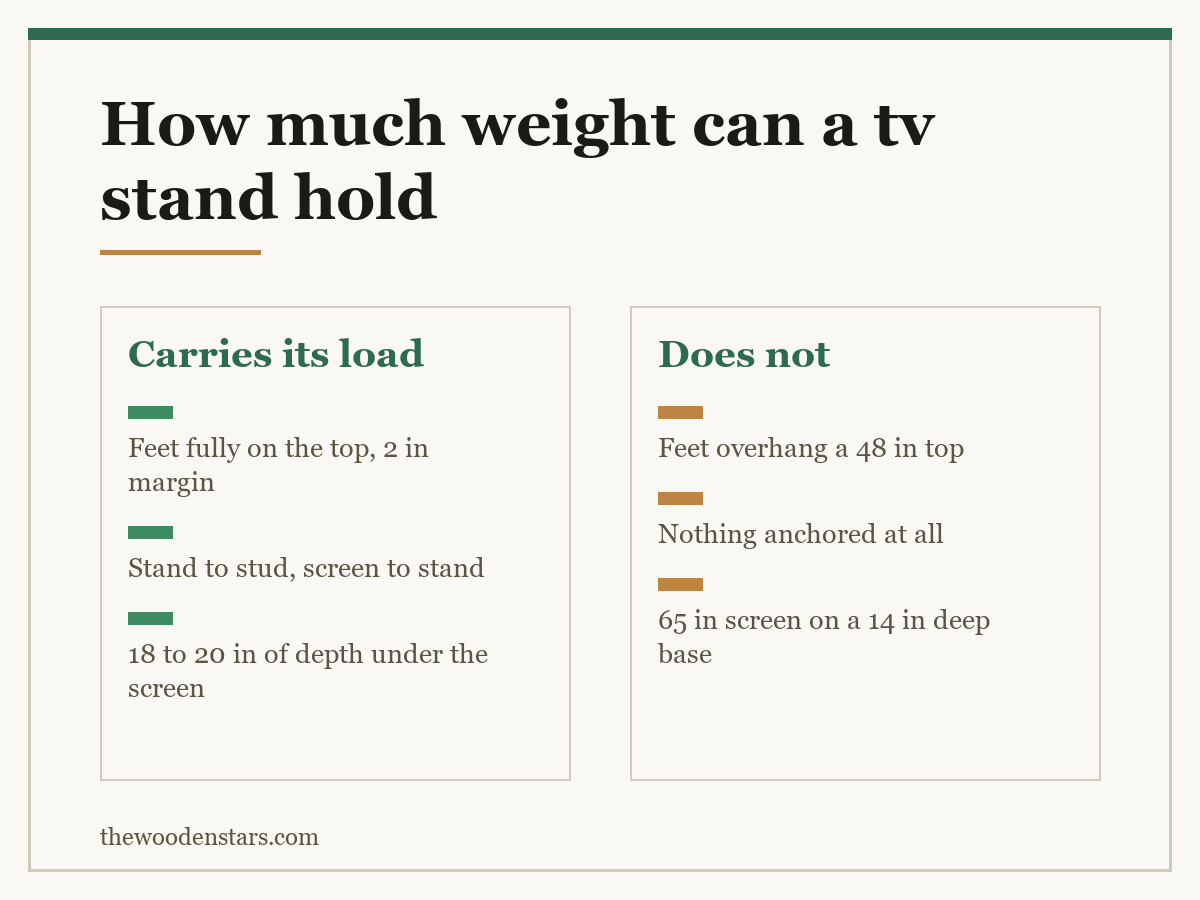
Typical top ratings: 50 to 80 lb on thin particleboard, 100 to 150 on a decent engineered-board stand, 150 to 250 on solid timber, and 250 to 300 on a heavy hardwood console. Screens are light by comparison — a 55-inch TV is 35 to 45 lb and a 75-inch is 70 to 90. So the rating is rarely the limit. Two things are: the foot spacing, because a screen whose feet overhang puts load on unsupported board, and tipping, which is about leverage rather than weight and is why every stand should be strapped to the wall.
How much weight can a TV stand hold, by build
- Thin particleboard, ready-to-assemble: 50 to 80 lb on the top.
- Thicker engineered board with a frame: 100 to 150.
- Solid timber: 150 to 250.
- Heavy hardwood console or sideboard: 250 to 300 and up.
- Glass shelf: usually rated separately, 60 to 100 lb on tempered glass.
Against those, screen weights: 43-inch TV 18 to 25 lb, 55-inch 35 to 45, 65-inch 45 to 60, 75-inch 70 to 90, 85-inch 90 to 120.
Only the largest screens on the cheapest stands get close. The headline number is not where the risk lives.
| Factor | Weak | Strong |
|---|---|---|
| Top thickness | 0.6 in particleboard | 0.75 in or more solid |
| Foot spacing | Feet overhang the top | Feet fully on, 2 in margin |
| Back panel | 3 mm hardboard, stapled | 6 mm ply, screwed in |
| Anchoring | None | Strapped to a stud |
| Legs or plinth | Screwed-in plastic feet | Plinth joined into the carcass |
| Shelf span | Unsupported over 32 in | Centre support or 1 in shelf |
Foot spacing beats total weight
A 65-inch television on two outboard feet does not load the stand evenly. Each foot is a concentrated point carrying 25 to 30 lb, and those points sit near the ends of the panel — often 50 to 55 inches apart.
Two failure modes follow:
The feet overhang. If the stand is 48 inches wide and the feet are 52 apart, there is nothing under them. People wedge the feet partly on, and the top takes a point load right at its unsupported edge, which is the weakest place on any panel.
The feet sit between supports. On a stand with a wide unsupported span, two point loads at the ends are still better than one in the middle — but a thin top will show a dip between them within a couple of years, the same creep described in how much weight a desk can hold.
The fix in both cases is a universal tabletop mount, which converts two outboard feet into one central pedestal over the strongest part of the stand. Sizing so this never arises is in how wide a TV stand should be.
Tipping, which is the actual hazard
A television on a stand is a tall mass on a shallow base, and toppling furniture is a genuine cause of injury to small children.
Weight ratings say nothing about it. What matters:
- Anchor the stand to a stud with an anti-tip strap. Then anchor the television to the stand with a second strap. Both, not either.
- Depth against screen height. A 65-inch screen on a 14-inch-deep stand is the risky proportion; 18 to 20 inches of depth is much better — TV stand against media console.
- Nothing climbable below. An open shelf at knee height with toys on it is an invitation.
- Drawers that stop. A stand with drawers has the same open-drawer leverage problem as a chest — anti-tip kits for dressers.
Wall-mounting the screen removes the problem entirely and turns the stand into furniture, which is the strongest argument for doing it.
What else goes on it
A soundbar is 4 to 10 lb and sits in front of the screen. Negligible, but check it does not block the TV’s own sensor.
A receiver is 15 to 30 lb and is the heaviest single box most people own. It belongs on the bottom shelf, over a leg or the plinth rather than mid-span.
Records or books on the shelves. This is where stands genuinely get overloaded — a shelf of vinyl is 40 to 70 lb per foot of run and exceeds what most stand shelves are built for. Books belong on something built for them: how tall a bookcase should be and bookcase against shelving unit.
The stand’s own shelves deserve the same span check as any other: unsupported over about 32 inches, a thin shelf will bow — the reasoning in how to fix a sagging bookshelf applies unchanged.
One check that takes a minute and is worth it on any stand you already own: put a straight edge across the top, front to back and side to side, with the television off it. If light shows under the middle, the top has already crept and the screen’s feet are sitting on a curve. That is the point to add a centre support, not after it visibly dips.
Making it safe
- Anti-tip TV straps Screen to stand, and stand to stud; you want both
- Universal tabletop TV mount Turns two overhanging feet into one central pedestal
- Stud finder An anchor into plasterboard alone is not an anchor
- Shelf support pins For adding a centre support to a sagging stand shelf
What to buy


For sizing, see how wide a TV stand should be and how tall a TV stand should be. For the format, TV stand against media console and media console with storage.
Questions we get asked
How much weight can a TV stand hold?
Fifty to 300 lb depending on build. Even an 85-inch screen at 90 to 120 lb sits inside a solid timber stand’s rating.
How heavy is a 65-inch TV?
Forty-five to 60 lb. A 75-inch is 70 to 90.
If screens are light, what is the risk?
Foot spacing and tipping. A screen whose feet overhang loads the weakest edge of the top, and tipping is leverage, not weight.
Do I need to anchor it?
Yes — the stand to a stud and the screen to the stand. Two straps.
What if the feet are wider than the stand?
Fit a universal tabletop mount, which replaces both feet with a central pedestal.
Can I keep records on the shelves?
Careful. A shelf of vinyl is 40 to 70 lb per foot and exceeds most stand shelves.