Slipcovered vs upholstered dining chairs — Washable
The Wooden Stars is a participant in the Amazon Services LLC Associates Program. We may earn a commission when you buy through links on our site, at no extra cost to you.
Slipcovered vs upholstered dining chairs comes down to one question: when something gets spilled on the seat, can you take the cover off and wash it?
That is the whole argument. Everything else is a consequence of it.
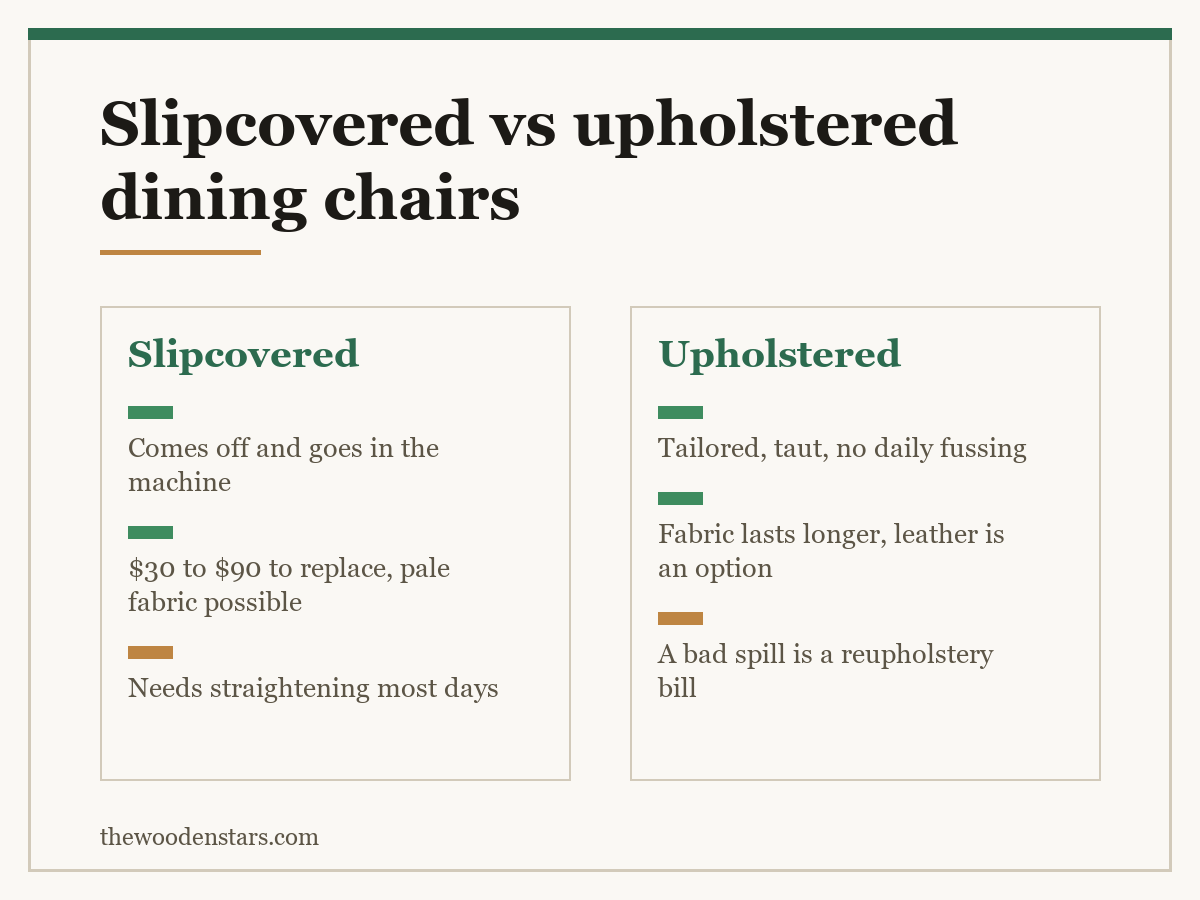
A slipcovered chair wears a removable fabric cover that unzips and goes in a washing machine, and a replacement cover costs $30 to $90 against $150 to $400 to have a chair reupholstered. An upholstered chair has the fabric stapled to the frame, so it looks sharper — no seams sagging at the corners — and it lasts longer per cover because nothing is being pulled on and off. Slipcovers suit households with children, pets or pale fabric. Upholstery suits formal rooms and dark performance fabric. The hidden cost of a slipcover is that it needs straightening most days.
Slipcovered vs upholstered dining chairs: what actually differs
- Cleaning: machine wash against spot-clean only.
- Cost to refresh: $30 to $90 a cover against $150 to $400 to reupholster.
- Look: slightly loose and soft against tailored and taut.
- Daily upkeep: straightening the cover against nothing.
- Fabric choice: slipcovers are mostly cotton, linen and blends; upholstery includes performance weaves, velvet and leather.
Both sit on the same kind of frame, so the structural questions — stretchers, corner blocks, the leg-to-seat joint — are identical, and they are covered in how much weight a dining chair can hold.
| Measure | Slipcovered | Upholstered |
|---|---|---|
| Cleaning | Machine wash | Spot clean or professional |
| Cost to refresh | $30 to $90 a cover | $150 to $400 to reupholster |
| Change the colour | Buy a second cover | Reupholster |
| Look | Softer, slightly loose | Tailored and taut |
| Daily upkeep | Straighten most days | None |
| Fabric range | Cotton, linen, blends | Performance, velvet, leather |
| Best for | Children, pets, pale fabric | Formal rooms, dark fabric |
The case for slipcovers
Spills stop being a crisis. That is the honest headline. Red wine on a stapled linen seat is a phone call to an upholsterer; on a slipcover it is a wash cycle. In a household with young children this one point outweighs everything else on the list.
You can own two sets. A heavier weave for winter, a lighter one for summer, or simply a spare so the chairs are usable while one set is drying. Nobody owns two sets of upholstery.
Pale fabric becomes possible. Cream chairs in a dining room are only a good idea if the cream comes off.
Damage is reversible. Claw marks through a slipcover cost $60. Through upholstery they cost a reupholstery job, or you live with them.
The trade is honest and worth stating: a slipcover never looks as sharp as stapled fabric. It sags at the corners, it rides up when someone shifts, and it wants straightening most days. If that will irritate you daily, it will irritate you daily.
The case for upholstery
It looks better, and not by a small margin. Fabric pulled tight over a frame reads as furniture; a slipcover reads as a cover on furniture. In a formal dining room that matters.
Performance fabric closes most of the gap. A solution-dyed acrylic or a treated polyester sheds liquid long enough to blot it, which handles the majority of everyday spills without any washing at all.
The fabric lasts longer. Nothing is being tugged on and off, so the weave is not working against itself. A well-chosen upholstery fabric outlives three or four slipcovers.
Leather is only available this way. No slipcover competes with a leather seat for wiping clean, and leather in a dining room ages well rather than badly.
Both of these land in the same place as the broader material question in upholstered against wood dining chairs: the more a seat has to survive, the more the cleaning route matters and the less the look does.
Choosing between them
- Count the spills you expect a year. More than three or four and slipcovers win on arithmetic alone.
- Check the cover actually fits the chair. Universal slipcovers on shaped chairs bunch badly. A cover made for that model is worth the premium.
- Look for a zip, not ties. Ties come undone, and undone ties look worse than a slightly loose cover.
- Pre-wash before fitting. Cotton covers shrink on the first wash, and a shrunk cover will never go back on.
- If you go upholstered, insist on performance fabric and treat it before first use.
The middle path that works for a lot of households: upholstered chairs in performance fabric at the ends, slipcovered in the middle where the children sit. Or, simpler still, timber chairs with removable seat pads — the seat-pad option is discussed in how deep a dining chair seat is.
Whatever the seat, the sizing does not change: how tall a dining chair should be, how wide a dining chair is, and the spacing in how much space between dining chairs.
If you do go slipcovered, the fabric weight matters more than the fibre. A lightweight cotton cover creases the moment anyone sits on it and needs straightening after every meal; a heavier weave in the 8 to 12 oz range holds its shape between washes and hangs cleanly at the corners. Weight is rarely published, so judge it by how the cover falls in the listing photographs — if it is pooling on the floor or rippling across the seat, it is too light for a dining chair.
Either way
- Dining chair slipcovers Buy for the model, not universal, and look for a zip
- Fabric protector spray Essential on upholstery, useful on a slipcover too
- Upholstery cleaner For the spills you cannot put in a machine
- Felt furniture pads Fabric chairs still get dragged three times a day
What to buy


For the wider seat question, see upholstered against wood dining chairs and dining chair against accent chair.
Questions we get asked
Are slipcovered dining chairs worth it?
If you expect more than three or four spills a year, yes. A wash cycle against a $150 to $400 reupholstery bill settles it.
Do slipcovers look cheap?
A model-specific cover with a zip looks fine. A universal cover on a shaped chair bunches and does look cheap.
Can upholstered dining chairs be cleaned?
Spot cleaned, yes, and performance fabric handles most everyday spills. Anything soaked in needs a professional.
How much does reupholstering a dining chair cost?
Roughly $150 to $400 a chair, against $30 to $90 for a replacement slipcover.
Should I wash a slipcover before fitting it?
Yes. Cotton shrinks on the first wash, and a shrunk cover will not go back on.
Can I mix the two at one table?
Yes, and it is a sensible compromise — upholstered at the ends, slipcovered where children sit.