How tall should a bookcase be? 30, 60 or 84 in
The Wooden Stars is a participant in the Amazon Services LLC Associates Program. We may earn a commission when you buy through links on our site, at no extra cost to you.
How tall should a bookcase be? 30, 60 or 84 inches — the three standard heights, and they correspond to three completely different jobs.
The choice is not about how many books you own. It is about whether you want the top.
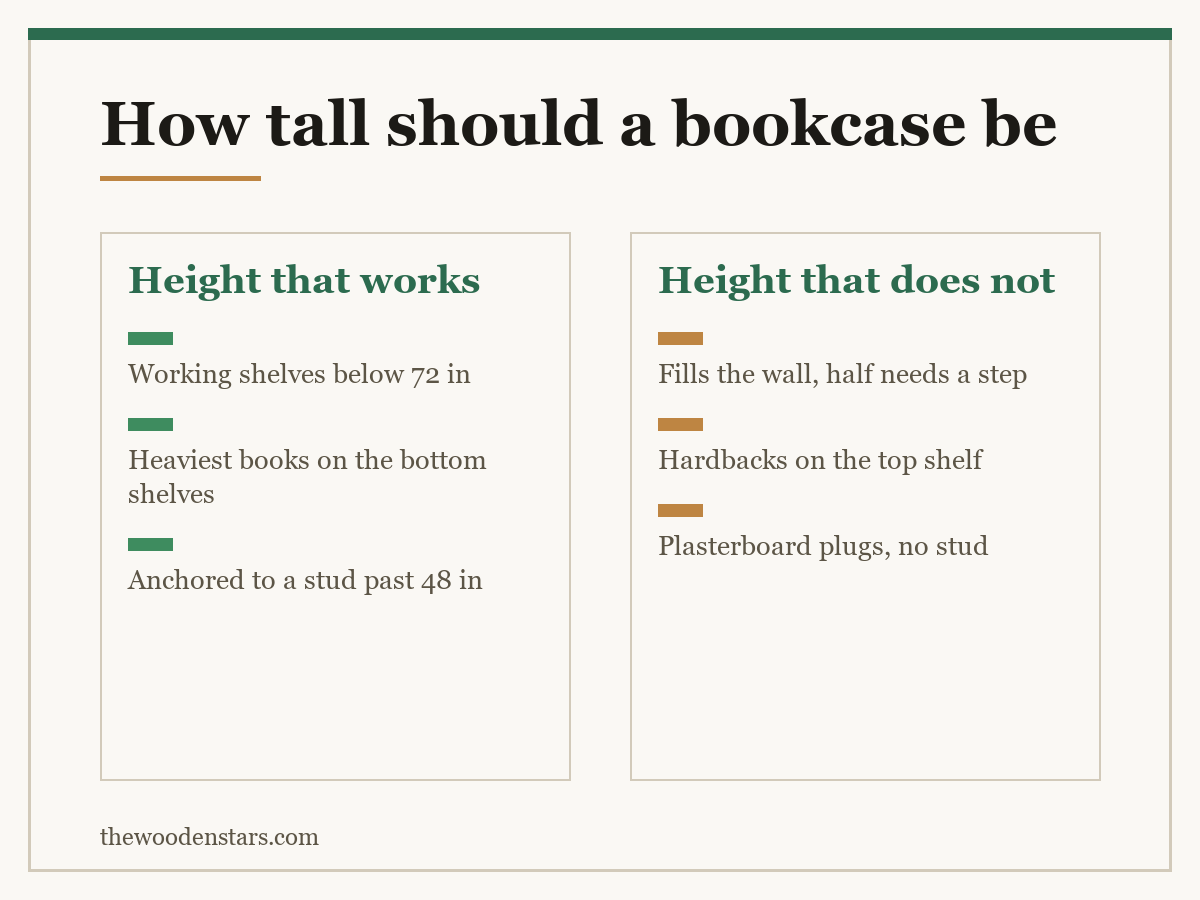
The three standards: 30 to 36 inches (two or three shelves) works as a low unit with a usable top, fits under a window, and doubles as a console. 60 to 72 inches (five shelves) is the normal room-height bookcase — the top shelf sits at eye level and everything is reachable. 84 to 96 inches (seven shelves) uses the wall properly but the top two shelves need a step. The functional ceiling for a shelf you use daily is 72 inches; above that is storage. Anything over 48 inches must be anchored to a stud.
How tall should a bookcase be for each job
- 30 to 36 inches, 2 to 3 shelves. Fits under a window, works as a room divider, and the top takes a lamp or a plant. Effectively a console with shelves.
- 48 to 54 inches, 4 shelves. Waist-to-chest height. Top still usable as a surface if you are tall.
- 60 to 72 inches, 5 shelves. The default. Top shelf at or just above eye level, nothing needs a step.
- 84 to 96 inches, 6 to 7 shelves. Wall-height. Maximum storage per square foot of floor, top shelves need a step.
Shelf spacing decides how many you get: 10 to 12 inches for paperbacks, 12 to 14 for hardbacks, 15 to 18 for art books and folios. That, and depth, are worked through in bookcase dimensions and how deep a bookshelf should be.
| Height | Shelves | Top usable | Needs a step |
|---|---|---|---|
| 30 to 36 in | 2 to 3 | Yes, as a surface | No |
| 48 to 54 in | 4 | If you are tall | No |
| 60 to 72 in | 5 | No | No |
| 84 in | 6 | No | Top shelf |
| 96 in | 7 | No | Top two |
The reach limit
Comfortable overhead reach is roughly your height plus 12 inches, and comfortable reading of spines tops out near eye level plus 6.
For a 5 ft 6 in adult, eye level is about 62 inches, so the highest shelf you will actually browse is 68 inches. For a 6-footer it is about 73.
That is why 72 inches keeps appearing. It is the tallest a bookcase can be while every shelf remains part of the room rather than part of the loft.
Go taller anyway when: the room has high ceilings and a short bookcase would look stranded; you genuinely have overflow to store; or the unit is built in, where stopping at 72 leaves an awkward gap above.
The practical compromise is a tall carcass with deep top shelves for archive storage and the working shelves below 72. Put reference books and things you touch weekly between waist and eye height.
Anchoring, which is not optional
A loaded bookcase is heavy, narrow and top-biased if the books are not distributed well. It is the second most common furniture tipping hazard after chests of drawers.
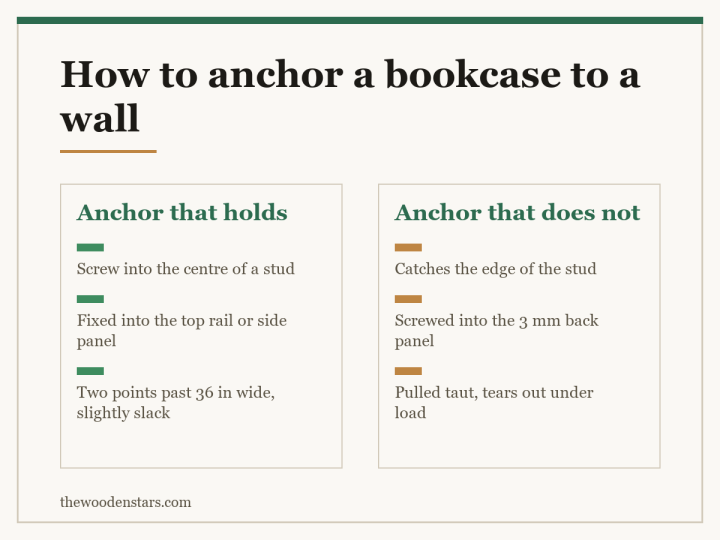
Anything over 48 inches goes to a stud. Two brackets into timber studs, not plasterboard plugs — plasterboard alone will not hold a loaded case that is being pulled on.
Load the bottom shelves first. Heavy books low lowers the centre of gravity. A case with hardbacks on top and nothing below is the worst arrangement possible.
Check the back panel. The same 3 mm hardboard problem as every other carcass: it is what keeps the unit square, and once it racks the shelves stop sitting level — the fix pattern is in how to fix a sagging bookshelf.
The full method is in how to anchor a bookcase to a wall, and the kit is the same as anti-tip kits for dressers.
Height, width and sag together
Taller cases are usually narrower, and that is deliberate — a wide shelf sags.
Unsupported shelf span should stay under 32 inches for a 0.75-inch shelf carrying books, or 36 for a 1-inch shelf. Past that, add a centre divider or accept a visible bow within a couple of years.
That is why a 96-inch bookcase is typically 30 to 36 inches wide, while a 30-inch low unit can be 60 wide — the low one carries less per shelf and is usually divided.
Two more practical notes. Adjustable shelves matter more on a tall case, because a fixed 12-inch spacing wastes height across seven shelves — shelf pins and supports sizes. And in a small room a tall narrow case beats a low wide one for storage per square foot, which is the argument in space saving bookshelf.
One thing worth planning before you buy, because it decides the height as much as the room does: how many linear feet of books you actually own. Measure your current shelves end to end rather than counting books. A 72-inch bookcase 32 inches wide gives about 13 linear feet across five shelves, and a typical paperback run is 10 to 12 books per foot. That sum tells you whether you need one case or two far more reliably than looking at the pile does.
The other habit worth forming: leave one shelf deliberately half empty. Book collections grow, and a case filled to capacity on day one means the next twenty books end up stacked horizontally on top of the rows, which is how a tidy bookcase becomes a cluttered one within a year.
Setting it up
- Anti-tip furniture straps Required past 48 inches; use studs, not plugs
- Stud finder A plug in plasterboard will not hold a loaded case
- Shelf support pins For adjusting spacing once you see what you own
- Step stool If shelves go above 72 inches, you will need one anyway
What to buy


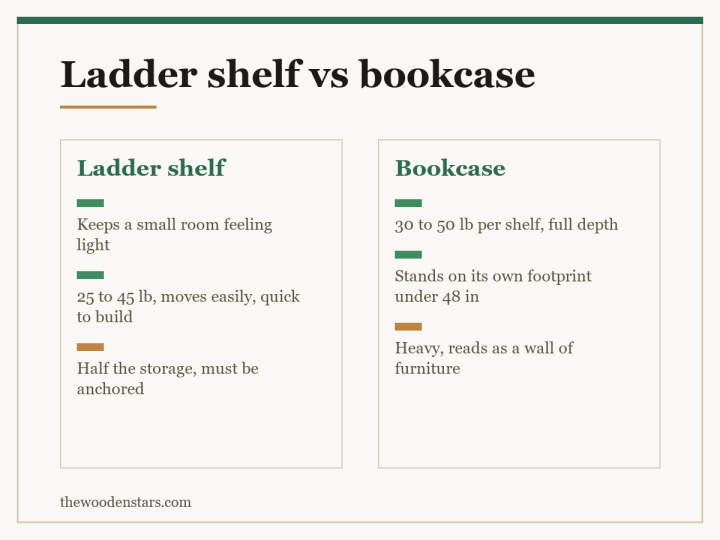
For the other dimensions, see bookcase dimensions and how deep a bookshelf should be. For the format, bookcase against shelving unit, ladder shelf against bookcase and with doors against open.
Questions we get asked
How tall should a bookcase be?
Thirty to 36 inches for a low unit with a usable top, 60 to 72 for the normal room height, 84 to 96 to use the wall.
What is the tallest useful height?
About 72 inches. Above that the top shelves need a step and become storage rather than shelves.
How many shelves in each height?
Two to three at 36 inches, five at 72, six or seven at 96, at 12 to 14 inches of spacing.
When does it need anchoring?
Past 48 inches, into studs rather than plasterboard plugs.
Why are tall bookcases narrow?
Because shelf sag limits the unsupported span to about 32 inches on a 0.75-inch shelf.
Tall or wide in a small room?
Tall. It stores far more per square foot of floor, provided you anchor it.