TV stand vs media console — Depth and cable space
The Wooden Stars is a participant in the Amazon Services LLC Associates Program. We may earn a commission when you buy through links on our site, at no extra cost to you.
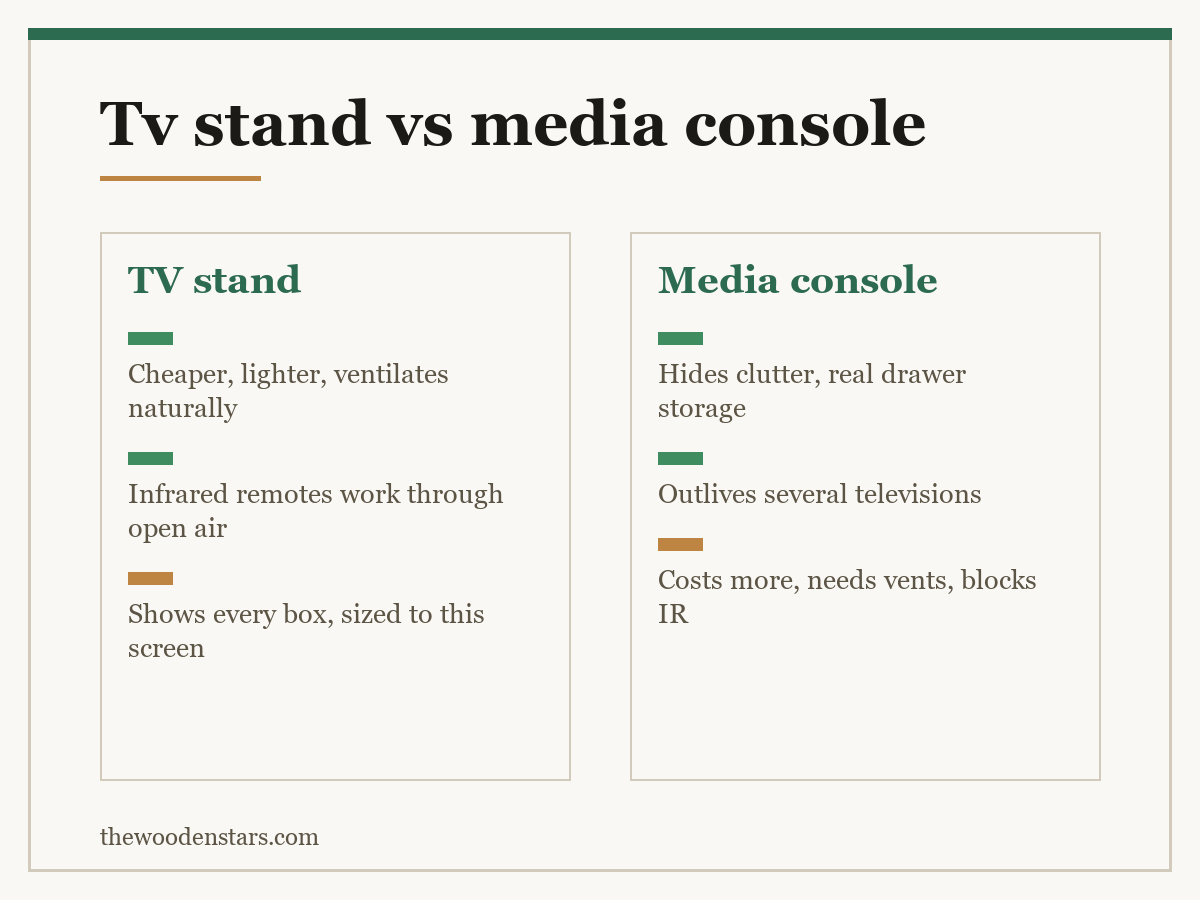
TV stand vs media console is a difference of depth and intent. A TV stand holds a television. A media console is a piece of furniture that happens to have a television on it.
Retailers use the words interchangeably. The dimensions do not.
A TV stand is 14 to 18 inches deep, mostly open shelving, sized to the screen, and often has an unfinished back. A media console is 16 to 22 inches deep, has doors or drawers, is finished all round, and is sized to the wall rather than the TV — it is a sideboard that took a new job. Consoles cost 40 to 100% more, weigh more, and hide equipment behind doors, which means you must check ventilation and whether the remote still works through the door. Stands are cheaper, lighter, better ventilated, and look like electronics furniture.
TV stand vs media console: the measurable differences
- Depth. 14 to 18 inches against 16 to 22. The extra depth is what lets a console take a deep drawer.
- Storage. Open shelves against doors and drawers.
- Finished back. A stand’s back is often chipboard; a console is finished to float.
- Sizing logic. A stand is sized to the screen; a console to the wall, usually about two-thirds of it.
- Height. Both 20 to 26 inches when the TV sits on top; a console can go to 30 to 34 under a wall-mounted screen.
The height question is the same either way and is set by your seated eye level — how tall a TV stand should be. The width is set by the screen’s foot spacing, per how wide a TV stand should be.
| Measure | TV stand | Media console |
|---|---|---|
| Depth | 14 to 18 in | 16 to 22 in |
| Storage | Open shelves | Doors and drawers |
| Finished back | Often not | Yes |
| Sized to | The screen | The wall |
| Ventilation | Good | Needs vents |
| Weight | 30 to 60 lb | 60 to 140 lb |
| Price | Baseline | 40 to 100% more |
Ventilation, which is the console’s real cost
An AV receiver, a games console and a streaming box in a closed cabinet produce heat with nowhere to go. Electronics throttle or shorten their life in a box that sits above about 40°C.
Four things to check before buying a console with doors:
- A cut-out or vented back panel. A solid back with a single small cable hole is not ventilation.
- Gaps above the units. Two inches of clear air above each box, not a shelf sitting on it.
- Glass or mesh doors if remotes matter — infrared does not pass through solid timber, so a closed console usually needs an RF remote or an IR repeater.
- Whether the shelves are adjustable. Fixed shelves force a receiver into whatever gap the maker chose.
A games console in a sealed cupboard is the specific case that goes wrong most often. If that is your setup, either buy an open stand or plan on a small cabinet fan.
What the console buys you back
The clutter disappears. This is the entire appeal and it is a real one. Boxes, cables and discs behind a door change how a living room reads.
Real storage. A 20-inch-deep console with drawers holds board games, cables, controllers and things that have nothing to do with the TV. An open stand holds what fits on a shelf.
It survives the TV. Screens get replaced every five to eight years and get bigger each time. A console sized to the wall accommodates the next one; a stand sized to this screen does not.
It can be something else later. A console is a sideboard. Move it to a dining room or a hallway and it still works — which is exactly what a purpose-built TV stand cannot do. The family resemblance is covered in credenza against sideboard against buffet and how deep a sideboard should be.
Which to buy
Buy the stand if the equipment is minimal, budget matters, the TV sits on it rather than the wall, or there is a games console that runs hot. Open shelving is the correct engineering answer for electronics, and it is cheaper.
Buy the console if the TV is wall-mounted, the room is a living space rather than a media room, you want storage that is not about the television, or you expect to change screens. Check the vents before you commit.
The middle option is a console with open centre bays and doors at the ends — equipment breathes in the middle, clutter hides at the sides. It is the format most people should buy and the one least often chosen.
Either way, confirm the screen’s feet fit — how wide a TV stand should be — that the top carries the load, per how much weight a TV stand can hold, and that “wood” on the listing means wood, per engineered wood against hardwood.
One detail that decides this for a lot of households: whether the cat sits on it. An open stand’s shelves become a perch, and a games console with a warm vent is the preferred spot. A closed console removes the problem entirely, which is a genuinely common reason to accept the ventilation trade rather than a frivolous one.
Either format
- Cabinet cooling fan For a closed console with a games console inside
- IR repeater kit Lets infrared remotes work through solid doors
- Cable management box Hides the power strip a stand leaves visible
- Anti-tip TV straps For any screen standing on its own feet
What to buy


For sizing, see how wide a TV stand should be and how tall a TV stand should be. For small rooms, TV stand for small spaces. For the sideboard relatives, credenza against sideboard against buffet.
Questions we get asked
What is the difference between a TV stand and a media console?
Depth and intent. A stand is 14 to 18 inches with open shelves, sized to the screen. A console is 16 to 22 with doors, sized to the wall.
Which is better for equipment?
The stand. Open shelving ventilates naturally and lets infrared remotes work.
Do closed consoles overheat?
They can. Look for a vented back, 2 inches of air above each box, and consider a cabinet fan for a games console.
Will my remote work through the doors?
Not if they are solid timber. Use glass or mesh doors, an RF remote, or an IR repeater.
Which lasts longer?
The console, because it is sized to the wall rather than to a screen you will replace in five to eight years.
Is there a middle option?
Yes — open centre bays with doors at the ends. Equipment breathes, clutter hides.