How much weight can a coffee table hold? 100 to 300 lb
The Wooden Stars is a participant in the Amazon Services LLC Associates Program. We may earn a commission when you buy through links on our site, at no extra cost to you.
How much weight can a coffee table hold? 100 to 300 lb spread across the top — but the figure that catches people out is the 50 to 80 lb a table takes at one corner before it tips.
Coffee tables rarely fail under load. They fail when somebody sits on the edge.
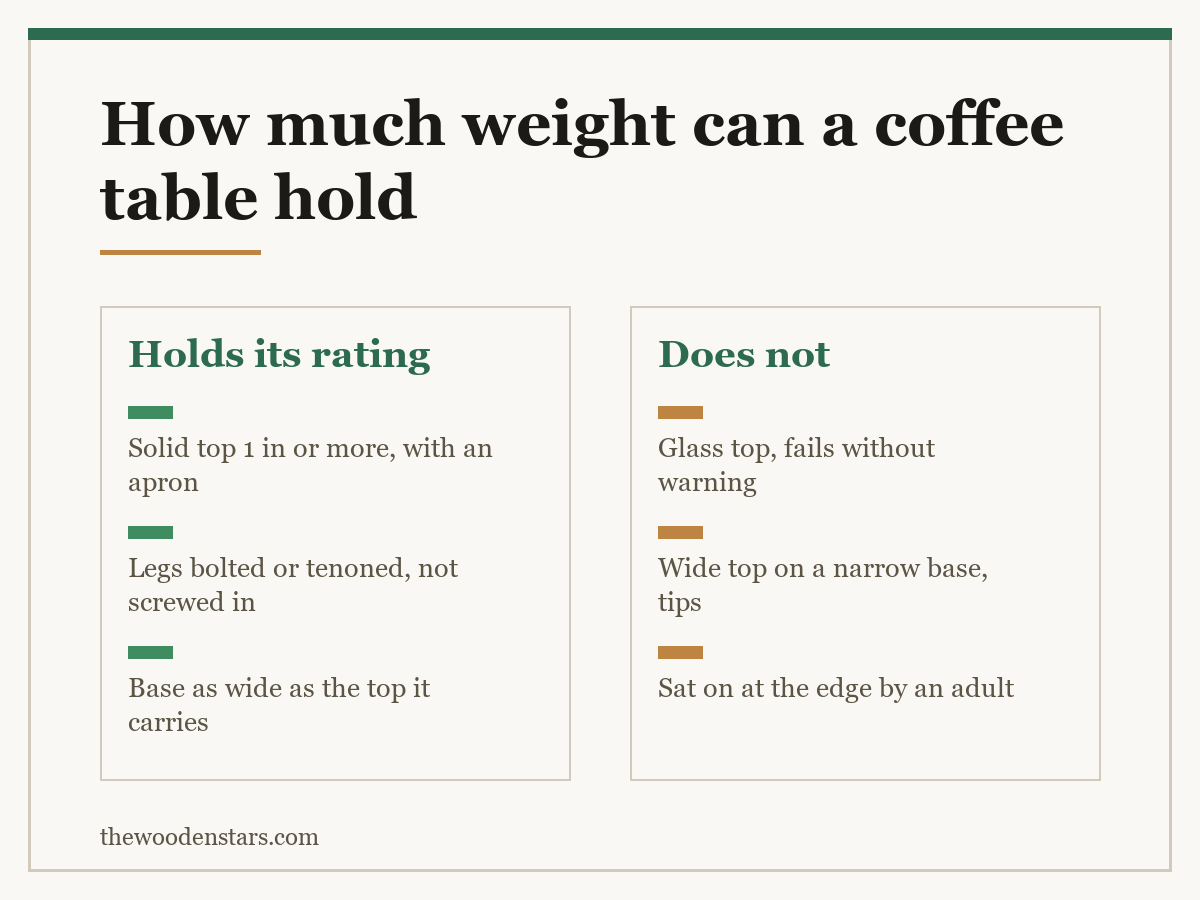
Typical static ratings: 100 to 150 lb on a glass or thin-panel table, 150 to 250 on a standard timber one, 250 to 400 on solid hardwood with an apron, and 300 to 500 on a heavy live-edge or trestle table. Those are evenly spread figures. At a single corner most tables manage 50 to 80 lb before tipping or cracking the top. Nobody should sit on a coffee table unless it is explicitly rated for it — that is what an ottoman is for. Glass tops fail suddenly; timber ones sag first and give warning.
How much weight can a coffee table hold, by construction
- Glass top on a metal frame: 100 to 150 lb spread, and much less at a point.
- Engineered board with veneer: 100 to 200, and the number falls as the span grows.
- Solid timber, no apron: 150 to 250.
- Solid hardwood with an apron or stretchers: 250 to 400.
- Live edge, trestle or plinth base: 300 to 500, and these are the ones that genuinely take a person.
Two things drive the number more than the material: the span between supports, and whether there is an apron under the top. A 48-inch top supported only at its two ends deflects far more than the same top with a rail running under it — the same relationship as in how thick a desktop should be.
| Feature | Weak | Strong |
|---|---|---|
| Top | Glass, or 0.5 in board | Solid timber 1 in or more |
| Apron | None | Rail under all four sides |
| Span between legs | 40 in or more | Under 32 in, or a plinth |
| Leg attachment | Screwed into the underside | Bolted, or tenoned to an apron |
| Base | Four thin legs | Trestle, plinth or sled |
| Corner load | 50 lb | 150 lb or more |
Why the corner figure matters more than the rating
Nobody spreads 200 lb evenly over a coffee table. What actually happens is that somebody perches on the edge to tie a shoe.
An adult sitting on the corner of a 48-inch table applies most of their weight within about 8 inches of one leg. Three things can then happen:
It tips. A table with a narrow base and a wide top has a small footprint relative to its reach, so the load goes outside the base and it rotates.
The top cracks. Glass fails without warning, because glass does not deflect much before it goes. This is the one that causes injuries.
The leg joint opens. Legs screwed straight into the underside of a top are working against a few inches of thread in board. Repeated corner loading strips them — the joint repair route is in how to reglue a loose joint.
So the practical rule: if people will sit on it, buy something rated for sitting. That means an ottoman, a bench, or a plinth-base table with the top supported along its whole length — see ottoman against coffee table.
Where the load actually comes from
Most real coffee table loads are far under any rating, and knowing the numbers stops you worrying about the wrong thing.
- Books, stacked: a large hardback is 3 to 5 lb, so a decorative stack is 15 to 25.
- A laptop and accessories: 5 to 10 lb.
- A full tray of drinks: 10 to 15 lb.
- A board game plus four players leaning on it: this is the real one, and the leaning is the load, not the game.
- A child standing on it: 40 to 80 lb, concentrated, and usually near an edge.
The last two are what break coffee tables, and neither appears in any specification. If either describes your household, buy for the corner figure rather than the spread one, and prefer a solid top with an apron over a glass one.
Reading a listing with no published figure
- Look for an apron. A rail under the top along all four sides roughly doubles what the top will carry before it deflects.
- Measure the span. Legs at the extreme corners of a 48-inch table is a 44-inch unsupported span. Legs inset 6 inches make it worse, not better.
- Check the top thickness. Under 3⁄4 of an inch in engineered board will sag over years under a permanent stack of books.
- Check how the legs attach. Hanger bolts into a solid apron are strong; screws into the underside of a veneered panel are the common weak point.
- Read the material claim honestly — engineered wood against hardwood and what “all wood” actually means.
If the table is already sagging, it is usually the top rather than the base, and adding a central support or a stretcher underneath is a genuine fix. Sizing the piece in the first place is in average coffee table dimensions, and the species question is in best wood for furniture.
Lift-top and nesting tables deserve a separate warning. A lift-top mechanism moves the load away from the supports, so the top is at its weakest precisely when it is raised and someone is leaning on it to eat or work. Treat the rated figure as applying to the closed position only, and assume roughly half of it when the top is up. Nesting tables have the opposite issue: the small ones are light and tip easily at the corner, so they take a mug and nothing heavier.
Keeping it sound
- Wood glue for loose joints Corner loading opens leg joints before anything breaks
- Furniture levellers A rocking table loads three legs instead of four
- Corner guards If small children use the room, this is the real safety fix
- Felt furniture pads Reduces the shock loading every time it gets shoved on a rug
What to buy


For the seating alternative, see ottoman against coffee table. For sizing, average coffee table dimensions.
Questions we get asked
How much weight can a coffee table hold?
One hundred to 300 lb spread evenly. Solid hardwood with an apron reaches 400.
Can you sit on a coffee table?
Not unless it is rated for it. Most manage only 50 to 80 lb at a corner before tipping or cracking.
Why is the corner figure so much lower?
Because the load goes outside the base and the top is unsupported there. Spread ratings assume neither.
Are glass coffee tables weaker?
Not always weaker, but they fail suddenly rather than sagging first, which is why they cause injuries.
What makes the biggest difference?
An apron under the top, and a short span between the supports.
What if no rating is published?
Assume the bottom of the class, then check for an apron, top thickness over three-quarters of an inch, and bolted rather than screwed legs.