How deep should an armchair be? 32 to 40 inches
The Wooden Stars is a participant in the Amazon Services LLC Associates Program. We may earn a commission when you buy through links on our site, at no extra cost to you.
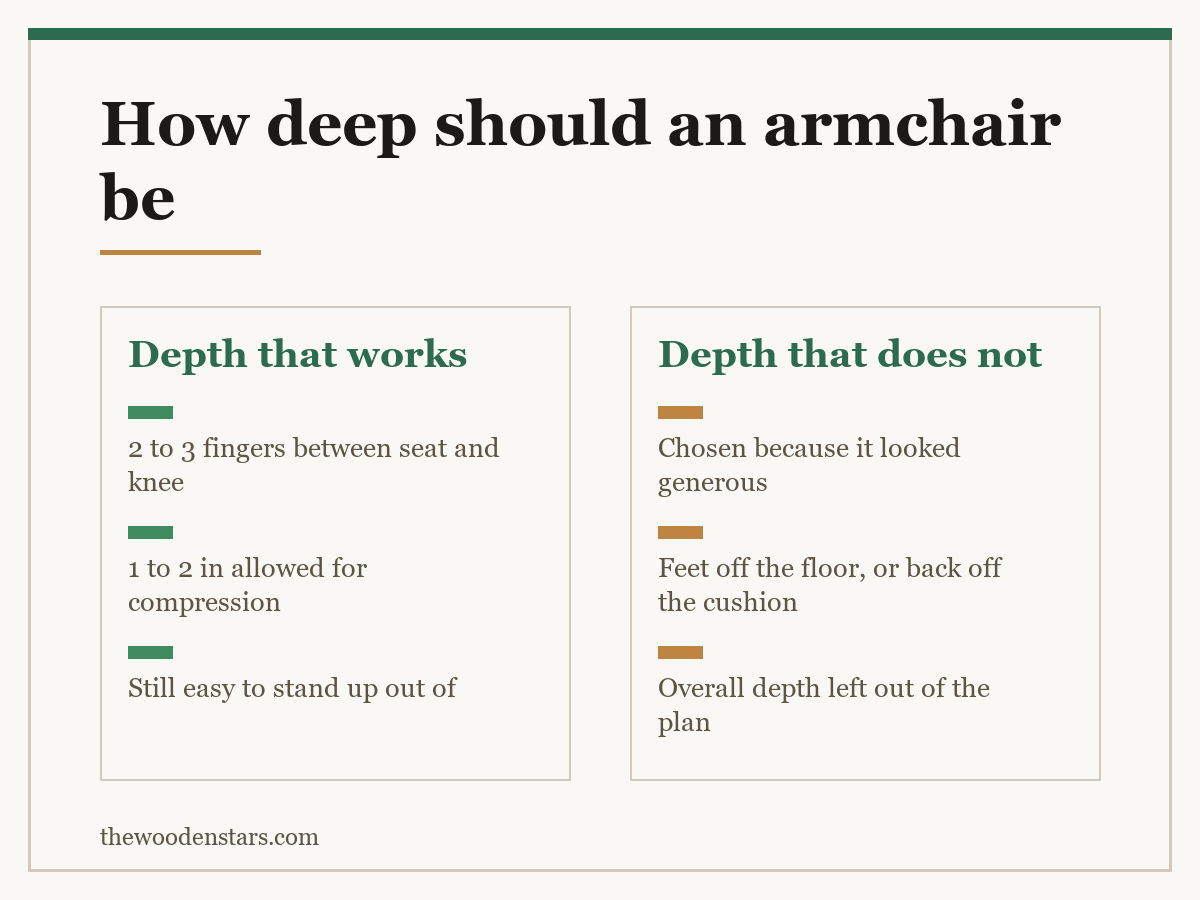
How deep should an armchair be? 32 to 40 inches overall — but the number that decides whether you are comfortable is the 20 to 24-inch seat depth inside it, and how tall you are.
Depth is the dimension most people get wrong, because it is the one that feels generous in a showroom and wrong at home.
Overall depths: 30 to 34 inches on a compact or upright chair, 34 to 38 standard, 38 to 44 on a deep lounge chair. Inside that, the seat depth is 20 to 24 inches. Match it to your height: 20 to 21 inches under 5 ft 4 in, 21 to 22 at average height, 23 to 24 over 6 ft. A seat too deep leaves your feet off the floor or your back off the cushion; too shallow and your thighs are unsupported. Remember that upholstery compresses, so a listed 22-inch seat behaves like 23 or 24 once you are in it.
How deep should an armchair be, by type and by person
- Compact or upright chair: 30 to 34 inches overall, 19 to 21 of seat.
- Standard armchair: 34 to 38 overall, 21 to 22 of seat. Suits most adults.
- Deep lounge or club chair: 38 to 44 overall, 23 to 26 of seat, and designed for lounging rather than sitting.
- Wingback: 32 to 36 overall, 19 to 21 of seat — deliberately upright.
- Recliner, closed: 36 to 40, and 65 to 70 when fully open, which is the figure people forget.
By height: 5 ft 2 in → 20 inches, 5 ft 6 in → 21, 5 ft 10 in → 22, 6 ft 2 in → 23 to 24. The test is that with your back against the cushion, two to three fingers fit between the seat edge and the back of your knee.
| Chair or sitter | Seat depth | Overall | Note |
|---|---|---|---|
| Compact or upright | 19 to 21 in | 30 to 34 in | Easy to get out of |
| Standard armchair | 21 to 22 in | 34 to 38 in | Suits most adults |
| Deep lounge chair | 23 to 26 in | 38 to 44 in | For lounging, not sitting |
| Wingback | 19 to 21 in | 32 to 36 in | Deliberately upright |
| Under 5 ft 4 in | 20 to 21 in | Under 34 in | Or a lumbar cushion |
| Over 6 ft | 23 to 24 in | 38 in or more | Thighs supported |
What goes wrong when the depth is wrong
Too deep is the commoner error. A 26-inch seat under someone 5 ft 4 in gives two bad options: sit back and your feet leave the floor, or slide forward and lose the backrest. Both end in a hunched lower back after half an hour.
It is also the error showrooms encourage, because a deep chair looks generous and feels luxurious for the ninety seconds you try it.
Too shallow leaves your thighs unsupported past the halfway point, so your weight concentrates on a smaller area. Less harmful than too deep, but you will fidget.
And depth affects getting out. A deep, soft, low chair is genuinely hard to leave — you have to shuffle forward first, then push. For anyone with a stiff knee or hip, a 21-inch seat with firm padding beats a 25-inch one every time, regardless of how it feels for the first minute.
The identical trade at a dining table is in how deep a dining chair seat is, where the numbers are smaller but the reasoning is the same.
Compression, and how to measure past it
A listed seat depth is measured on an unloaded cushion. Sit down and a soft seat gains 1 to 2 inches of effective depth as the back cushion squashes and you sink into the seat.
So a chair listed at 22 inches often behaves like 23 or 24. For a shorter sitter that is the difference between comfortable and not.
Three ways to handle it:
- Buy an inch shallower than the chart says if the chair is soft and feather-filled.
- Prefer firm foam if depth is marginal, because it compresses less and the published number stays truer.
- Plan on a lumbar cushion. A 4-inch bolster turns a 24-inch seat into a 20-inch one, which is the cheapest correction available and works permanently.
The same compression trap governs the footstool that goes with the chair — how tall an ottoman should be.
What the overall depth costs the room
Seat depth is about your body. Overall depth is about the floor.
Allow the overall depth plus 30 inches of walkway in front, or 36 if it is the main route through the room. A 40-inch lounge chair therefore claims nearly 6 feet of floor from the wall.
Add 3 to 5 inches behind if the chair has a raked back and you want it off the skirting board.
Recliners need their open depth planned, not their closed one. Sixty-five to 70 inches from the wall for a standard recliner, unless it is a wall-hugger design, which needs 4 to 6.
And check the diagonal for delivery. A 38-inch-wide chair at 38 inches deep has a diagonal near 54 inches, and hallway turns defeat more armchairs than doorways do — the width side of this is in how wide an armchair is.
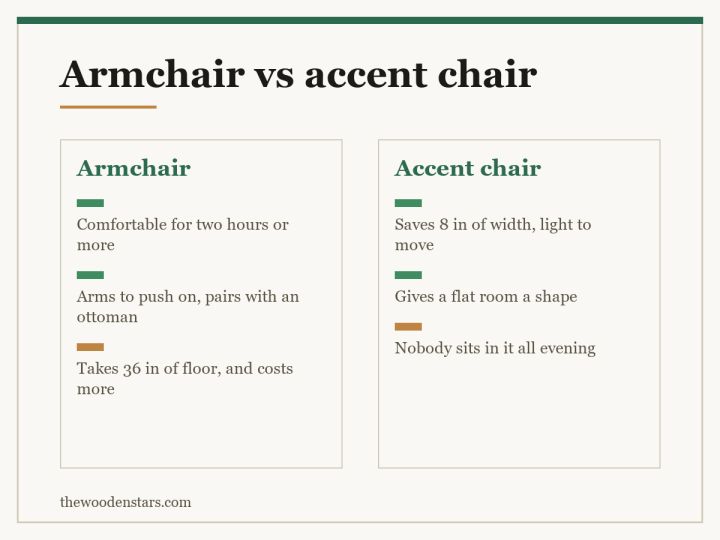
If the numbers do not fit, the smaller alternative is set out in armchair against accent chair.
Getting the depth right
- Tape measure Seat depth to the back cushion face, then overall to the outside
- Lumbar cushion A 4 inch bolster converts a 24 in seat into a 20 in one
- Painter’s tape Tape the overall footprint plus 30 inches of walkway
- Furniture sliders Deep chairs are heavy and hallway corners are unforgiving
What to buy


For width, see how wide an armchair is. For the footstool, how tall an ottoman should be.
Questions we get asked
How deep should an armchair be?
Thirty-two to 40 inches overall, with a seat depth of 20 to 24 matched to your height.
How do I know if a seat is the right depth?
Sit back against the cushion. Two to three fingers should fit between the seat edge and the back of your knee.
Is too deep or too shallow worse?
Too deep. Your feet leave the floor or you slide forward and lose the backrest.
Does the cushion compress?
Yes, by 1 to 2 inches. A listed 22-inch seat often behaves like 23 or 24.
What depth suits a shorter person?
Twenty to 21 inches of seat, or a 4-inch lumbar bolster on a deeper chair.
How much floor space does a deep chair need?
Its overall depth plus 30 inches of walkway. A recliner needs 65 to 70 inches from the wall when open.