Bookcase vs shelving unit — Back panel and depth
The Wooden Stars is a participant in the Amazon Services LLC Associates Program. We may earn a commission when you buy through links on our site, at no extra cost to you.
Bookcase vs shelving unit comes down to the back panel. That thin sheet is what makes a bookcase stay square under load, and its absence is what makes a shelving unit lighter, cheaper and see-through.
One is furniture for a wall. The other is a structure for a room.
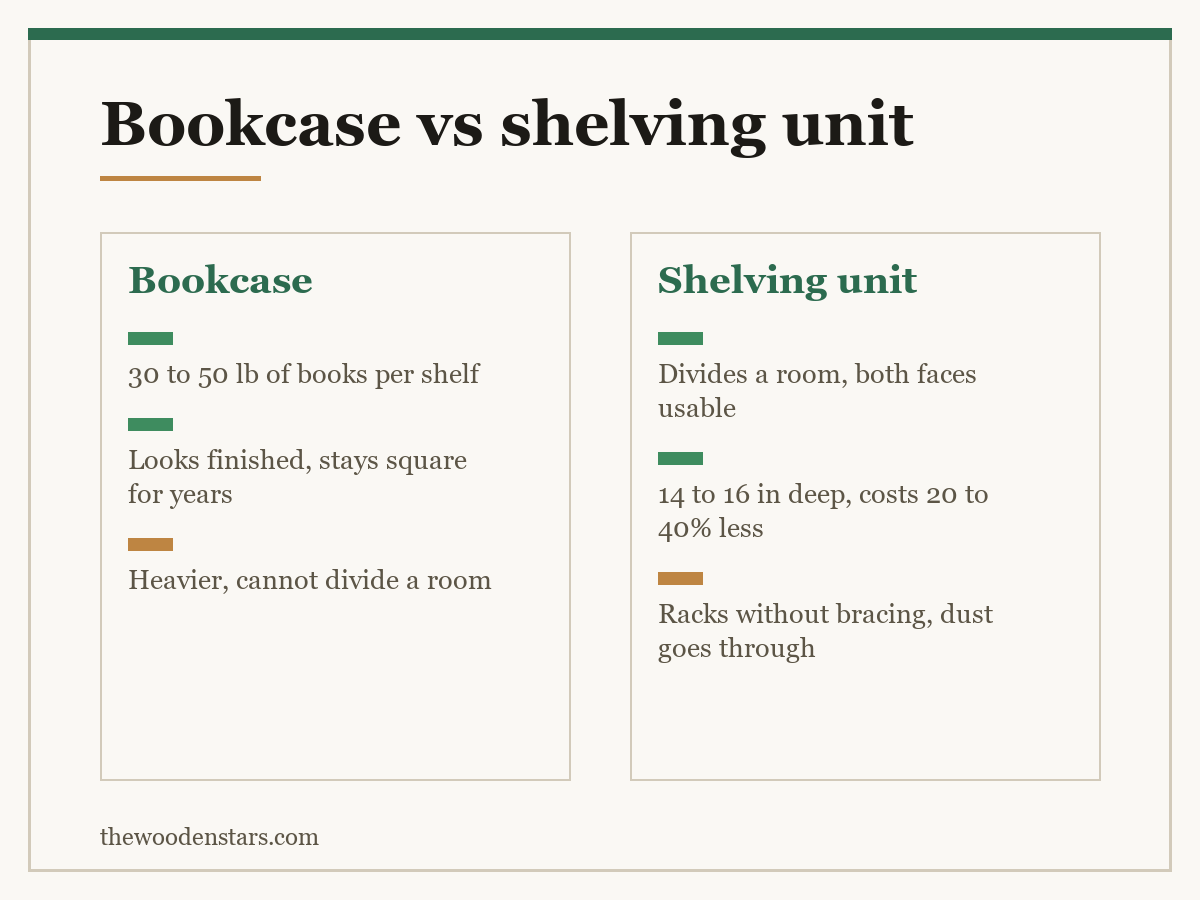
A bookcase is a closed carcass — two sides, a top, a base and a back panel — with shelves housed into the sides. The back stops it racking, so it carries books at 30 to 50 lb per shelf and looks finished against a wall. A shelving unit is an open frame with no back: lighter, cheaper, usually deeper at 14 to 16 inches, and it works as a room divider because you can see through it. Without a back it relies on cross-bracing or the wall for rigidity, and most need anchoring even when short. Books and a finished room say bookcase; plants, baskets and a divider say shelving unit.
Bookcase vs shelving unit: what the back panel does
A rectangle of four sticks hinged at the corners folds flat with almost no force. That is a bookcase without a back — and it is why the thin sheet matters far more than its thickness suggests.
The back panel resists racking: the parallelogram deformation that happens when a tall unit is pushed sideways, leaned on, or loaded unevenly. Once a carcass racks, shelves stop sitting level, doors stop closing, and the unit never fully recovers.
- Bookcase: back panel of 3 to 6 mm, plus shelves housed into the sides. Rigid on its own.
- Shelving unit: no back. Rigidity comes from a diagonal brace, bolted joints, or being fixed to the wall.
A shelving unit with none of those three is the one that wobbles in the shop and wobbles worse at home.

| Measure | Bookcase | Shelving unit |
|---|---|---|
| Back panel | Yes | No |
| Depth | 10 to 13 in | 14 to 16 in |
| Load per shelf | 30 to 50 lb | 20 to 40 lb |
| Works as a divider | No | Yes |
| See-through | No | Yes |
| Weight | Heavier | Lighter |
| Needs anchoring | Past 48 in | Usually, at any height |
| Price | Baseline | 20 to 40% less |
Where the shelving unit wins
As a room divider. The only format that does this. Open on both sides, it separates without closing off light, and both faces are usable. A bookcase’s unfinished back kills that immediately.
Depth for objects rather than books. Fourteen to 16 inches takes baskets, boxes, records and plants. A bookcase at 10 to 12 is sized for spines and nothing deeper — how deep a bookshelf should be.
Weight and moving. Lighter to carry, and most bolt together so they go up stairs in pieces.
Airflow. Relevant for plants, and for anything that should not sit against a cold external wall.
Price. Twenty to 40% less for the same footprint, because there is less material and simpler joinery.
Where the bookcase wins
Books. The load per shelf is higher because the carcass is stiffer and the shelves are housed rather than resting on pins or brackets. A run of hardbacks is 30 to 40 lb per foot, and that is what a bookcase is engineered for.
It looks finished. Against a wall, a closed back reads as furniture. An open unit against a wall shows the wall through it, which looks unresolved unless the wall is doing something interesting.
Dust and small objects. Without a back, small things fall out behind, and dust travels straight through.
It stays square. This is the durability argument, and over ten years it is the one that matters — the same failure mode described in how to fix a sagging bookshelf and how much weight a dresser can hold.
The hybrids worth knowing
A cube unit is a shelving unit with internal dividers, and those dividers do the back panel’s job — every vertical is a brace. That is why cube storage is stiffer than it looks and why it takes boxes well.
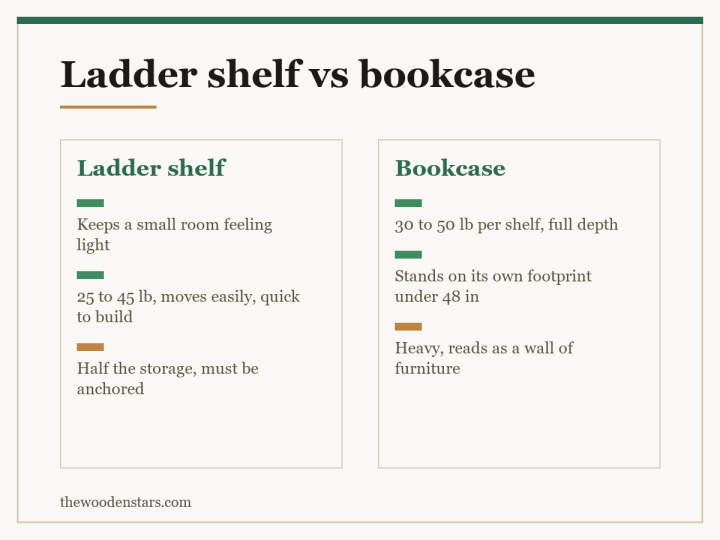
A ladder shelf leans on the wall and uses gravity for its rigidity. Shallow at the top, deep at the bottom, and never a books-and-hardbacks piece — ladder shelf against bookcase.
An open-back bookcase — a carcass with the back left off deliberately — gives you the housed shelves and the see-through. It needs a diagonal brace or wall fixing, and makers who offer it usually supply one.
Floating shelves take the wall as the structure entirely, which shifts every question to the fixings — floating shelf brackets and bookshelf brackets.
Whichever you choose
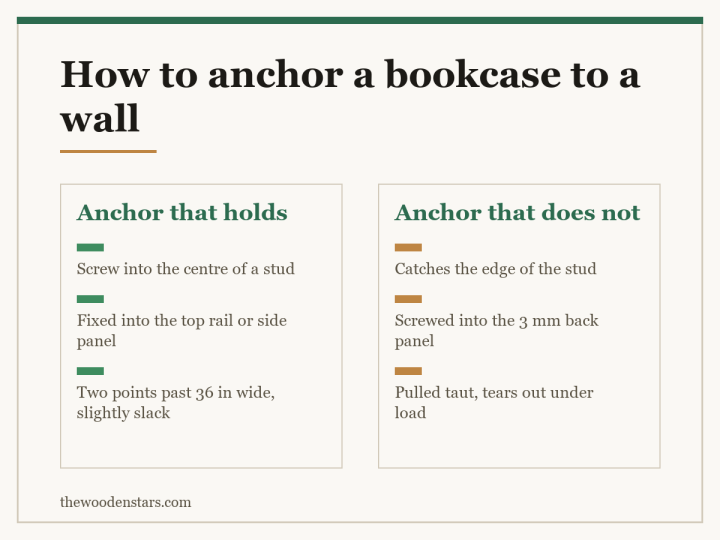
Anchor it. A shelving unit without a back should be fixed to the wall at almost any height, because bracing is what it lacks. A bookcase needs it past 48 inches — how to anchor a bookcase to a wall.
Watch the span. Under 32 inches unsupported for a 0.75-inch shelf with books on it, whichever format.
Check the material. A shelving unit’s thin shelf in engineered board sags faster than a bookcase’s housed one — engineered wood against hardwood.
Get the height right first. That decision comes before the format — how tall a bookcase should be and bookcase dimensions.
For either format
- Anti-tip furniture straps A unit without a back needs this more, not less
- Stud finder The fixing only works if it lands in timber
- Shelf support pins For adjusting spacing to what you actually own
- Storage baskets What makes a 14 to 16 inch open shelf usable
What to buy


For sizing, see how tall a bookcase should be, how deep a bookshelf should be and bookcase dimensions. For other formats, ladder shelf against bookcase and bookcase against bookshelf.
Questions we get asked
What is the difference between a bookcase and a shelving unit?
The back panel. A bookcase has one and stays square; a shelving unit does not and relies on bracing or the wall.
Which holds more weight?
The bookcase, at 30 to 50 lb per shelf against 20 to 40, because the carcass is stiffer and the shelves are housed.
Can a bookcase divide a room?
Not well. Its back is usually unfinished, and it blocks light. That is the shelving unit’s job.
Why does my shelving unit wobble?
No back and no diagonal brace. Fix it to the wall, or add a brace across the back.
Is cube storage a shelving unit?
Technically yes, but the internal dividers act as braces, which is why it is stiffer than an open frame.
Which is cheaper?
The shelving unit, by 20 to 40% for the same footprint.