Dining chair vs accent chair — Height and depth
The Wooden Stars is a participant in the Amazon Services LLC Associates Program. We may earn a commission when you buy through links on our site, at no extra cost to you.
Dining chair vs accent chair is a difference of six inches of height and four inches of depth — and those two numbers are why an accent chair pulled up to a table never quite works.
They look interchangeable in photographs. They are built to completely different rules.
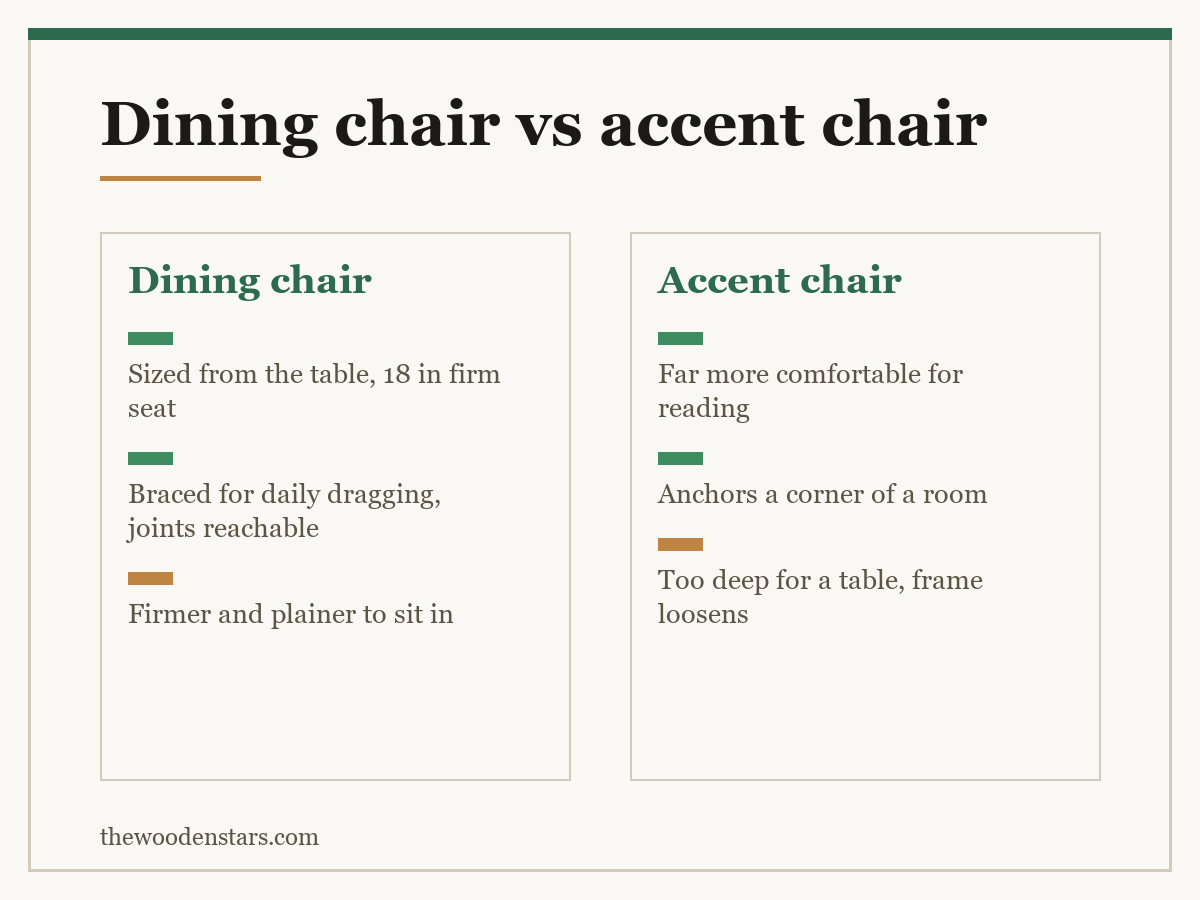
A dining chair has an 18-inch seat, a 16 to 18-inch depth, an upright back and a frame built to be dragged three times a day. An accent chair has a 16 to 19-inch seat that is usually softer, a 20 to 24-inch depth, a reclined back, and it is built to be sat in and left alone. Put an accent chair at a 30-inch table and you sit too low and too far back — the deep seat and raked back put your chest 4 to 6 inches below where the table expects it. Accent chairs also loosen faster under daily dining use, because the frames are not braced for it.
Dining chair vs accent chair: the measurable differences
- Seat height: 18 inches against 16 to 19 — but the accent chair’s is soft and compresses another inch or two under load.
- Seat depth: 16 to 18 against 20 to 24.
- Back angle: near-upright against 10 to 20° of rake.
- Frame: stretchers and corner blocks against a lighter upholstered carcass.
- Arms: 24 to 27 inches high on a dining armchair, 22 to 25 and much thicker on an accent chair.
The dining chair’s numbers all come from the table. The accent chair’s come from a person relaxing with a book, which is a different posture entirely.
| Measure | Dining chair | Accent chair |
|---|---|---|
| Seat height | 18 in, firm | 16 to 19 in, compresses |
| Seat depth | 16 to 18 in | 20 to 24 in |
| Back angle | Upright | 10 to 20 degrees raked |
| Overall depth | 20 to 24 in | 30 to 36 in |
| Frame bracing | Stretchers, corner blocks | Lighter upholstered carcass |
| Suits daily dragging | Yes | No |
| Table edge needed | 24 to 28 in | 30 in or more |
Why an accent chair fails at a table
Three things stack up, and each is small on its own.
The seat compresses. A soft 18-inch seat becomes 16 under an adult, so your clearance to the apron grows from 8 inches to 10 and your chest drops below the tabletop.
The depth pushes you back. A 22-inch seat seats you 5 or 6 inches further from the table edge than a 17-inch one, so you lean forward for every mouthful — the distances are set out in how far a dining chair should be from the table.
The raked back stops you sitting forward. You can lean out of the back, but then nothing supports you, which is exactly the posture that makes a long meal tiring.
Together they put your eating height 4 to 6 inches below where the table expects it. People compensate with a cushion, which fixes the height and makes the depth worse.
The frame problem, which shows up later
A dining chair is dragged in and out three times a day, every day. That is thousands of racking cycles a year, and dining chair frames are braced for it: stretchers between the legs, corner blocks under the seat, tenoned joints — the construction detail covered in how much weight a dining chair can hold.
An accent chair is built for a different duty cycle: sat in, occasionally moved, mostly left in a corner. The frame is lighter, often stapled rather than tenoned, and hidden under upholstery where you cannot inspect it.
Put one at a dining table and it loosens in a year or two, and because the joints are inside the upholstery you cannot easily reglue them — how to reglue a loose joint assumes you can reach the joint.
When mixing them does work
Plenty of well-set-up dining rooms use an upholstered chair at the table. The trick is buying a dining chair that looks like an accent chair, not an accent chair.
What to check on any upholstered chair headed for a table:
- Seat height 18 inches when compressed, not unloaded. Press it in the shop.
- Seat depth 18 inches or less. Past 20 it stops working at a table.
- A near-upright back. Some rake is fine; 15° is not.
- A braced frame. Ask whether there are stretchers or corner blocks — “dining” in the product name usually means yes, “accent” usually means no.
- Performance fabric, because it is now at a table where food is — upholstered against wood dining chairs and slipcovered against upholstered.
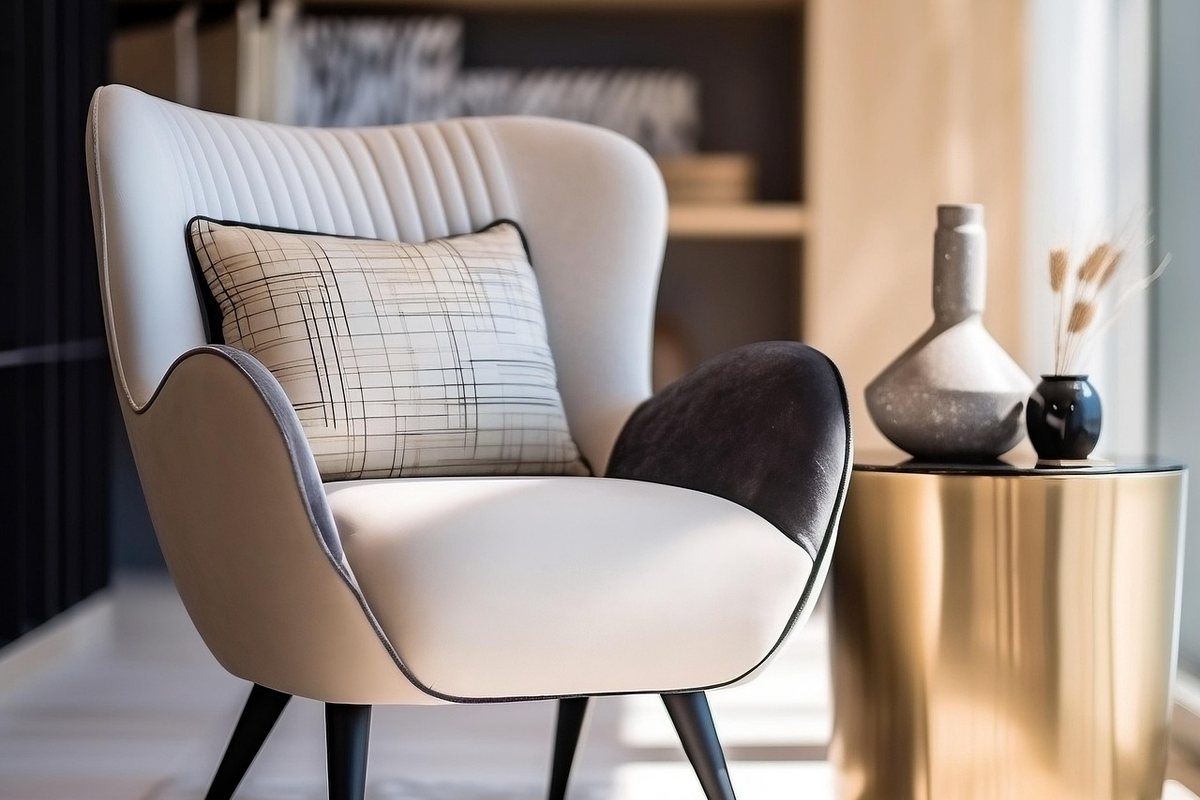
And the honest reverse case: an accent chair is much better than a dining chair for the thing it is for. If what you want is somewhere to read, buy the accent chair and keep it out of the dining room — the sizing is in how wide an armchair is and armchair against accent chair.
If you mix them
- Tape measure Seat height compressed, not unloaded, and depth under 18 inches
- Fabric protector spray Any upholstered chair at a table needs it
- Felt furniture pads An accent chair at a table gets dragged like a dining chair
- Seat pads for dining chairs The cheaper way to soften a firm dining chair
What to buy


For dining sizing, see how tall a dining chair should be and how deep a dining chair seat is. For living-room seating, how deep an armchair should be.
Questions we get asked
What is the difference between a dining chair and an accent chair?
Depth and bracing. A dining chair is 16 to 18 inches deep with an upright back and a braced frame; an accent chair is 20 to 24 inches deep, raked and softer.
Can I use an accent chair at a dining table?
Not well. The soft seat compresses and the deep seat pushes you back, so you sit 4 to 6 inches below where the table expects you.
Will a cushion fix it?
It fixes the height and makes the depth worse. You end up further from the table still.
Why do accent chairs loosen at a table?
They are built to be sat in, not dragged three times a day, and the frames lack stretchers and corner blocks.
Can I use an upholstered chair at the table at all?
Yes — buy a dining chair that looks upholstered rather than an accent chair. Seat 18 inches compressed, depth under 18, near-upright back.
Which is more comfortable?
The accent chair, clearly — for reading. For eating at a table, the dining chair is more comfortable.