Armchair vs accent chair — Comfort or punctuation
The Wooden Stars is a participant in the Amazon Services LLC Associates Program. We may earn a commission when you buy through links on our site, at no extra cost to you.
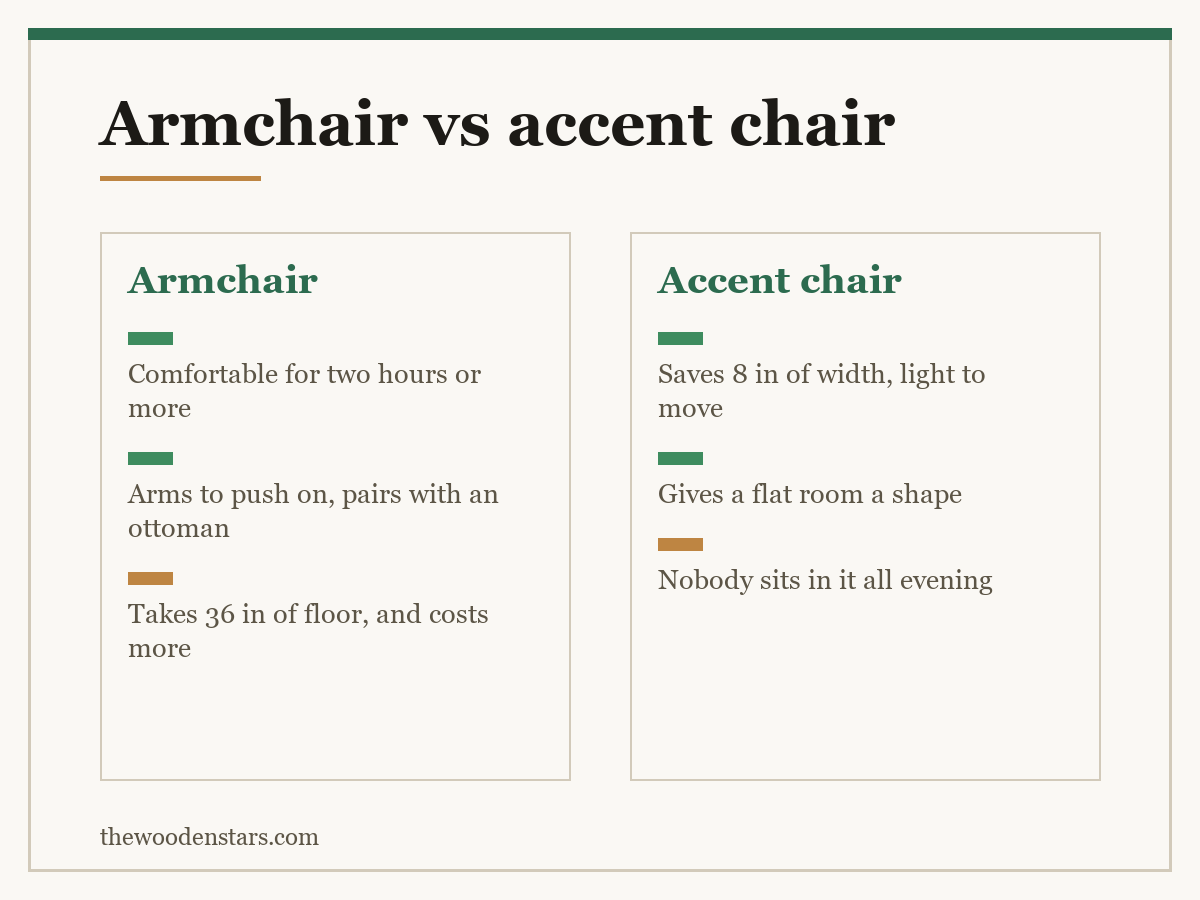
Armchair vs accent chair is the difference between a chair bought to be sat in for two hours and one bought to finish a room — and the giveaway is whether it has arms you can rest on.
The terms overlap in shop listings. They do not overlap in use.
An armchair is 32 to 38 inches wide, 32 to 40 deep, has padded arms and a reclined back, and is built for long sitting. An accent chair is 26 to 32 inches wide, 28 to 34 deep, often has slim arms or none, and is bought for how it looks — shape, colour, a contrast to the sofa. Every armchair can be an accent chair; not every accent chair is comfortable for an evening. Choose the armchair where someone will actually sit; the accent chair for a corner, a bedroom, or beside a console where seating is occasional.
Armchair vs accent chair: what separates them
- Width: 32 to 38 inches against 26 to 32.
- Depth: 32 to 40 against 28 to 34.
- Arms: padded and load-bearing against slim, low or absent.
- Seat: a thick loose cushion against a thinner fixed one.
- Price: an armchair costs more for the same fabric, because there is more frame and more filling in it.
The category names are marketing, so ignore them and read the measurements. A chair described as an accent chair at 36 inches wide with 8-inch arms is an armchair; one called an armchair at 28 inches with pencil arms is not.

| Measure | Armchair | Accent chair |
|---|---|---|
| Width | 32 to 38 in | 26 to 32 in |
| Depth | 32 to 40 in | 28 to 34 in |
| Inside arms | 20 to 22 in | 18 to 21 in |
| Arms | Padded, load bearing | Slim, low or none |
| Seat cushion | Thick and loose | Thinner, often fixed |
| Comfortable for | Two hours or more | Twenty to forty minutes |
| Bought for | Sitting | Looking |
When the armchair is the right buy
Somebody sits there every evening. That is the whole test. A reading chair, a television chair, the chair a grandparent uses when they visit — these need arms at the right height, a deep seat and a back you can lean into for two hours.
You want a footstool with it. Ottomans pair with armchairs because armchairs have the back angle that makes feet-up sitting work — how tall an ottoman should be.
Getting out of it matters. Padded, load-bearing arms are what people push on to stand up. A chair with pencil arms or no arms is meaningfully harder to leave, and for anyone with a stiff knee that is not a small point.
It is replacing a second sofa. Two armchairs facing a sofa is a room that seats four properly. Two accent chairs is a room that seats two properly and two briefly.
When the accent chair is the right buy
The floor space is not there. Eight inches of width and six of depth is a real saving, and in a room under about 12 × 14 feet it can be the difference between a walkway and a squeeze.
The seating is occasional. A bedroom corner, a hallway, beside a console table, the chair in a home office someone sits in twice a week. Comfort for two hours is not being asked for.
You want the room to have a shape in it. This is a real function, not a frivolous one. A room of matched neutral upholstery is flat, and one chair in a different form and colour fixes it. Accent chairs are cheaper to be bold with because they are smaller.
It has to move. Accent chairs are lighter, and a chair that gets carried to the dining room when guests come needs to be liftable — though not to the dining table itself, for the reasons in dining chair against accent chair.
Reading a listing that uses the words loosely
- Find the inside arm width. Twenty inches or more and it is a sitting chair whatever it is called — how wide an armchair is.
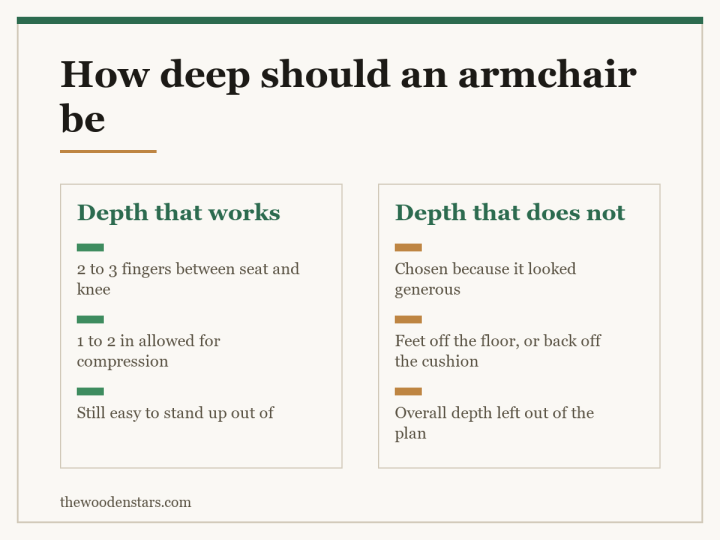
- Find the seat depth. Under 20 inches and it is for short sits; 21 to 24 is an armchair’s range — how deep an armchair should be.
- Look at the arm in profile. Can you rest a forearm on it and push down to stand? If not, it is decorative.
- Look for a loose seat cushion. A cushion you can turn lasts years longer than a fixed one, because you can even out the wear.
- Check the frame claim. Kiln-dried hardwood against “solid wood” is the usual distinction, and it matters — engineered wood against hardwood and what “all wood” actually means.
The compromise that works in a small room: one proper armchair, one accent chair. The armchair takes the spot someone sits in nightly; the accent chair does the visual work in the corner and takes the overflow. Buying two of either is usually the worse answer.
Fabric durability is worth checking on whichever you buy, and it is measured in double rubs. Anything under 15,000 is decorative and belongs on an occasional chair; 15,000 to 30,000 suits normal domestic use; over 30,000 is contract grade and is what an armchair sat in nightly should have. The figure is usually buried in the specification rather than in the description. A low rating on an accent chair is perfectly reasonable. The same rating on a chair someone will use every evening is not.
Sizing either one
- Tape measure Inside arm width and seat depth, not the overall figures
- Painter’s tape Tape the footprint down and walk past it for a day
- Furniture sliders Getting an armchair around a hallway corner intact
- Fabric protector spray A chair sat in nightly needs it more than a corner chair
What to buy


For sizing, see how wide an armchair is and how deep an armchair should be. For the dining-room version of the same question, dining chair against accent chair.
Questions we get asked
What is the difference between an armchair and an accent chair?
An armchair is 32 to 38 inches wide with padded load-bearing arms, built for long sitting. An accent chair is 26 to 32 inches and bought mainly for how it looks.
Is an armchair an accent chair?
It can be. Every armchair can do the accent job; not every accent chair can do the sitting job.
Which is more comfortable?
The armchair, by a clear margin, for anything over about forty minutes.
Which suits a small room?
The accent chair. Eight inches of width and six of depth is a real saving under 12 by 14 feet.
How do I tell them apart in a listing?
Inside arm width of 20 inches or more, a seat depth of 21 to 24, and arms you could push on to stand up.
Should I buy one of each?
In a small room, usually yes. One chair for sitting in nightly, one for the corner.