How wide is an armchair? 30 to 40 inches
The Wooden Stars is a participant in the Amazon Services LLC Associates Program. We may earn a commission when you buy through links on our site, at no extra cost to you.
How wide is an armchair? 30 to 40 inches overall — but the number that decides whether you are comfortable is the 20 to 22 inches between the arms, and listings rarely print it.
Two chairs both described as 34 inches wide can differ by four inches of usable seat.
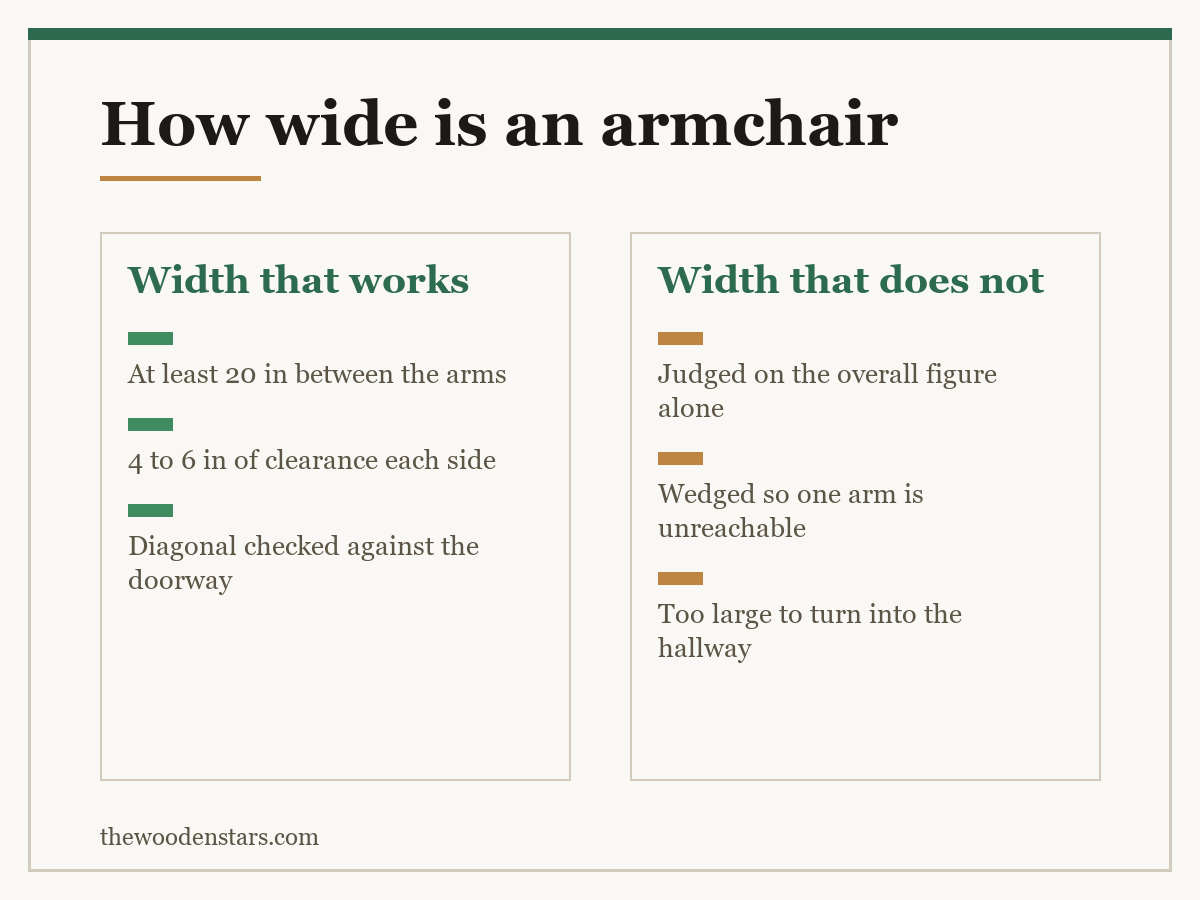
Overall widths: 28 to 32 inches on a compact or apartment armchair, 32 to 38 as standard, 38 to 44 on an oversized chair, and 42 to 52 on a chair-and-a-half. The figure that matters is the inside width between the arms — 19 to 24 inches, and you want at least 20 for an adult, 22 to sit cross-legged. Arms take 4 to 8 inches each, which is where the overall figure goes. Allow 4 to 6 inches of clearance beside the chair, and check the diagonal against your doorway before ordering.
How wide is an armchair, by type
- Compact or apartment chair: 28 to 32 inches overall, 19 to 21 inside.
- Standard armchair: 32 to 38 overall, 20 to 22 inside. The great majority of chairs.
- Oversized or club chair: 38 to 44 overall, 22 to 24 inside.
- Chair-and-a-half: 42 to 52 overall, and deliberately wide enough for two.
- Wingback: 30 to 36 overall, and the inside is usually tighter than the overall suggests.
The gap between overall and inside is the arms, and it varies enormously. A slim-armed mid-century chair gives 4 inches to each arm; a rolled-arm club chair gives 8. That is a 16-inch overall difference that buys you nothing in seat.

| Chair | Overall | Inside arms | Suits |
|---|---|---|---|
| Compact or apartment | 28 to 32 in | 19 to 21 in | Small rooms, one person |
| Standard armchair | 32 to 38 in | 20 to 22 in | Most adults |
| Oversized or club | 38 to 44 in | 22 to 24 in | Sitting cross-legged |
| Chair and a half | 42 to 52 in | 30 in or more | Two, or one and a dog |
| Wingback | 30 to 36 in | 19 to 22 in | Draughty rooms, upright sitting |
| Slipper chair, no arms | 22 to 30 in | Full width | Tight corners |
The inside width is the one to ask for
Twenty inches is the practical minimum for an adult. Below that the arms press your shoulders inward, and a chair that does this is noticeable within twenty minutes.
Twenty-two inches lets you sit cross-legged, turn sideways, or share the chair with a small child. If you are buying one chair for a reading corner, this is the number to hold out for.
Twenty-four and above starts to be too wide for a single sitter — you lose the arms as armrests, because they are no longer where your elbows fall.
Most listings publish only the overall width. Ask the seller for the inside, or work it out from a photograph: arms that look like a quarter of the chair’s width each are taking 8 inches, and you should subtract accordingly.
The same distinction applies at a dining table, where arm width drives how many chairs fit — how wide a dining chair is and dining chair with arms against without.
What the room has to give
An armchair needs more than its own width.
Four to 6 inches of clearance each side. Pushed hard against a wall or a sofa arm, a chair reads as wedged in and the arm on that side becomes unusable for reaching a side table.
A side table within reach. Eighteen to 24 inches from the chair arm, at arm height — the heights are in how tall a side table should be.
Thirty inches of walkway past the front, or 36 if it is the main route through the room.
The diagonal, for the doorway. This is the one that ruins delivery day. A 38-inch-wide chair with a 36-inch depth has a diagonal near 52 inches, and while it can be tilted through a 30-inch door, a tight hallway turn may defeat it. Measure the door, the hall width and the turn before ordering anything over 38 inches wide.
Choosing a width for your room
- Decide how it will be sat in. Upright reading takes 20 inches inside; curling up takes 22 or more.
- Tape the overall footprint on the floor and leave it a day. Thirty-eight inches is much larger in a room than on a screen.
- Check it against the sofa. An armchair much wider than a sofa cushion looks wrong beside it; roughly matching the cushion width reads as a set.
- Two narrow chairs often beat one wide one. Two 30-inch chairs seat two people in 60 inches; one 44-inch chair seats one.
- Measure the route in. Door, hall, turn, stair. Then subtract an inch for your own optimism.
Depth is the other half of the sizing question and it is the one that decides comfort — how deep an armchair should be. And for the difference between an armchair and its slimmer cousin, armchair against accent chair.
Swivel chairs need more clearance than their width suggests. A 34-inch swivel chair sweeps a circle roughly 38 inches across once you allow for the arms passing a side table, so the 4 to 6 inches of clearance that suits a fixed chair is not enough. Plan on 8 inches each side, and check that the swing does not catch a lamp cord or a radiator. The upside is real, though: in an open-plan room a swivel chair serves a television and a dining table without being moved.
Before it arrives
- Tape measure Inside arm width first, then the door, hall and turn
- Painter’s tape Tape the footprint on the floor and live with it a day
- Furniture sliders Getting a 40 inch chair around a hall corner without gouging
- Felt furniture pads Heavy chairs dent a floor where they stand for years
What to buy


For depth and comfort, see how deep an armchair should be. For the footstool that goes with it, how tall an ottoman should be.
Questions we get asked
How wide is a standard armchair?
Thirty-two to 38 inches overall, with 20 to 22 inches between the arms.
What inside width do I need?
At least 20 inches for an adult, and 22 if you want to sit cross-legged.
Why do two 34-inch chairs feel different?
Arm thickness. Slim arms take 4 inches each; rolled arms take 8, which is six inches of seat gone.
How much clearance around an armchair?
Four to 6 inches each side, and 30 inches of walkway past the front.
Will it fit through my door?
Check the diagonal, not the width. A 38-inch chair can have a 52-inch diagonal, and the hallway turn is usually the problem, not the door.
One wide chair or two narrow ones?
Two narrow ones, in most rooms. Sixty inches of floor seats two people rather than one.