Floating Shelf Brackets: What Holds the Weight Is Inside the Shelf
The Wooden Stars is a participant in the Amazon Services LLC Associates Program. We may earn a commission when you buy through links on our site, at no extra cost to you.
A floating shelf has no visible support, so people assume the bracket is doing less work. It is doing more. The same weight is held on a steel rod cantilevered out of the wall, with nothing under the front edge to share the load.
That is why floating shelves fail differently from bracketed ones. A bracketed shelf sags. A floating shelf tips, and the rods lever a chunk of plasterboard out on their way down.
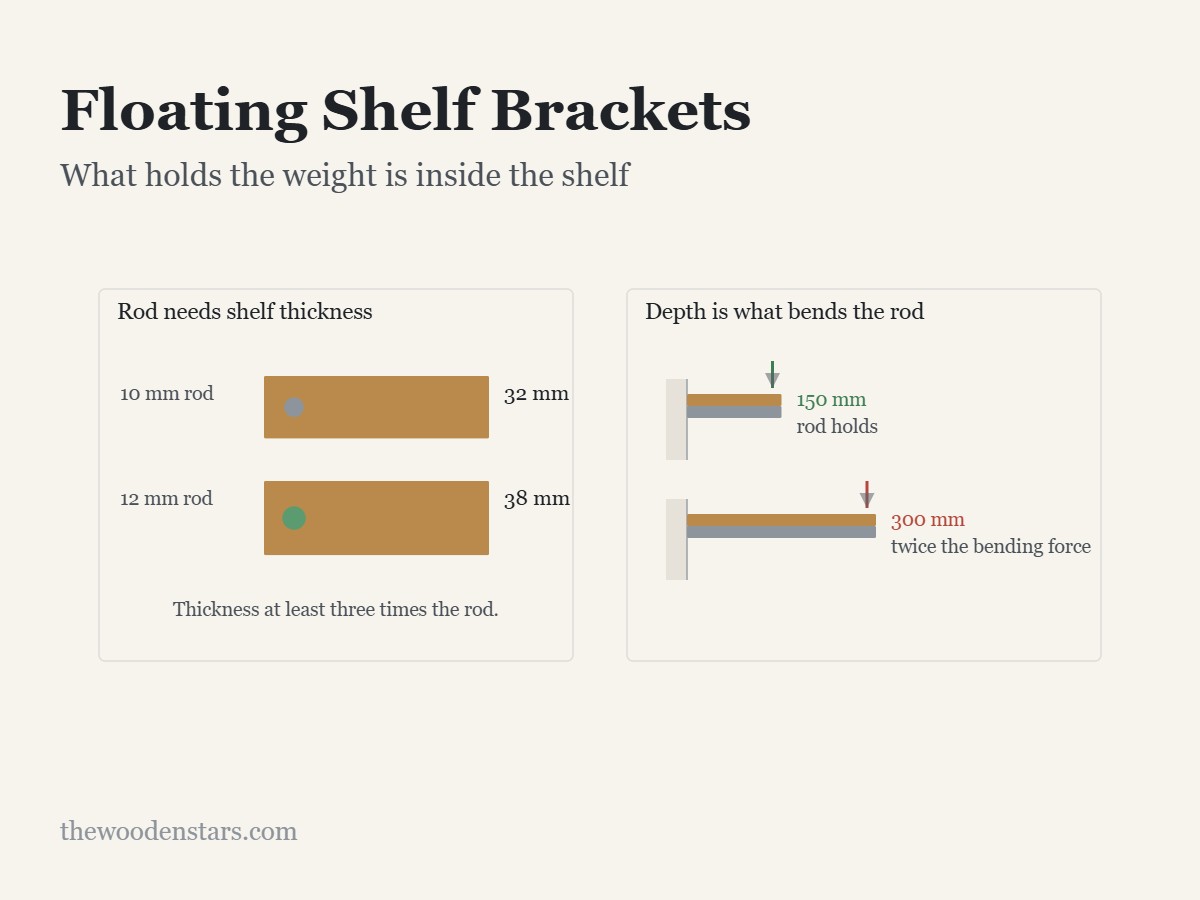
Two numbers decide it. The rod diameter must suit the shelf: 10 mm rods want a shelf at least 32 mm thick, 12 mm rods at least 38 mm. And the fixing must reach a stud — a concealed bracket in plasterboard alone carries almost nothing, because all the load arrives as a pull-out force on the top screws. If the studs do not fall where you want the shelf, a floating shelf is the wrong choice there; use a visible bracket instead.

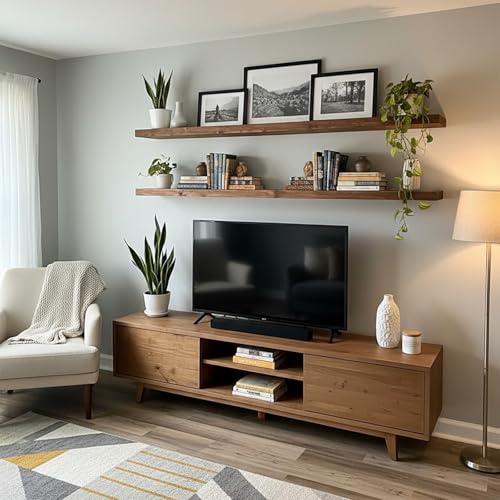
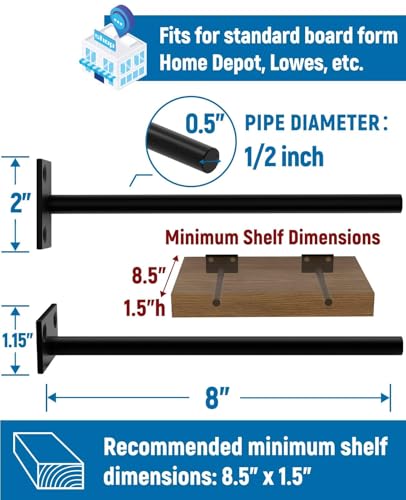
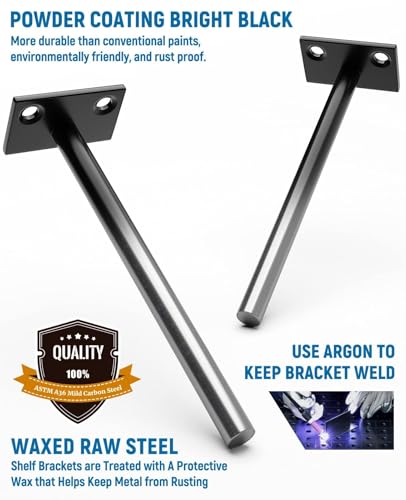
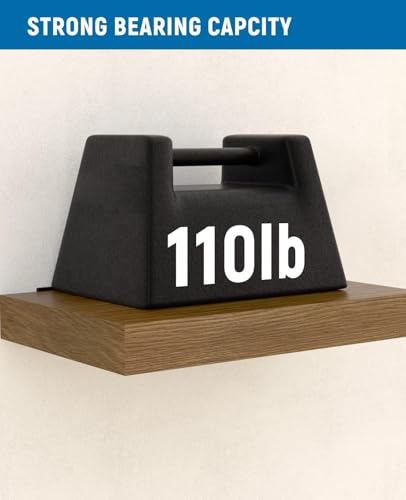
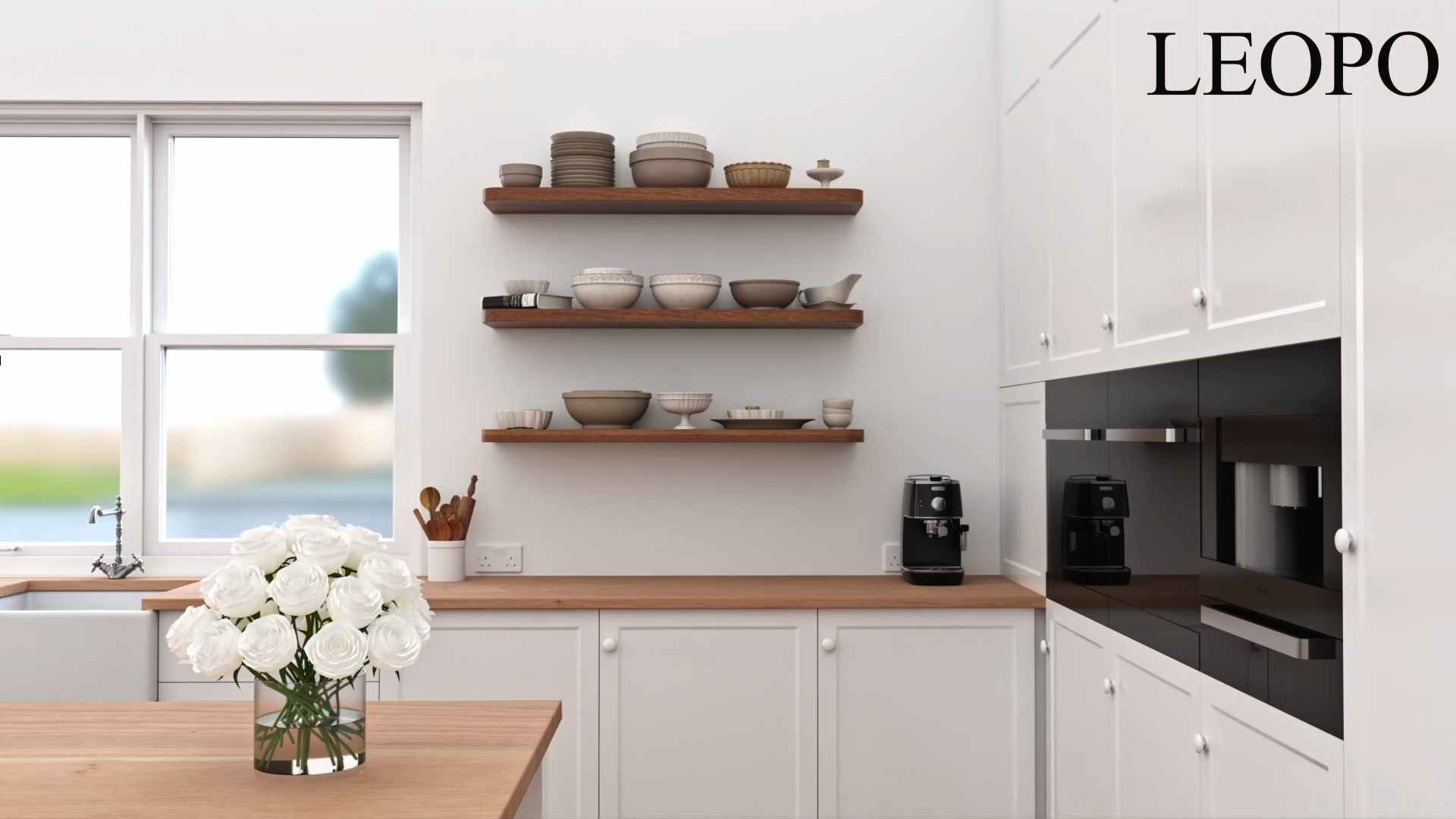
Prime LEOPO 12-Pack 8 inch Floating Shelf Brackets, Hidden Shelf Bracket for Wood




As an Amazon Associate we earn from qualifying purchases. Product prices and availability are accurate as of the date/time indicated.
Start here: buy the bracket to suit the shelf you already have, not the other way round — rod diameter sets the minimum shelf thickness, and there is no way around it.
What a concealed bracket actually is
Underneath the marketing, there are only three mechanisms.
Rod-and-plate
A steel plate screws flat to the wall with two or three rods welded to it, pointing outwards. Holes are drilled into the back edge of the shelf and the shelf slides on. The most common type, the strongest when fitted well, and the one that demands a thick shelf.
Full-length concealed rail
A single steel section spanning most of the shelf width, screwed to the wall along its length, with a routed channel in the back of the shelf to receive it. Spreads the load along the whole back edge rather than at two or three points, which is a real advantage in board material. Needs a router or a supplier who has already machined the shelf.
Blind keyhole
A plate on the wall and a matching keyhole slot routed into the shelf back. Cheap, common on ready-made shelves, and the weakest of the three: the shelf lifts straight off, and nothing resists a knock from below.
| System | Shelf thickness needed | Realistic load, into studs | Weak point |
|---|---|---|---|
| Rod-and-plate, 10 mm rods | 32 mm minimum | 15–25 kg | Rod bends where it leaves the plate |
| Rod-and-plate, 12 mm rods | 38 mm minimum | 25–40 kg | Wall fixing, not the rod |
| Full-length rail | 30 mm, routed | 30–45 kg | Needs machining, no adjustment after |
| Blind keyhole | 20 mm | 5–10 kg | Lifts off, and tips forward under front load |
Those figures assume the plate reaches timber. In plasterboard with the supplied plugs, every row in that table drops to roughly the weight of the shelf itself.
Why leverage matters more here than on a normal bracket
An ordinary shelf bracket has an arm under the shelf, so weight on the front is carried down the arm and into the wall. A concealed rod has nothing underneath. Every kilogram on the front edge tries to rotate the shelf, and the rod resists that rotation by bending.
The practical consequence is that depth is the enemy. Doubling the shelf depth roughly doubles the bending force on the rod for the same weight. A 400 mm floating shelf is not a slightly bigger version of a 200 mm one; it is a substantially harder engineering problem, and it is where most droop comes from.
It also explains the droop that appears months later. The rod has not moved. The shelf has: the holes in the timber have crushed slightly on the underside at the front and the top at the back, letting the shelf rotate a degree or two. That degree is very visible over 400 mm.
Matching the rod to the shelf
Three rules, and the first one is where most kits are misused.
- Shelf thickness at least three times the rod diameter. A 12 mm rod in a 25 mm shelf leaves 6.5 mm of timber above and below the hole. That is not enough material to resist crushing, and it is why the shelf droops.
- Rod length at least two thirds of the shelf depth. Short rods concentrate all the leverage in the first few centimetres of the shelf.
- Drill on a stand, or with a jig. The holes must be parallel to the shelf face and to each other. A hole drilled a couple of degrees off makes the shelf sit visibly nose-down, and you cannot correct it afterwards.
| Rod | Minimum shelf thickness | Sensible maximum depth | Suits |
|---|---|---|---|
| 8 mm | 25 mm | 150 mm | Display, small objects |
| 10 mm | 32 mm | 200 mm | Books on a shallow shelf |
| 12 mm | 38 mm | 250 mm | Books, kitchen jars |
| 16 mm | 50 mm | 300 mm | Slab shelves, heavy use |
Solid hardwood tolerates the crushing forces around the holes better than any board material. In MDF or plywood, drop one size in depth from the table above, or use the full-length rail instead, which spreads the load rather than concentrating it.
The fixing, which is where these actually fail
Because the load arrives as rotation, the top screws in the wall plate take almost all of it, pulled straight out of the wall. The bottom screws mostly just stop the plate swinging.
- Into a stud is the only comfortable answer. Two screws into timber, and the plate is stronger than the shelf.
- One stud, one toggle is a common compromise on a narrow shelf. It works, at reduced load, provided the stud takes the end that will carry more.
- No stud at all means metal toggles and an honest reduction — a decorative shelf, not a bookshelf. This is the case where a visible bracket is simply the better engineering, and worth swallowing the aesthetics for.
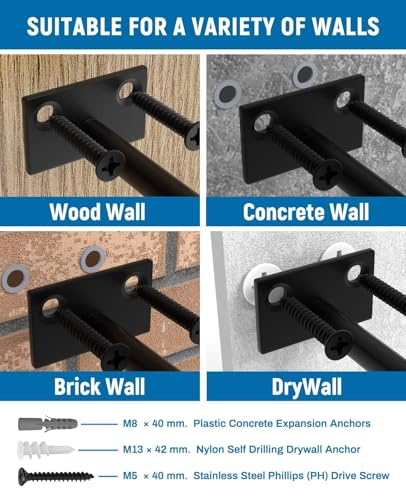
Plastic plugs are not a floating-shelf fixing under any circumstances. They resist being pulled out very poorly, and pull-out is the entire load case here.
Fitting so it sits level and stays level
- Find the studs and set the shelf position from them, not the other way round.
- Fix the plate, then check the rods with a level before the shelf goes anywhere near it. Rods that are slightly nose-down can often be persuaded true with a gentle pull; once the shelf is on, you are levering against the wall.
- Drill the shelf with a depth stop. Going through the front face is unfixable, and stopping too short means the shelf will not close against the wall.
- Dry-fit before glue. If the shelf will not slide fully home, the holes are not parallel; ream slightly rather than forcing, which splits the shelf along the grain.
- Load it and leave it a week, then look along it. A small settle is normal. Continuing movement means the fixing, not the shelf.
Two habits pay off later: put the heavy things at the back, near the wall, where the leverage is least; and if the shelf carries books, treat the depth table above as a limit rather than a suggestion.
What to buy
- Concealed rod brackets, 8 in The default hidden bracket for a shelf that carries books On Amazon →
- Solid steel floating shelf brackets Heavier gauge where the shelf is deeper On Amazon →
- Metal toggle fixings Where one end of the plate cannot reach a stud On Amazon →
- Stud detector Decides whether a floating shelf is viable in that spot at all On Amazon →
- Drill stand or a doweling jig The one tool that makes the holes parallel
What to buy


When a floating shelf is the wrong answer
Three situations where the honest recommendation is a visible support.
- The shelf must be deeper than about 250 mm. Beyond that the leverage wins, and you are into slab thicknesses and 16 mm rods to keep it looking flat.
- The studs are nowhere near where the shelf has to go. A concealed bracket cannot be moved along to find timber; a twin-slot standard can.
- The shelf carries records, textbooks or crockery. Those loads belong on something with an arm underneath. Our guide to shelf brackets covers the visible options and what each holds.
Questions we get asked
How much weight can a floating shelf hold?
With 12 mm rods, a 38 mm solid timber shelf and both plate screws in a stud, 25–40 kg is realistic on a 200 mm deep shelf. Halve it if the shelf is board material, halve it again for plasterboard fixings, and reduce it further as depth increases. The number quoted on the packet assumes conditions you almost certainly do not have.
Why does my floating shelf tilt down at the front?
Almost always the holes in the shelf, not the bracket. The timber around the rods has crushed slightly, letting the shelf rotate. Thicker shelf, larger rods or a shallower shelf are the fixes; packing the front is not, because the crushing continues.
Can I fit a floating shelf without hitting a stud?
You can, with metal toggles, and you should expect a fraction of the load — a shelf for photographs rather than books. If the shelf has a job to do and no stud is reachable, a bracketed shelf in the same spot will carry several times as much.
What thickness shelf do I need?
At least three times the rod diameter, so 32 mm for 10 mm rods and 38 mm for 12 mm. Solid hardwood at the minimum is fine; MDF and plywood at the minimum are not, because the material around the hole crushes far sooner.
Are the rods meant to be glued into the shelf?
Usually no, and it is better not to: an unglued shelf can be lifted off to paint the wall, and a glued one cannot be removed without damage. Glue only if the shelf is a loose fit on the rods, and then use epoxy rather than wood glue, since you are bonding steel to timber.