Adjustable vs fixed height bar stools — One or both
The Wooden Stars is a participant in the Amazon Services LLC Associates Program. We may earn a commission when you buy through links on our site, at no extra cost to you.
Adjustable vs fixed height bar stools is really a question about your worktop: if it measures a standard 36 or 42 inches, fixed wins on almost every count. If it measures 38, adjustable is the only clean answer.
The mechanism solves a real problem. It also introduces one.
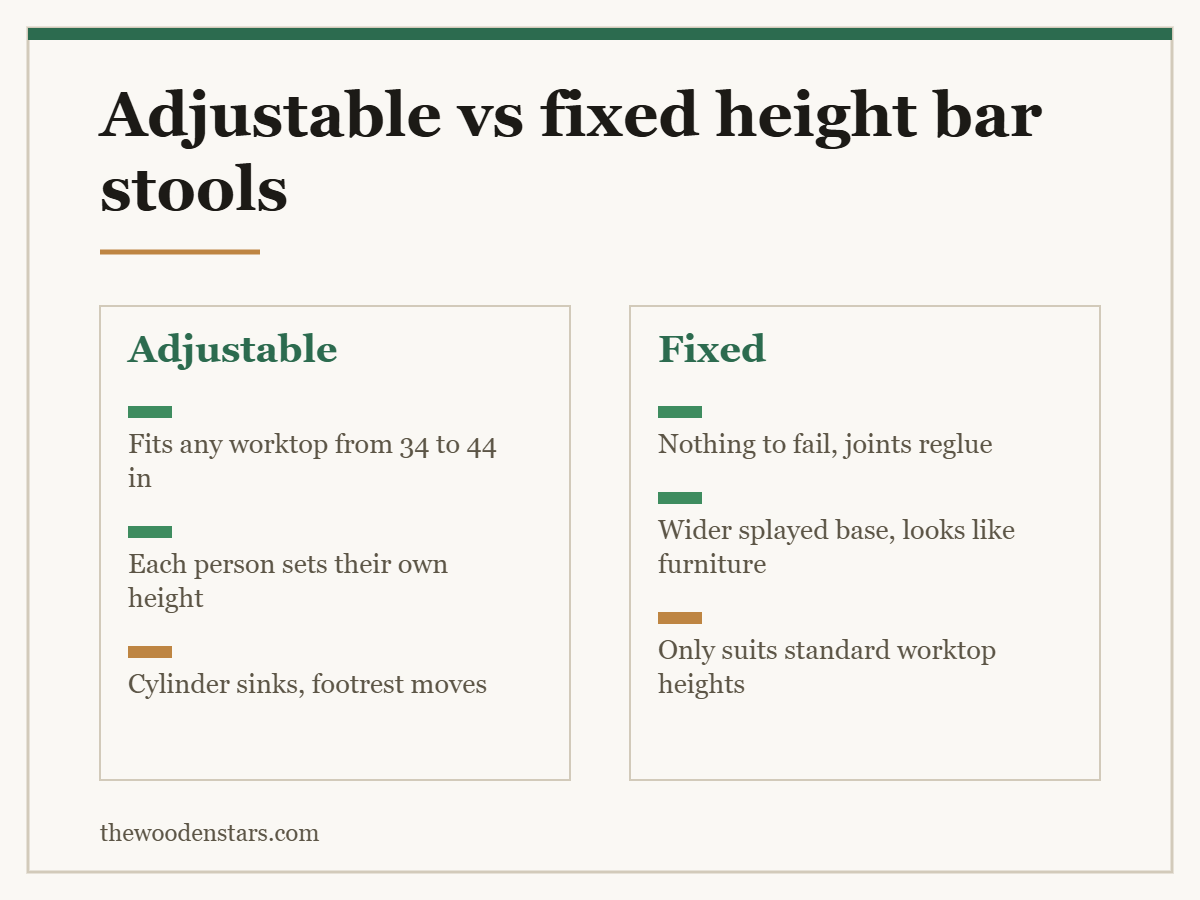
An adjustable stool uses a gas lift to cover roughly 23 to 33 inches of seat height, so one stool suits any counter from 34 to 44. That is the whole case, and it is decisive for non-standard worktops, rental homes and households with children. The costs: a metal column whatever the seat is made of, a cylinder that slowly sinks after 3 to 8 years, a smaller footprint that is less stable, and a footrest fixed to the base so its distance from the seat changes as you adjust. A fixed timber stool has nothing to fail, sits steadier, and looks like furniture rather than office equipment.
Adjustable vs fixed height bar stools: what each solves
The adjustable stool exists because worktops are not standardised as tightly as stool makers pretend. Self-built islands, converted spaces and older kitchens routinely land at 37, 38 or 39 inches — between the counter and bar families entirely.
A fixed stool at either family height gives you 8 inches of clearance or 14. Neither is comfortable; the right gap is 10 to 12, as set out in how tall a bar stool should be.
A gas-lift stool covers the whole span and lands wherever you need it. It also lets different people set their own height, which matters if a child does homework at the same stool an adult eats at.
Against that, if your counter is a standard 36 or your bar a standard 42, the mechanism is solving a problem you do not have — and you pay for it in stability, looks and lifespan.
| Measure | Adjustable | Fixed |
|---|---|---|
| Seat range | 23 to 33 in | One height |
| Suits worktops | 34 to 44 in | 34 to 36 or 40 to 42 |
| Column material | Metal, always | Any |
| Base | Small round or star | Four legs, wider |
| Typical failure | Cylinder sinks in 3 to 8 years | Joints loosen, repairable |
| Footrest distance | Changes as you adjust | Constant |
| Looks like furniture | Rarely | Yes |
| Price | Similar to slightly more | Baseline |
The gas cylinder, honestly
Every gas lift eventually sinks. The seal in the cylinder lets nitrogen past, the stool drops an inch an hour under load, and then it stops holding at all. Three to eight years of daily use is the realistic window.
Two things follow.
Check the cylinder is replaceable. A standard-diameter cylinder held by a taper fit can be knocked out and swapped for a modest sum, and that turns a five-year stool into a fifteen-year one. A proprietary or welded cylinder means the stool is disposable.
Check the weight rating. Gas lifts are rated, and an under-rated cylinder sinks much sooner. This is the one place where the published load number on a stool really matters — the general picture is in how much weight a bar stool can hold.
The fixed stool’s equivalent failure is a loose joint, which glue and a clamp restore — how to reglue a loose joint. That asymmetry is the strongest argument for fixed, and it is the same argument as wood against metal bar stools.
Stability and the footrest problem
Base footprint. Adjustable stools use a round plate or a five-star base, typically 16 to 20 inches across. A four-legged fixed stool is usually 18 to 22 at the feet and splayed. The wider, splayed base resists tipping better, and at bar height that is worth having.
The footrest moves. On an adjustable stool the foot ring is fixed to the column while the seat rises, so the distance from seat to rail changes every time you adjust. Set high, the rail can end up 14 inches below the seat, which is too far to be useful. The target is 7 to 9 inches.
Some better adjustable stools put the ring on the moving part instead. It is worth looking for, and photographs usually show it clearly.
Swivel comes bundled. Nearly every gas-lift stool swivels, whether you wanted it or not — the trade-offs are in swivel against stationary bar stools.
Which to buy
Buy adjustable if your worktop is not 36 or 42 inches; you rent and will take the stools to an unknown kitchen; children use the same seats as adults; or you are buying before the island is built and the final height is still uncertain.
Buy fixed if the worktop is standard; you want the stools to read as furniture rather than office equipment; the stools will take heavy daily use for a decade or more; or stability matters because of older users or a hard floor.
One combination to avoid: adjustable stools bought purely because the range sounds like flexibility, then set once on day one and never touched again. That is all the downsides and none of the benefit — which is most adjustable stools in most kitchens.
If the worktop is genuinely between standards and you would rather have timber, the third option is a fixed stool with an inch or two cut off all four legs. On a solid wood stool that is a clean, permanent fix — see best wood for furniture for what takes the cut well.
For either kind
- Tape measure Confirms whether you have a standard worktop before you buy a mechanism
- Replacement gas cylinder Turns a five-year adjustable stool into a fifteen-year one
- Felt furniture pads Small round bases concentrate load and mark floors faster
- Wood glue for loose joints The fixed stool’s only real failure, and it is repairable
What to buy


For the underlying height question, see how tall a bar stool should be and bar stool against counter stool. For the rest of the choice, with a back against backless and wood against metal.
Questions we get asked
Are adjustable bar stools worth it?
Only if your worktop is not a standard 36 or 42 inches, or if different people need different heights. Otherwise fixed is better in every way.
What range does a gas lift cover?
Roughly 23 to 33 inches of seat height, which suits worktops from 34 to 44.
How long does the cylinder last?
Three to eight years of daily use before it starts sinking. Check whether it is a standard replaceable size.
Are adjustable stools less stable?
Slightly. The base is a 16 to 20-inch plate or star, against 18 to 22 inches of splayed legs on a fixed stool.
Why does the footrest feel wrong when I raise it?
Because the ring is usually fixed to the column while the seat rises. Look for stools that put the ring on the moving part.
Can I just cut down a wooden stool instead?
Yes. An inch or two off all four legs equally, then refinish the ends, and you keep timber and stability.