Swivel vs stationary bar stools — The mechanism
The Wooden Stars is a participant in the Amazon Services LLC Associates Program. We may earn a commission when you buy through links on our site, at no extra cost to you.
Swivel vs stationary bar stools is decided by how people get on and off them — not by whether spinning sounds fun.
At 30 inches off the floor, turning your body is harder than turning the seat. That is the whole case for a swivel, and it is a better case than it sounds.
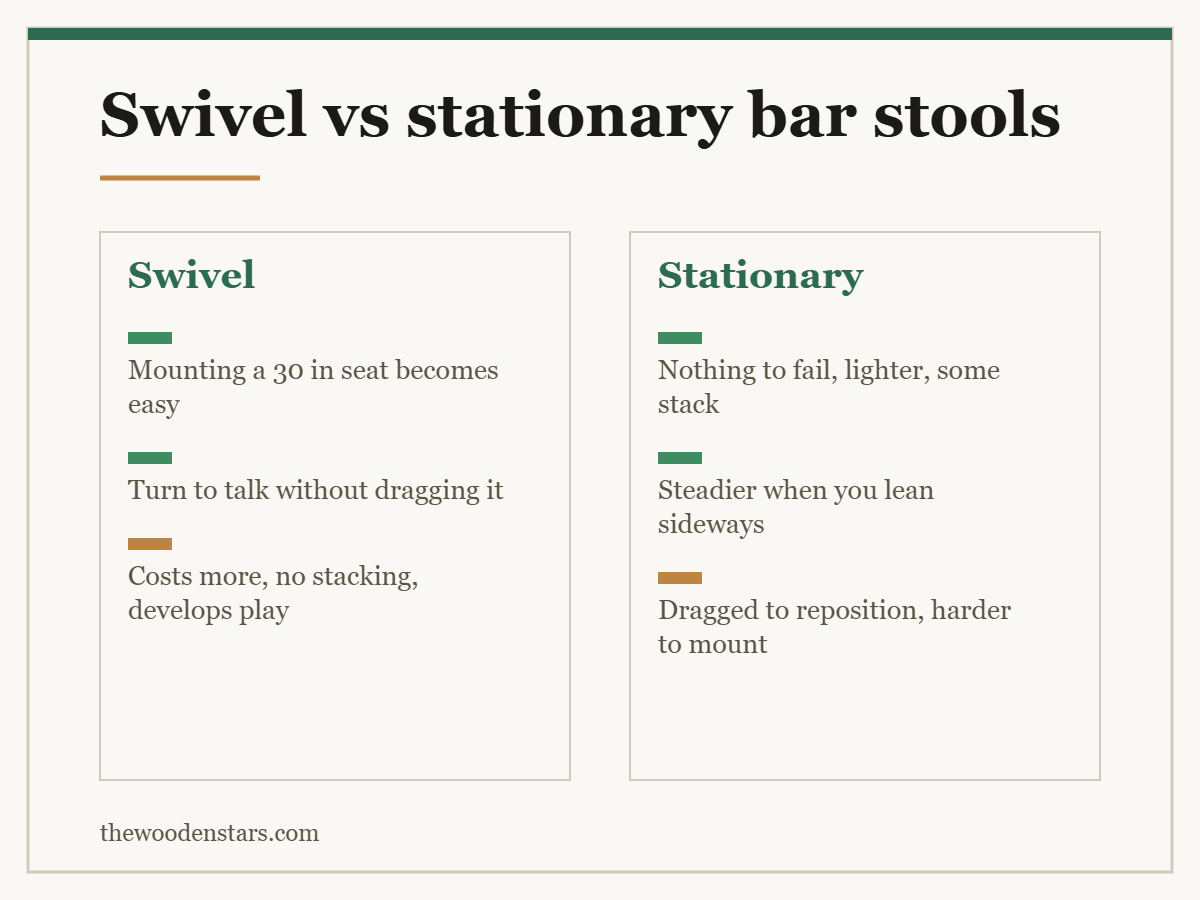
A swivel stool rotates on a bearing plate between seat and base, usually 360°, sometimes with a return-to-centre spring. It makes getting on and off a tall stool much easier, which matters most for older users and anyone with a stiff hip or knee. It costs 30 to 60% more, adds a moving part that develops play after a few years, and lets children spin. A stationary stool has nothing to fail, weighs less, often stacks, and is steadier under someone leaning sideways. Swivels earn their keep at bar height; at counter height the gain is small.
Swivel vs stationary bar stools: what the mechanism gives
Mounting and dismounting. On a stationary 30-inch stool you approach from the front, get one foot on the rail, and twist your torso to face the counter. On a swivel you sit down sideways, then turn the seat. For anyone who cannot easily lift a leg to rail height, that is the difference between using the seat and not.
Turning to talk. A kitchen island seats people in a row facing a worktop. Conversation happens sideways, and on a fixed stool that means twisting at the waist for an hour.
Not dragging. Stationary stools get shoved across the floor every time someone repositions. Swivels stay put, which saves both the floor and the noise — the same argument as swivel against stationary patio chairs, where the surface underneath decides it.
What a swivel does not give you is comfort while seated. Once you are sitting square to the counter, a swivel and a fixed stool feel identical.
| Measure | Swivel | Stationary |
|---|---|---|
| Rotation | 360°, some return to centre | None |
| Easier to mount | Yes, noticeably at bar height | No |
| Moving parts | Bearing plate, sometimes a spring | None |
| Weight each | 13 to 24 lb | 9 to 18 lb |
| Stacks | No | Some designs |
| Develops play | After 3 to 7 years | No |
| Price | 30 to 60% more | Baseline |
What the mechanism costs
It develops play. A swivel plate is two rings and a ball race. After a few years of daily use the seat starts to rock a millimetre or two before it turns. It is not dangerous, and it is not really repairable either — most plates are riveted, not bolted. Check before buying whether the plate is bolted (replaceable for a few pounds) or riveted (not).
It cannot stack. Stationary stools sometimes nest or stack; no swivel does. For occasional seating that is stored between uses, that settles it.
Children spin. Predictable, and worth saying out loud before you buy four of them for a family kitchen. A return-to-centre mechanism helps: the seat turns freely but springs back to facing the counter when you get off.
It is less steady sideways. Leaning hard to one side on a swivel feels looser than on a fixed stool, because the seat gives before the base does. The base and load rating still do the real work — how much weight a bar stool can hold.
It adds 30 to 60% to the price. On a set of four that is a real number, and it buys a mechanism rather than comfort.
Height changes the answer
This is the part that gets missed.
At counter height, 24 to 26 inches, most adults can plant a foot on the floor and sit down normally. The swivel saves a small twist. Nice, not necessary.
At bar height, 29 to 32 inches, your feet never touch the floor. You mount by stepping onto a rail and pivoting, and a swivel turns an awkward manoeuvre into an easy one. The taller the stool, the stronger the case.
At extra-tall, 33 to 36, a swivel is close to essential for anyone who is not young and agile.
Which height you are buying for is worked out in bar stool against counter stool and how tall a bar stool should be.
Buying either one well
- Check whether the swivel plate is bolted or riveted. Bolted is replaceable; riveted means the stool is disposable once the bearing goes.
- Ask about return-to-centre if there are children. It is the single feature that stops a row of stools ending up facing four directions.
- Look at the foot ring. On a swivel it is fixed to the base while the seat turns, so it has to be at a height that works from every angle — 7 to 9 inches below the seat.
- Weigh it. Under about 10 lb, a tall stool of either kind is too light to feel solid.
- Check the timber and joints as you would on any stool — wood against metal bar stools and how to reglue a loose joint.
One last check: a swivel stool with a back will end up facing whichever way it was left, so a row of four can look chaotic in a way fixed stools never do.
Living with either
- White lithium grease The annual job that keeps a swivel plate quiet
- Felt furniture pads Stationary stools get dragged daily; this saves the floor
- Hex key set Swivel plates are bolted on the good stools and need retightening
- Seat pads for stools Works on both, and costs less than upgrading the stool
What to buy


For the height decision, see how tall a bar stool should be. For the other choices, with a back against backless, adjustable against fixed height and upholstered against wood seat.
Questions we get asked
Are swivel bar stools worth it?
At bar height, yes — they make mounting a 30-inch seat much easier. At counter height the gain is small.
How much more do they cost?
Thirty to 60% more, and the premium buys a mechanism rather than comfort while seated.
Do swivel stools wear out?
The plate develops a little play after three to seven years of daily use. Check whether it is bolted, which is replaceable, or riveted, which is not.
What is return-to-centre?
A spring that lets the seat turn freely but springs it back to facing the counter when you get off. Worth having with children.
Can swivel stools stack?
No. If the stools need to be stored between uses, buy stationary.
Are swivels less stable?
Slightly, when you lean hard sideways, because the seat gives before the base. The load rating still depends on the base and joints.