How wide is a bar stool? 15 to 21 inches
The Wooden Stars is a participant in the Amazon Services LLC Associates Program. We may earn a commission when you buy through links on our site, at no extra cost to you.
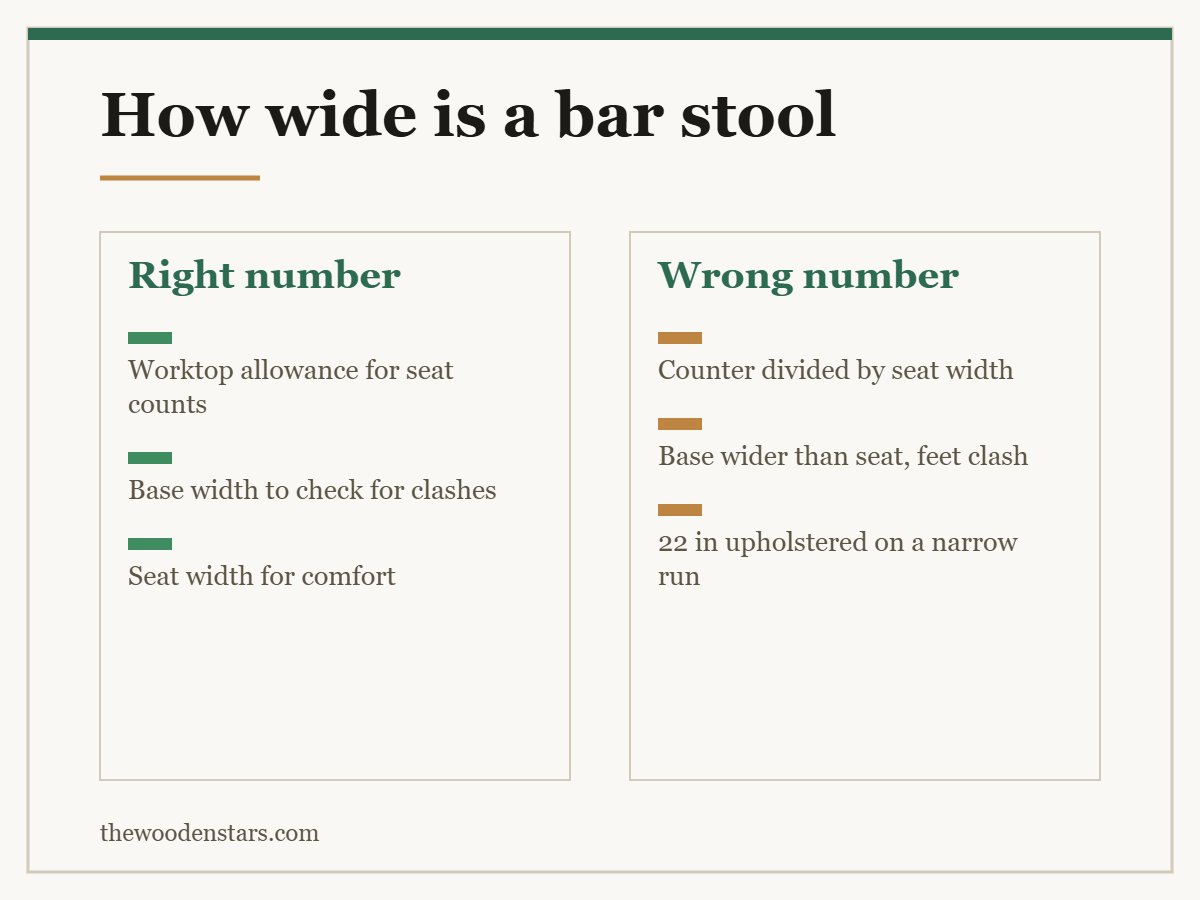
How wide is a bar stool? The seat is 15 to 21 inches — but the number that decides how many fit at your island is the 26 to 30 inches of worktop each one needs, and the number that decides whether they clash is the base.
Three widths, three jobs. Listings give one of them.
Seat widths: 15 to 16 inches for a narrow round backless stool, 17 to 18 for a standard round, 18 to 20 for a square or rectangular seat, 20 to 22 upholstered with a back, and 22 to 24 with arms. The base is often wider than the seat — 16 to 22 inches at the feet or foot ring — and that is what clashes first when stools are close. For planning a run, allow 26 to 30 inches of worktop per stool, which is more than the seat because elbows and getting off need the difference.
How wide is a bar stool: three measurements
- Seat width — 15 to 21 inches, or up to 24 with arms. This is what listings publish, and it decides comfort.
- Base width — 16 to 22 inches at the feet or the foot ring. Rarely published, and it is what clashes first between neighbouring stools.
- Worktop per stool — 26 to 30 inches. Not a property of the stool at all, but the figure you plan a kitchen with.
The base catches people out. Four-legged stools splay outward for stability, so two stools whose seats have a comfortable 8-inch gap can still knock feet at floor level. Round pedestal bases are worse per inch of seat, because the whole plate has to be wide enough to stop the stool tipping.
Seat counts are worked through in how many bar stools fit at an island, and the spacing rule in how much space between bar stools.
| Type | Seat | Base | Worktop each |
|---|---|---|---|
| Narrow round backless | 15 to 16 in | 16 to 18 in | 24 to 26 in |
| Standard round | 17 to 18 in | 18 to 20 in | 26 to 28 in |
| Square or rectangular | 18 to 20 in | 18 to 21 in | 28 in |
| Upholstered with a back | 20 to 22 in | 20 to 22 in | 30 in |
| With arms | 22 to 24 in | 20 to 22 in | 30 to 32 in |
| Adjustable gas lift | 17 to 20 in | 16 to 20 in | 28 in |
How wide the seat should be for comfort
A seat narrower than about 15 inches is a perch. It is fine for ten minutes and for occasional seating, and it is what makes very narrow island runs work at all.
Seventeen to 18 inches is where a stool becomes comfortable for a meal. It matches the seat width of an ordinary dining chair, which is not a coincidence.
Twenty inches and up is generous, and the point at which the stool starts costing you seats. Two 22-inch upholstered stools take the worktop that three 16-inch backless ones would.
Shape matters as much as width. A round 18-inch seat has less usable area than a square 18-inch one, but it is easier to get on and off from any direction and it does not catch hips at the corners. Round suits tight runs; square suits stools people sit at for an hour.
What width does to the rest of the kitchen
Seat count. The clearest effect. On a 72-inch usable overhang: three 16-inch backless stools at 24-inch centres, or two 22-inch upholstered ones at 30. Same counter, one seat’s difference.
Tucking under. Width does not stop a stool tucking in — the back does. But wide stools with wide bases sometimes will not pass between the island and an adjacent run when being moved.
Getting it home. Measure doorways against the base width plus the box. Assembled stools go through most doors; boxed sets of four are wider than people expect.
Stability. A wide base is not a downside, it is the thing keeping a tall stool upright. Narrow seat with a wide splayed base is the combination worth looking for — how much weight a bar stool can hold covers why.
What to check before ordering
- Ask for the base width if it is not listed. It is the figure that decides whether stools clash.
- Multiply properly. Three stools at 28-inch centres is 84 inches of worktop plus 12 at each end — so 108, or 9 feet of overhang.
- Match the shape to the use. Round for tight runs and frequent mounting; square for long sitting.
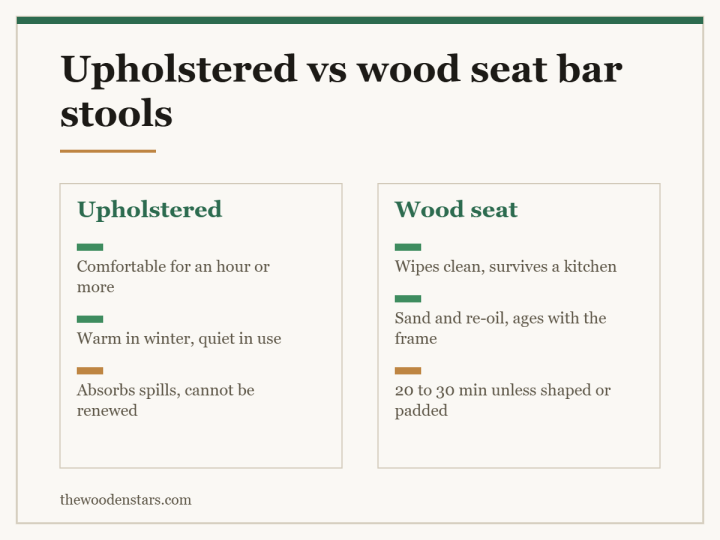
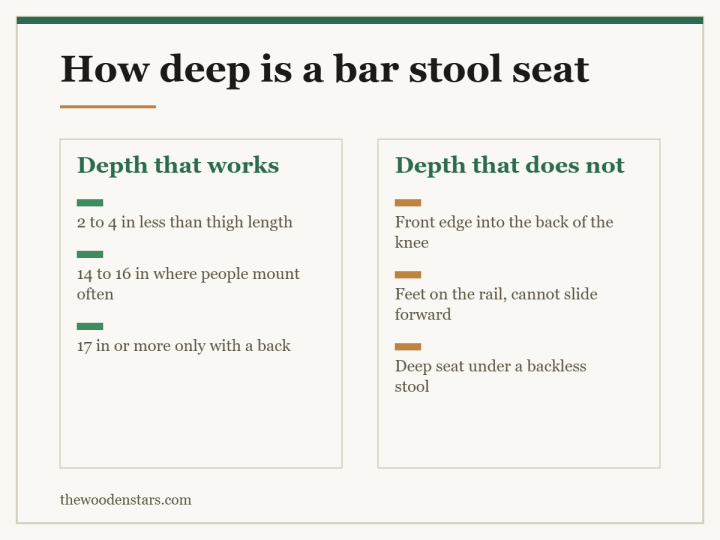
- Check seat depth too, which is a separate figure — how deep a bar stool seat is.
- Look at the joints and timber as always — wood against metal bar stools and best wood for furniture.
Arms deserve a separate note. An armed bar stool is 22 to 24 inches wide and needs 30 to 32 inches of worktop, so a set of three becomes a set of two on most islands. They are worth that cost for the same reason arms are worth it on dining chairs: anyone who pushes up on something to stand gains real support from them. At bar height, where you are already mounting an awkward seat, that support matters more than it does at a table.
Measuring and fitting
- Tape measure Base width is the number listings leave out
- Painter’s tape Mark seat circles on the floor to test a run before ordering
- Seat pads for stools An inch of pad makes a narrow perch tolerable for longer
- Felt furniture pads Wide splayed feet mark floors more, not less
What to buy

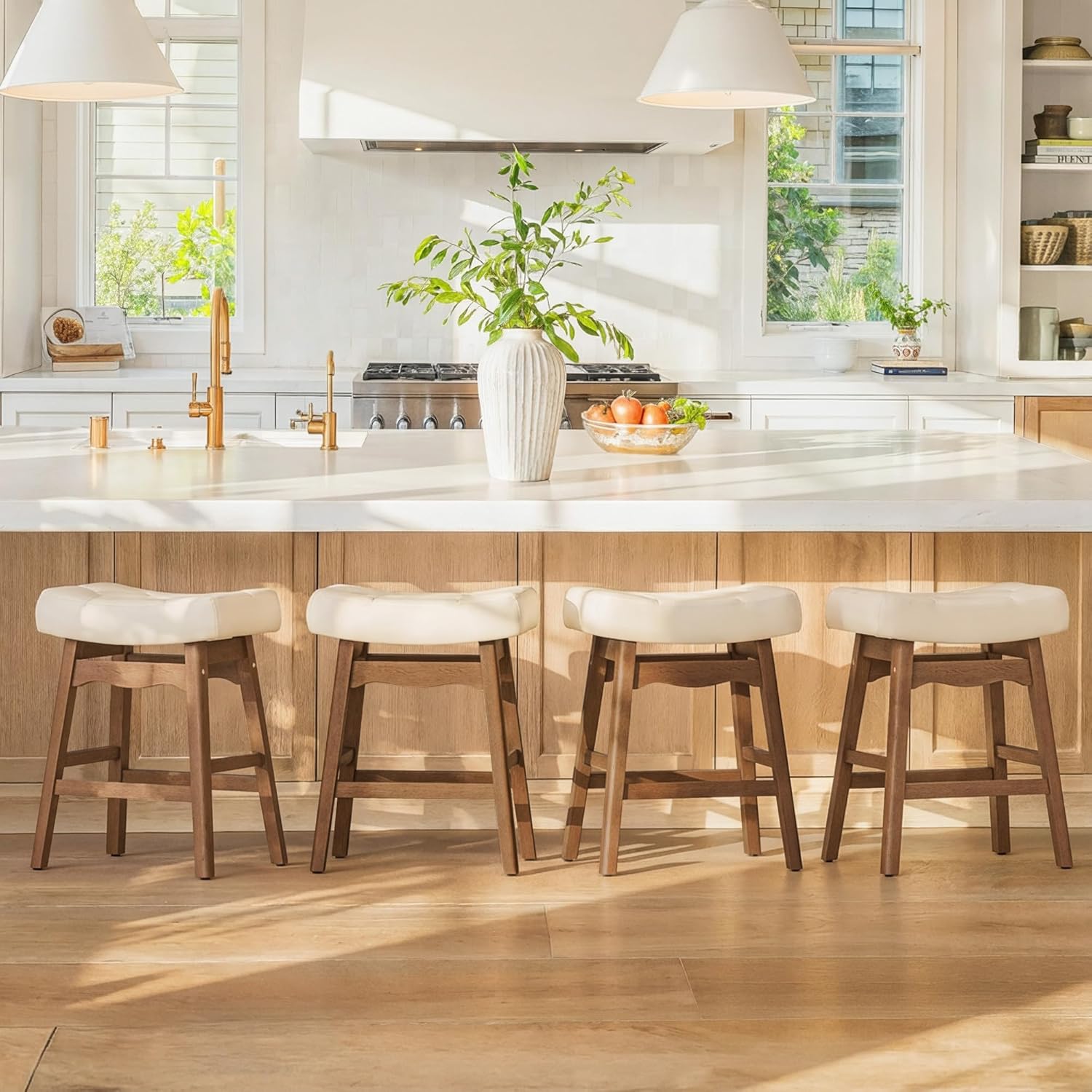


For layout, see how many bar stools fit at an island and how much space between bar stools. For the stool type, with a back against backless and upholstered against wood seat.
Questions we get asked
How wide is a bar stool?
Fifteen to 21 inches at the seat, or up to 24 with arms. The base is often wider still.
Which width do I use for seat counts?
Neither. Use the worktop allowance of 26 to 30 inches per stool.
Why do my stools knock into each other?
Because the base is wider than the seat. Splayed legs and pedestal plates clash before the seats do.
What seat width is comfortable?
Seventeen to 18 inches for a meal. Under 15 is a perch suited to short stays.
Round or square seat?
Round is easier to get on and off from any side and suits tight runs. Square is more comfortable for long sitting.
Does a wide base mean a worse stool?
No, the opposite. At bar height the splay is what keeps the stool upright.