Under-window storage benches — Height, radiators and sills
The Wooden Stars is a participant in the Amazon Services LLC Associates Program. We may earn a commission when you buy through links on our site, at no extra cost to you.
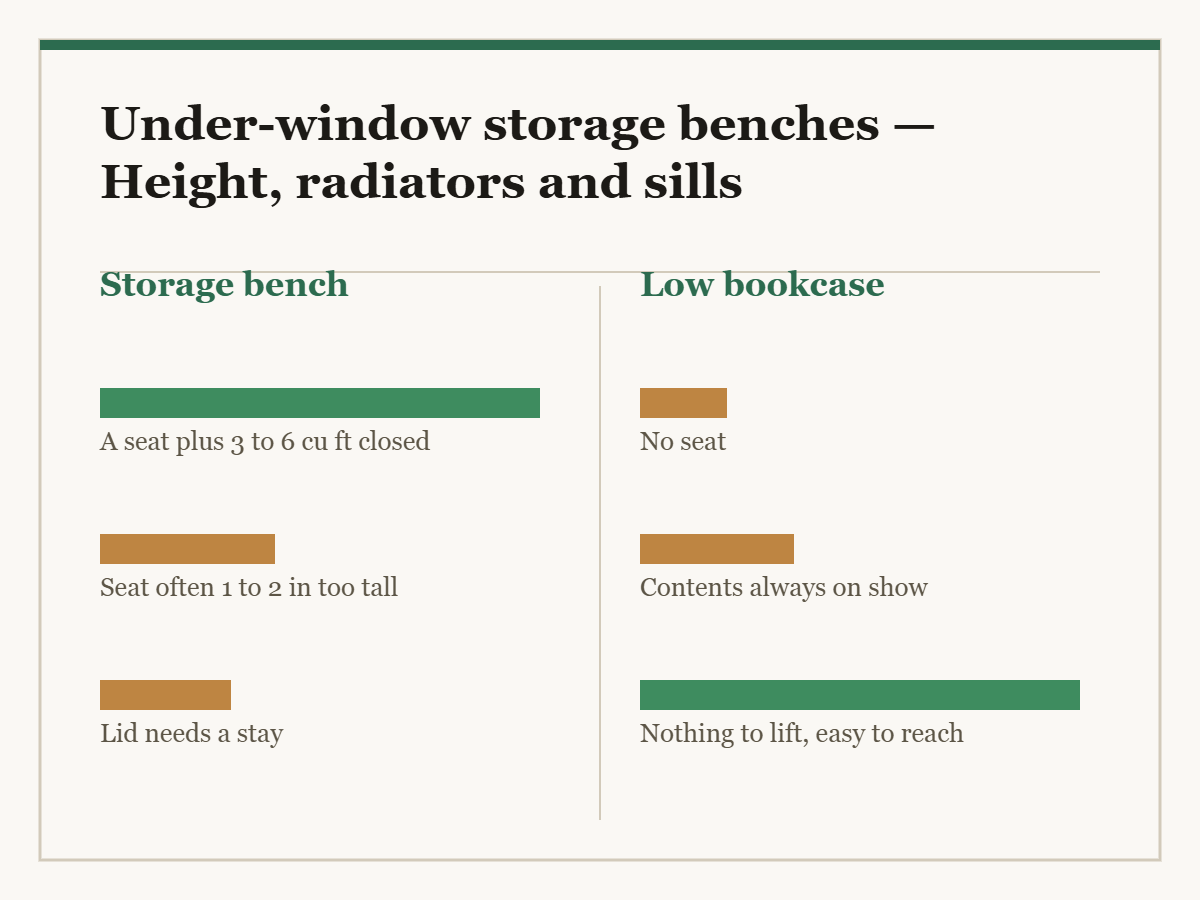
The wall under a window is the one stretch of a room that cannot take a tall piece of furniture. It is also, in most houses, where the radiator is. A bench is the only thing that fits, and a bench with a box under the seat is the only thing that fits and holds anything.
Whether it works comes down to three numbers on the wall itself, all of which you can measure in two minutes.
Measure three things before you shop. Sill height — the bench should finish below it, so a seat at 17 to 19 inches plus a back or cushion must clear the sill, which in most houses is 24 to 36 inches. Radiator position — a bench in front of one blocks the heat and bakes whatever is inside, so leave 4 inches of air or move the bench clear. Reveal width, because a bench cut to the window width looks deliberate and one that overruns by 3 inches looks like a mistake. Storage is 3 to 6 cubic feet, and the lid wants a friction stay or it drops.
The three measurements
Sill height
A bench seat wants to be 17 to 19 inches. Add a cushion at 2 to 4 and a back or a row of pillows at 12 to 18, and the top of the arrangement lands somewhere between 31 and 41 inches.
If the sill is at 30 inches, a bench with a back will cover it. If the sill is at 36, most benches sit comfortably underneath. Measure from the floor to the underside of the sill, not to the glass.
The radiator
This is the one that catches people out. A radiator under a window is there precisely because that is the coldest part of the room, and a bench in front of it does two things: it stops the convection current that makes the radiator work, and it turns the inside of the box into a warm cupboard.
Neither is a disaster, but neither is what you want for stored textiles. Leave 4 inches of clear air in front of a radiator, or set the bench to one side of it.
Width of the reveal
A bench the exact width of the window reads as built in. A bench 3 inches wider reads as furniture that nearly fits. Either match the reveal or be clearly different — 6 inches narrower each side looks intentional.
Seat height, which depends on what it is for
A window bench does one of two jobs and they want different heights.
A seat you sit on properly — reading, putting shoes on — wants 17 to 19 inches, the same as a dining chair. Feet flat, thighs level.
A window seat you perch on or lounge along can go lower, 14 to 16, especially with deep cushions. This is the one that looks like a window seat and is less comfortable to sit upright on.
The seat height rule is the same one that applies at a table, and it is worked through in dining benches with storage.
Storage pushes both upwards, because the box floor, sides and lid add height. If a bench is advertised at 20 inches, that is the seat, and with a 3-inch cushion you are at 23 — which is bar-stool territory and too high to sit at comfortably.
| Measure | Range | Note |
|---|---|---|
| Seat height | 17 to 19 in | Add the cushion before comparing |
| Depth | 15 to 20 in | Deeper needs a back or pillows |
| Storage volume | 3 to 6 cu ft | A 48-inch bench is about 4 |
| Clearance to a radiator | 4 in minimum | Or place the bench to one side |
| Clear below the sill | 2 in | Measure to the underside of the sill |
| Lid hinge | Friction stay | A plain hinge drops the lid |
The lid
The same rule as every storage bench, and it matters more here because a window bench is often in a bedroom or a child’s room.
A friction stay or soft-close hinge holds the lid wherever you let go. Against a wall a plain lid will lean back on the wall and stay — until you move the bench, or until the cushion pushes it forward.
Safety hinges — the kind specified for toy boxes — hold the lid at any angle and are designed not to fall on fingers. If children use the room, this is the specification to look for, not a nice-to-have.
A lift-off lid needs somewhere to go, and under a window there is usually nowhere.
Damp, which is specific to this location
Under a window is the coldest surface in the room and the place condensation forms. A closed box against that wall, full of textiles, with a radiator warming one side of it, is a small humidity experiment.
Two things prevent trouble:
- A gap behind the bench, even half an inch, so air moves against the wall. Benches with a solid plinth pushed hard against the skirting are the worst case.
- Ventilation holes or a slatted base in the box itself. Many decent benches have them; many do not.
If the bench holds cushions and blankets rather than seasonal storage, this matters less — things that come out weekly do not sit long enough to take up moisture.
Structure, because it is a box people sit on
The seat spans the full length with no rail beneath it, and the sides take the load through their panel edges.
- A centre divider carries the middle of the lid. Without one, a 48-inch lid flexes when two adults sit on it.
- A solid base panel rather than a thin sheet pinned on. It holds the contents plus what the sides transmit.
- Corner blocks where the sides meet the base — the joint that opens first when a full bench is dragged.
- A finish that takes a wipe, because a bench under a window collects condensation and dust in equal measure — see the best finish for a solid wood table top.
The material argument is in what engineered wood actually is: all the load here lands on screws in panel edges, which is exactly where particleboard is weakest.
Before it goes in
- Safety lid hinge Holds the lid at any angle and will not fall on fingers
- Levelling feet Floors near an external wall are rarely flat
- Felt glides A full bench is heavy and gets dragged rather than lifted
- Storage bins Keeps the contents from sliding to one end
What to buy


For a bench at a table instead, see dining benches with storage. For shelving on the same wall, bookcases with drawers and space saving bookshelves. By a front door, console tables with drawers.
Questions we get asked
How tall should a window bench be?
Seventeen to 19 inches to the seat if you sit on it properly. Add the cushion thickness before comparing with the listing.
Can it go in front of a radiator?
Leave at least 4 inches of clear air, or place the bench to one side. A bench hard against a radiator blocks the heat and warms the contents.
How much does it hold?
Three to 6 cubic feet — a 48-inch bench is about 4.
What hinge should it have?
A friction stay, or a safety hinge if children use the room. A plain hinge lets the lid drop.
Will things get damp inside?
Possibly, under a window on an external wall. Leave a gap behind the bench and prefer a box with ventilation holes or a slatted base.
Should the bench match the window width?
Match it, or be clearly narrower by 6 inches each side. A bench that overruns the reveal by a couple of inches looks like a mistake.