Acacia against teak — What the price difference actually buys
The Wooden Stars is a participant in the Amazon Services LLC Associates Program. We may earn a commission when you buy through links on our site, at no extra cost to you.

Acacia and teak sit at opposite ends of the outdoor furniture market — acacia at the affordable end, teak at the top — and they are frequently presented as alternatives to each other. In one respect they are. In the respect that matters outdoors, they are not.
The difference is oil, and it decides how much work each one costs you every year.
Both are dense tropical hardwoods and both are genuinely durable. The difference is natural oil content: teak is unusually oily and silica-rich, which is why it survives outdoors untreated for decades, weathering to silver without rotting. Acacia is dense and hard — often harder than teak on the Janka scale — but has far less natural oil, so outdoors it needs sealing or oiling every year and will crack and grey badly if neglected. Indoors the gap nearly disappears. Teak costs roughly three to five times as much.
The numbers, and why they mislead
| Property | Acacia | Teak |
|---|---|---|
| Janka hardness | 1,700 to 2,300 | About 1,070 |
| Natural oil content | Low to moderate | Very high |
| Silica content | Low | High |
| Untreated outdoor life | 3 to 7 years | 25 to 50 years |
| Maintenance outdoors | Oil or seal yearly | Optional, cosmetic only |
| Typical price | Low | 3 to 5 times acacia |
| Weight | Heavy | Moderate |
| Indoor durability | Excellent | Excellent |
Read the first two rows together, because this is the counter-intuitive part. Acacia is harder than teak. On dent resistance it wins comfortably. If you were choosing an indoor table top on toughness alone, acacia is the better timber and much cheaper.
Outdoors, hardness is almost irrelevant. What matters is whether water and fungi can get in, and that is decided by oil and silica, not by how hard the surface is.
What teak’s oil actually does
Teak grows with a high natural content of oils and rubber-like compounds in its cells, plus silica. Three consequences:
Water does not soak in. The oils repel it, so the timber does not repeatedly swell and shrink, which is what opens checks and cracks in other woods.
Fungi and insects are discouraged. The same compounds are mildly toxic to the organisms that cause rot.
It does not need a finish to survive. Left alone, teak weathers to a soft silver-grey and keeps its structural integrity for decades. The grey is a surface layer, not decay, and it sands back to gold if you want it to.
The silica has one side effect worth knowing: it blunts tools fast, which is part of why teak furniture costs what it does to make.
What acacia needs instead
Acacia outdoors is perfectly viable, and millions of patio sets prove it. It just needs you to supply what teak supplies itself.
- Oil or seal it once a year, ideally twice in a harsh climate. This is a 30-minute job with a cloth and it is the single thing that decides whether the set lasts three years or ten.
- Keep it off wet ground. Feet standing in a puddle wick water up the end grain. Pads or a dry surface help enormously.
- Cover or store it over winter. Freeze-thaw cycles on wet timber are what open the cracks.
- Expect some movement. Acacia furniture is often made from finger-jointed or laminated sections, and joints can open slightly in a dry spell. Usually cosmetic.
Neglected acacia greys, checks along the grain, and eventually the joints loosen. Neglected teak greys and carries on.
Which to buy
Buy teak if
The furniture lives outdoors permanently, you do not want an annual job, and the budget allows it. On a ten- or twenty-year view teak is frequently the cheaper option per year, which is the argument its buyers make and it is a fair one.
Buy acacia if
The budget is the constraint, the furniture comes in over winter, or you are content with the yearly oiling. Also buy acacia for indoor furniture without hesitation — a dining table, a coffee table, a bed frame. Indoors, teak’s advantage disappears and acacia’s hardness becomes the useful property.
Its behaviour indoors, against the other common mid-price timber, is in acacia against mango, and the outdoor question specifically in is acacia good outdoors.
Two things to check on any teak listing
Grade. Teak is sold as A, B and C grade. Grade A is heartwood from the centre of a mature tree — the oily, durable part. Grade C includes sapwood, which is pale, much less oily and not durable outdoors. A cheap “teak” set is often C grade or a mix, and it will not behave like the timber’s reputation.
Species. Genuine teak is Tectona grandis. “Brazilian teak”, “African teak”, “Rhodesian teak” and similar are different species entirely, sold under a borrowed name. Some are excellent timbers; none are teak, and they do not have the oil content.
On acacia, the equivalent check is simpler: it is usually honestly labelled, and the variation that matters is thickness of section rather than grade.
Sustainability, briefly
Acacia grows fast and is widely plantation-grown, which makes it one of the easier hardwoods to source responsibly at low cost.
Teak is slow-growing, and the difference between plantation teak and wild-harvested teak is significant both ecologically and in quality — plantation teak is younger, with more sapwood and less oil. Certification is worth looking for on teak in a way it rarely is on acacia.
For outdoor timber
- Teak oil For acacia, annually — despite the name it suits most outdoor hardwoods
- Exterior wood sealer The alternative to oil; longer intervals, more preparation
- Furniture cover Freeze-thaw on wet timber is what opens the cracks
- Feet pads or risers Keeps end grain out of standing water
What to buy


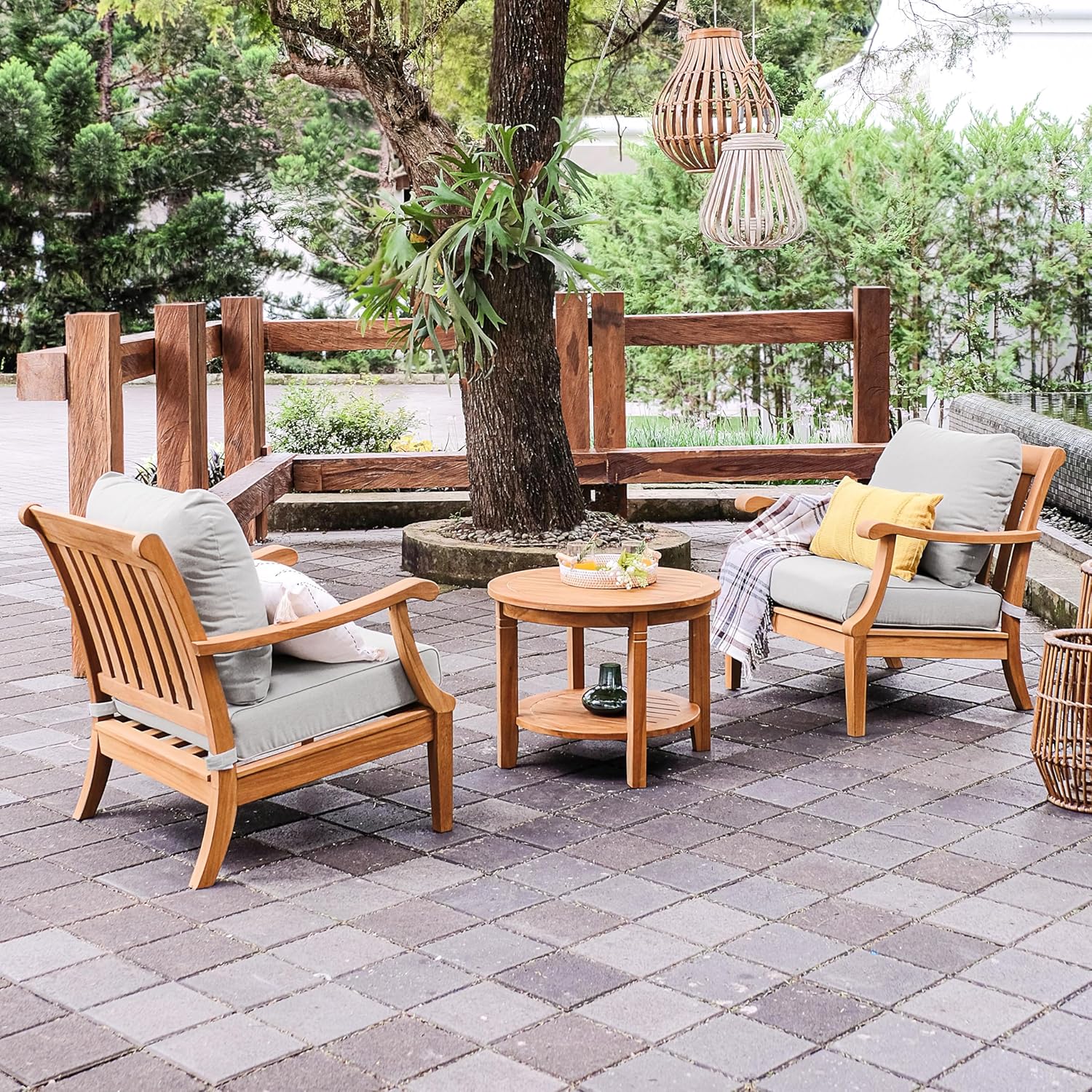

For acacia outdoors specifically, see is acacia wood good outdoors; for the wider outdoor timber question, best wood to use outside. Indoors, compare acacia against mango and the hardness table in the wood hardness scale.
Questions we get asked
Is acacia as good as teak for outdoor furniture?
Not untreated. Teak’s natural oils let it survive decades with no finish; acacia needs oiling or sealing every year to get close.
Is acacia harder than teak?
Yes, usually by a wide margin on the Janka scale. Hardness resists dents, which matters indoors — outdoors, oil content matters more.
How long does acacia furniture last outside?
Three to seven years untreated, considerably longer with annual oiling and winter storage.
Do I need to oil teak furniture?
Only for appearance. Oiling keeps the golden colour; leaving it alone lets it silver, which harms nothing.
What is the difference between teak grades?
Grade A is oily heartwood from mature trees. Grade C includes pale sapwood, which is far less durable outdoors.
Is acacia good for indoor furniture?
Very. It is dense, hard-wearing and warm-coloured, and indoors it has no disadvantage against teak at a fraction of the price.

