CB2 and Pottery Barn desk alternatives — What the price buys
The Wooden Stars is a participant in the Amazon Services LLC Associates Program. We may earn a commission when you buy through links on our site, at no extra cost to you.
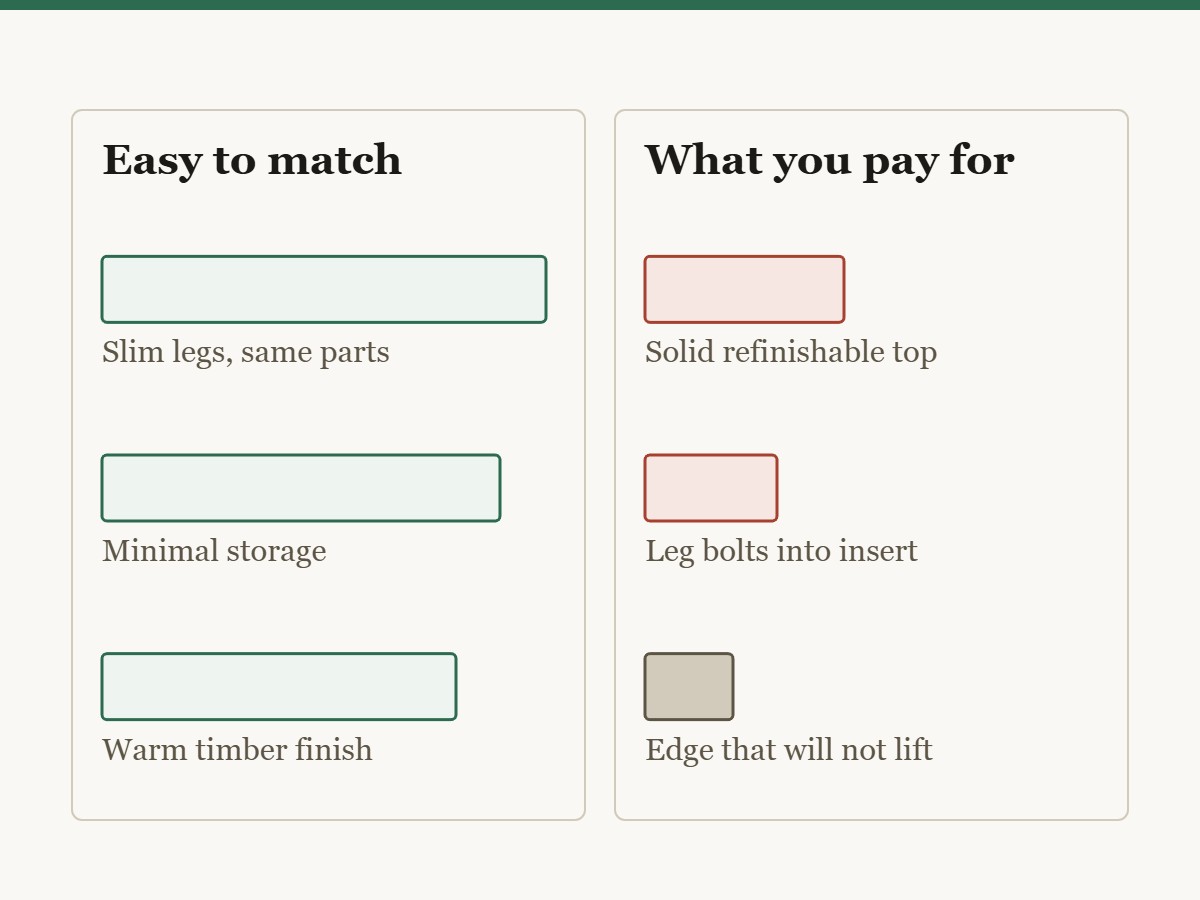
Designer desks from the well-known homeware brands share a fairly narrow visual language: a thin solid-looking top, slim legs — tapered timber or fine powder-coated steel — and either no drawers at all or one shallow one. Clean, light, and expensive.
A desk is also the simplest piece of furniture in the house: a flat board and something holding it up. That makes it the category where a cheaper version gets closest to the original, provided you know which two details actually cost money.
The look is: a slim top (often 1 to 1.5 inches, sometimes a built-up edge), fine legs — tapered timber or thin steel — a minimal or absent drawer, and a warm timber or matt monochrome finish. Cheaper desks match all of that easily. The two things they usually do not match: a genuinely solid top that can be refinished, and a leg-to-top joint that can be re-tightened. Judge those two, treat everything else as styling — and remember you can buy the top and legs separately, which is often the cheapest route to the real thing.
The look, in four parts
A slim top
The whole impression rests on the top looking thin. Premium desks achieve it with a solid slab of 1 to 1.5 inches. Cheaper ones often use a built-up edge: a thinner panel with a frame beneath, so the visible edge reads thick while the middle is hollow or thin.
That is legitimate construction, used in good furniture. It matters in exactly two ways — the desk is lighter than it looks, and a knock to the edge can open the mitre.
Fine legs
Tapered timber legs, hairpin legs or thin square steel. Widely available as parts, which is what makes this style so copyable — see wooden desk legs.
Minimal storage
One shallow drawer or none. Easy to match, and worth thinking about honestly: a desk with no drawer means everything lives on the surface.
Finish
Warm oak or walnut tone, or matt white/black. A real timber surface has depth under a raking light; a printed foil reads flat. That difference is the one that shows in a room and not in a photograph.
The two things that actually cost money
| Feature | Premium | Common at lower prices |
|---|---|---|
| Top | Solid timber, refinishable | Laminate or foil over particleboard |
| Leg joint | Bolt into threaded insert or solid block | Screw into a particleboard underside |
| Edge | Solid, or veneer with a tight band | Edge band that can lift |
| Legs | Solid timber or steel | Same, honestly — easy to match |
| Drawer | Dovetailed or none | Stapled, or none |
| Finish | Oil or quality lacquer | Foil print |
1. The top
A desk top takes forearms, a mug without a coaster, and a monitor stand dragged into position. A solid top sands a scratch out and can be refinished repeatedly; a laminate one cannot be repaired at all, and a chipped edge band lets moisture into the core.
This is the single biggest difference over a decade, and it is the thing worth paying for or working around. The material vocabulary is in what engineered wood actually is.
2. The leg joint
A slim leg carries the whole corner load on a small joint, and a desk gets leaned on, pushed and dragged.
Good: a bolt into a threaded metal insert, or into a solid timber corner block. Re-tightenable for the life of the desk.
Bad: a screw straight into the underside of a particleboard top. The hole enlarges, the leg develops play, and there is no clean repair — this is why cheap desks wobble in year two. Diagnosis order is in how to fix a wobbly desk.
The cheapest route to the real thing: buy the parts
A desk is a top and some legs, so unlike a dresser or a bed frame you can simply assemble the good version yourself for less than a mid-market finished desk.
- A solid timber top. A butcher block or edge-glued panel gives you genuinely solid, refinishable timber at a fraction of what a branded desk costs. Fixing it down correctly — allowing for seasonal movement — is covered in mounting a butcher block desktop.
- Legs to suit. Tapered timber, hairpin or steel, all sold as sets with fixing plates — see wooden desk legs.
- Threaded inserts. Fitting inserts into the underside of a solid top gives you the premium joint directly, and it costs a few pounds.
The result is a desk with the one feature that is hardest to buy cheaply — a solid, repairable top — and legs identical to the ones on the expensive version, because they are the same parts.
Get the dimensions right first
Styling is the easy part. These numbers decide whether the desk is usable at all.
- Height 29 to 30 inches to the top, paired with a seat at 17 to 19. Some design-led desks sit at 28 or 31; check rather than assume.
- Depth 24 to 30 inches. Under 24 and a monitor is too close for comfortable focus. Slim designer desks are frequently 20 to 22 inches, which suits a laptop and not a screen.
- Width 40 inches minimum for a laptop plus notebook; 48 to 55 for a monitor and room either side.
- Knee clearance 24 to 26 inches under the top, and check for a stretcher or drawer box in that space.
Two upgrades that close most of the gap
Levelling feet or glides. Most perceived wobble is the floor, not the desk. Adjustable feet take two minutes and cost very little — options in levelling feet and glides.
Cable management. Nothing makes a minimal desk look less minimal than a bundle of cables. A grommet through the top and a power strip fixed underneath is the difference between the photograph and the reality — see desk grommets.
What not to compromise on
Particleboard where the legs mount. Discussed above; it is the thing that ends the desk.
A top under 20 inches deep if you use a monitor. No styling fixes sitting too close to a screen.
A frame with no cross bracing on a wide span. A 55-inch top on four slim legs with nothing tying them needs either a stretcher or a properly engineered joint at each corner. One of the two has to be there.
Closing the gap
- Threaded inserts Converts a solid top into a premium re-tightenable leg joint
- Levelling feet Most desk wobble is the floor rather than the desk
- Desk grommet The difference between a minimal desk and a nest of cables
- Hardwax oil For a solid top; repairs marks and re-seals in ten minutes
What to buy


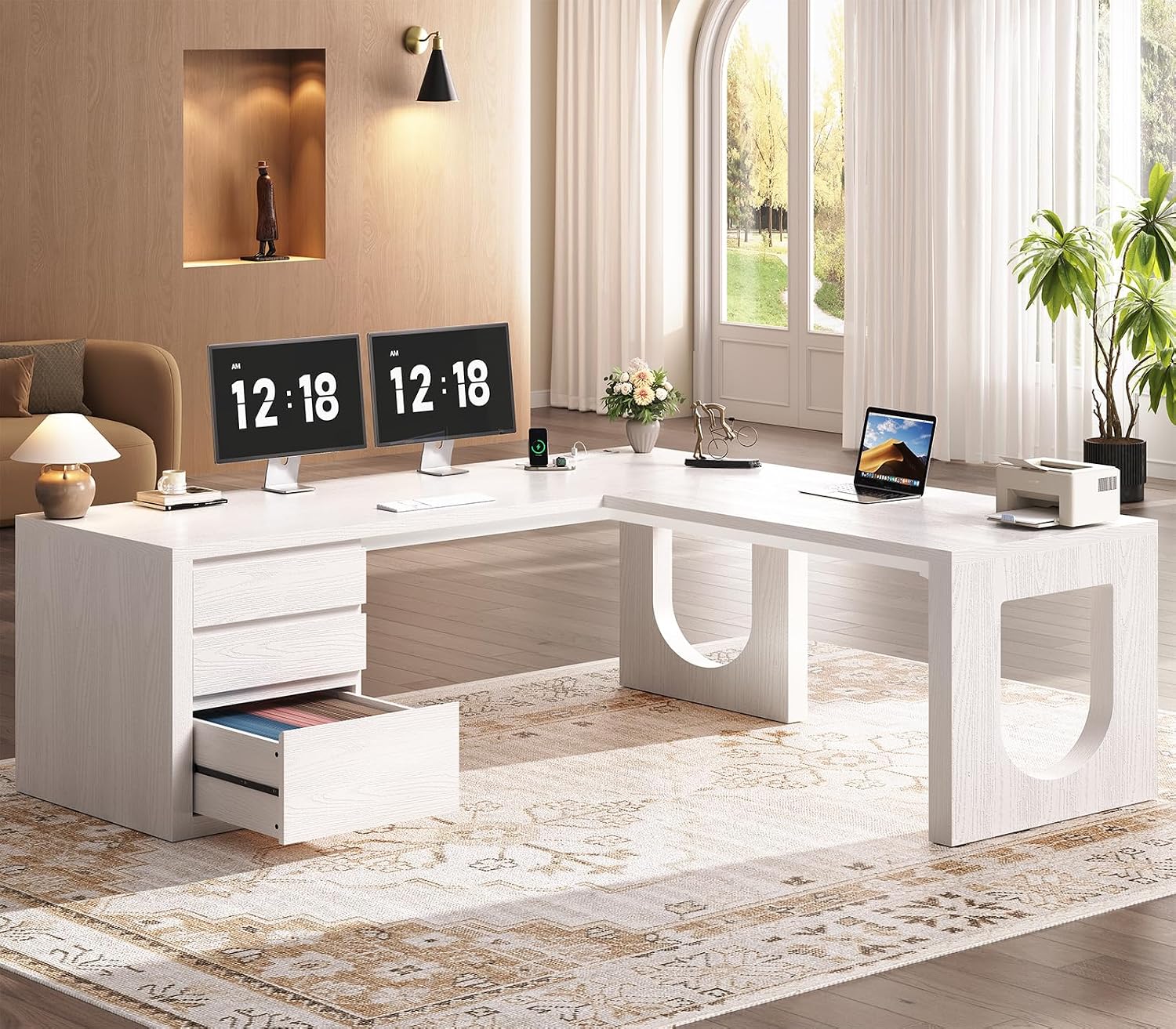

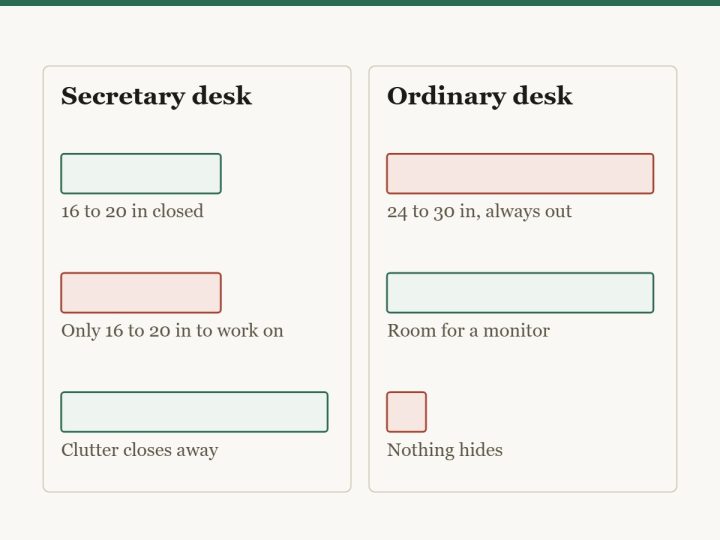
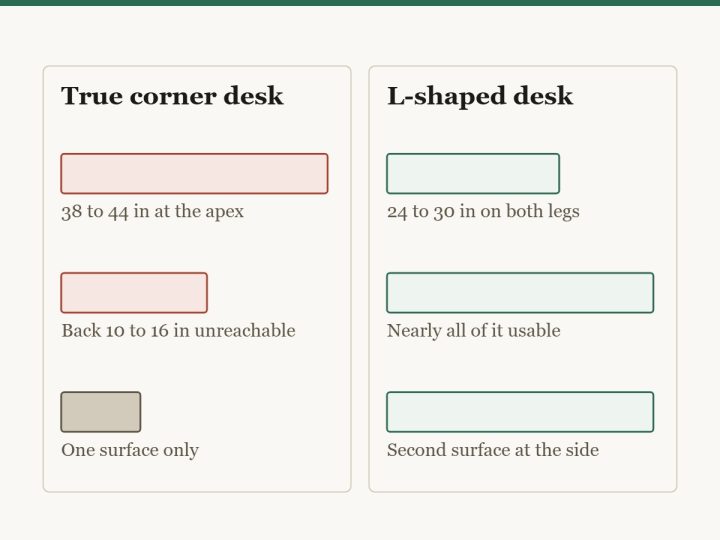
To build one from parts, start at wooden desk legs and mounting a butcher block desktop. If floor space is the real constraint, see corner desks for small spaces or the secretary desk, which closes away entirely.
Questions we get asked
What makes a designer desk look the way it does?
A slim top, fine tapered or steel legs, minimal or no storage, and a warm timber or matt monochrome finish.
What do cheaper desks usually give up?
A genuinely solid top that can be refinished, and a leg joint that can be re-tightened. The legs themselves are often identical parts.
Is a thick-looking edge always solid wood?
No. Many are built up from a thinner panel with a frame beneath. That is normal construction — the desk is simply lighter than it looks.
Is it cheaper to build a desk from a top and legs?
Usually, and it gets you the hardest feature to buy cheaply: a solid, repairable top with legs identical to the expensive version.
How deep should a desk be?
Twenty-four to 30 inches. Slim design-led desks are often 20 to 22, which suits a laptop but puts a monitor too close.
Why does my desk wobble?
Usually an uneven floor first, then the leg joint. Fit levelling feet, then check whether the legs bolt into inserts or screw into particleboard.