How tall should an ottoman be? Match the seat
The Wooden Stars is a participant in the Amazon Services LLC Associates Program. We may earn a commission when you buy through links on our site, at no extra cost to you.
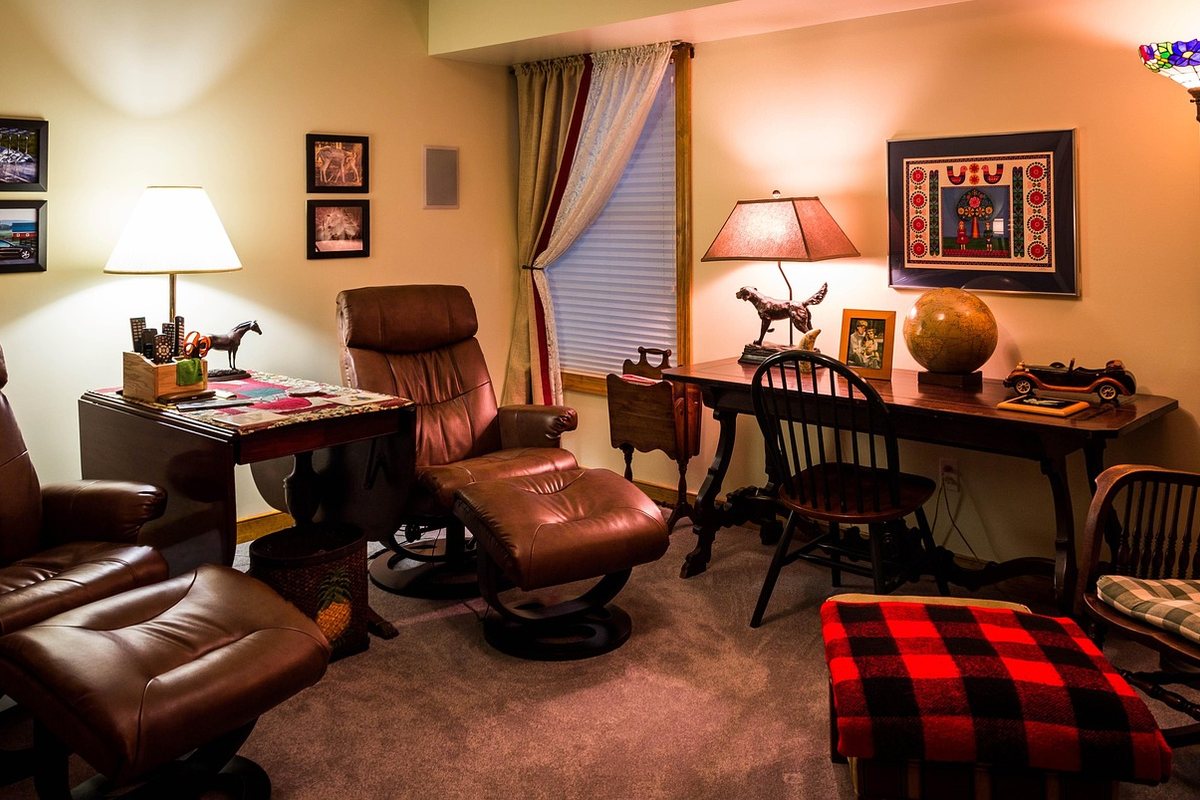
How tall should an ottoman be? Level with the seat it serves, or up to 2 inches below — which in practice means 15 to 18 inches, because that is where sofa seats sit.
There is no standard ottoman height. There is only your sofa.
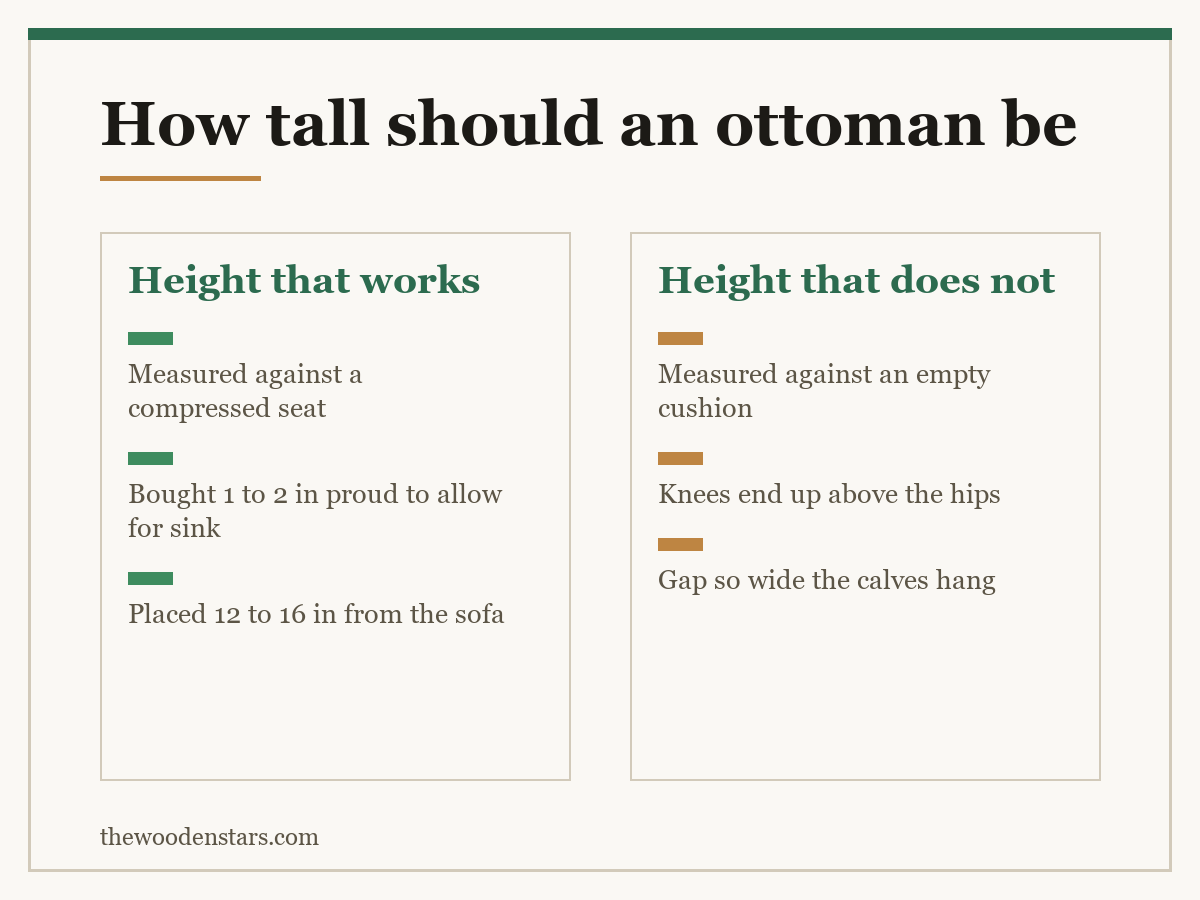
Measure the compressed seat height of your sofa — sit on it and measure the floor to the top of the cushion, which is usually 16 to 19 inches. The ottoman should finish level with that or up to 2 inches lower. Buy it 1 to 2 inches taller than your target, because an upholstered top compresses under legs. As a coffee table replacement the same range applies. As extra seating it needs to be 17 to 18 inches compressed. Too tall and your knees rise above your hips; too low and your legs dangle unsupported.
How tall should an ottoman be for each job
- Footstool for a sofa: sofa seat height, or up to 2 inches below. Typically 15 to 18 inches.
- Footstool for an armchair: armchair seat height, or up to 2 below. Usually 15 to 17.
- Coffee table replacement: 16 to 18 inches, plus a tray.
- Extra seating: 17 to 18 inches compressed, so your feet reach the floor.
- Bed-end bench: 18 to 20 inches, because the mattress is high.
The two jobs that conflict are footstool and seating. A 15-inch footstool is uncomfortable to sit on; an 18-inch one is slightly high for feet. If it must do both, 17 inches compressed is the honest compromise.
| Use | Height | Measured against | Note |
|---|---|---|---|
| Sofa footstool | 15 to 18 in | Compressed seat | Level or up to 2 in below |
| Armchair footstool | 15 to 17 in | Compressed seat | Same rule |
| Coffee table replacement | 16 to 18 in | Sofa seat | Needs a tray |
| Extra seating | 17 to 18 in | Feet to the floor | Compressed, not unloaded |
| Bed-end bench | 18 to 20 in | Mattress top | Sit to put shoes on |
| Storage ottoman | 16 to 18 in | Sofa seat | Lid adds 1 to 2 in |
Why compressed height is the only number worth measuring
Upholstery lies. A sofa cushion measured empty reads 1 to 3 inches taller than the height you will actually sit at, and a foam-topped ottoman loses 1 to 2 inches under a pair of legs.
So do it this way: sit on the sofa, and have someone measure the floor to the top of the cushion beside your leg. That is the target.
Then buy an ottoman whose listed height is 1 to 2 inches above that target, since the listed figure is unloaded. A firm-topped or timber-framed ottoman compresses less, so buy those closer to the target.
This is the same trap that catches people buying upholstered dining chairs, where a soft 18-inch seat behaves like a 16-inch one — see how tall a dining chair should be.
What goes wrong at the wrong height
Too tall is the commoner error, and it is the worse one. When the ottoman sits above the seat, your knees rise above your hips, your weight rolls back onto your tailbone, and your lower back arches. It is comfortable for ten minutes and sore after an hour.
Too low — more than about 3 inches below the seat — leaves your legs sloping down with your heels taking all the pressure. Less damaging, but you will keep shifting.
Too far away is a separate error people misread as a height problem. The gap between the sofa and the ottoman wants to be 12 to 16 inches. Much more and your legs bridge the gap unsupported at the calf, which feels exactly like the ottoman being too low.
Sizing the piece itself — length against the sofa, walkways around it — follows the coffee table method in average coffee table dimensions, and the wider choice between the two is in ottoman against coffee table.
Fixing an ottoman you already own
Too low by 1 to 3 inches: taller feet. Most ottomans use a standard 5⁄16-inch hanger bolt, and replacement legs in 2, 4 and 6-inch heights cost very little. This is the cleanest fix available.
Too low by more: a firm cushion or a folded throw on top raises it an inch or two, and a second ottoman placed alongside sometimes works better than solving it vertically.
Too tall: shorter legs, or remove them entirely — many ottomans lose 3 to 4 inches that way and sit flat on the floor, which also stops them sliding.
Too soft, so it reads as too low: a firm board cut to the top’s footprint, laid under the existing cover, stops the sink. This is also what makes an ottoman usable as seating.
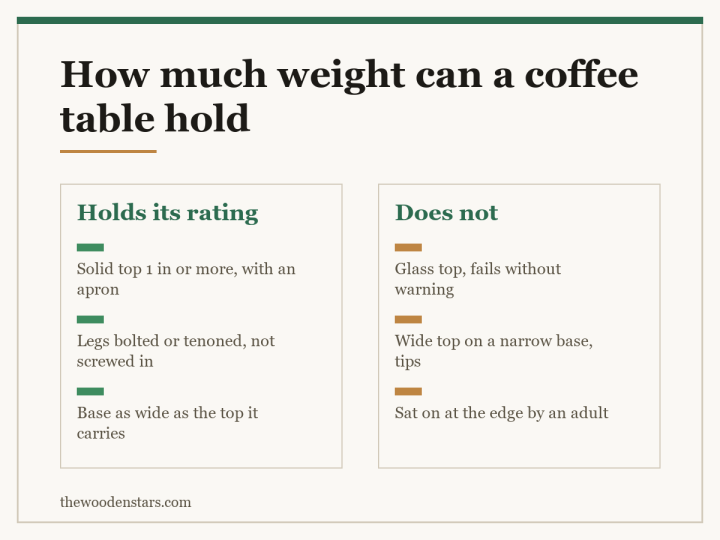
If it is going to carry drinks as well, the tray route is covered in ottoman against coffee table, and for the hard-top alternative see how much weight a coffee table can hold.
With a sectional or an L-shaped sofa, two smaller ottomans usually beat one large one. A single piece sized to the long run of the sofa blocks the short run, and a piece sized to the short run looks lost against the long one. Two matching cubes at 18 to 20 inches square can be pushed together for one person with their feet up, separated for two, or moved out entirely when the room needs the floor. The same height rule applies to both: level with the compressed seat, or just under.
Adjusting the height
- Replacement furniture legs Standard 5/16 in hanger bolt, sold in 2, 4 and 6 inch heights
- Tape measure Floor to the compressed cushion, with someone sitting on it
- Large wooden serving tray Makes an ottoman at coffee table height hold a mug
- Felt furniture pads A legless ottoman drags on a rug and marks a hard floor
What to buy


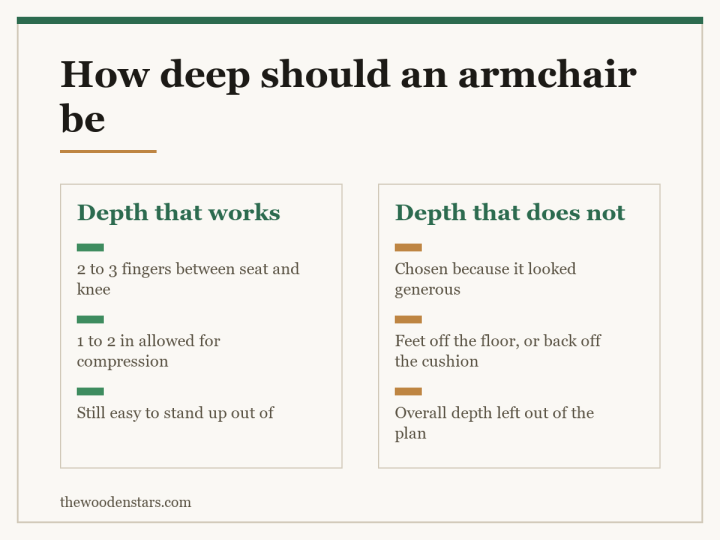
For the wider comparison, see ottoman against coffee table. For seating heights, how wide an armchair is and how deep an armchair should be.
Questions we get asked
How tall should an ottoman be?
Level with the compressed sofa seat or up to 2 inches below, which is 15 to 18 inches in most rooms.
Should an ottoman be lower than the sofa?
Slightly lower is fine and often better. Higher than the seat is the error that causes back ache.
Why measure the seat compressed?
An empty cushion reads 1 to 3 inches tall. You will never sit at that height.
How far from the sofa should it sit?
Twelve to 16 inches. Further and your calves bridge the gap unsupported.
What height works for sitting on?
Seventeen to 18 inches compressed, so your feet reach the floor.
Can I change the height of one I own?
Yes. Replacement legs on a standard hanger bolt add or remove 2 to 6 inches for very little money.